Security must be linked to expanding national development space: PM

Prime Minister Le Minh Hung urged the public security force to continue setting the standard in translating the Party’s strategic policies and the State’s laws into practice. He called on the force to take the lead in enabling development through concrete, measurable outcomes, proactively review and recommend measures to address shortcomings in institutions, policies and legislation, and focus on removing bottlenecks in order to unlock resources needed to achieve double-digit economic growth.

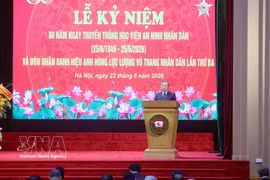
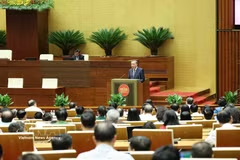
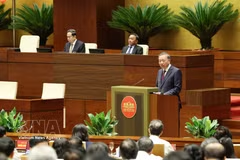
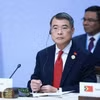
Prime Minister Le Minh Hung (right) attends the conference held by the Ministry of Public Security in Hanoi on July 2, 2026. (Photo: VNA)

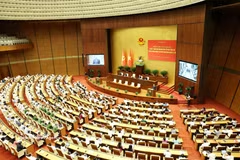
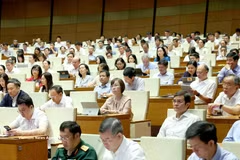
Hanoi (VNA) – Security and public order must be closely integrated with socio-economic development, with efforts to safeguard them linked to expanding the national development space, Prime Minister Le Minh Hung said at a conference reviewing public security work in the first six months of 2026 and one year of operating the two-tier local public security model under the new administrative boundaries.

Addressing the conference held in Hanoi on July 2, the Government leader said the review meeting was of particular significance not only for the people's public security force but also for the country’s socio-economic development. He stressed the need to immediately implement the priorities set out at the recent conference of the Central Public Security Party Committee, particularly the directions issued by Party General Secretary and State President To Lam.

PM Hung noted that despite numerous challenges, the protection of national security and the maintenance of public order and social safety have achieved notable results. He said the people's public security force had not only fulfilled its assigned targets and tasks with distinction but had also increasingly demonstrated its role in creating a secure and safe environment for development, serving as a steadfast shield in safeguarding national security and maintaining public order.
vnanet-pm-le-minh-hung-2.jpg
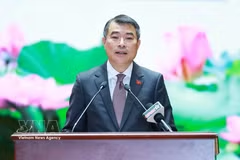
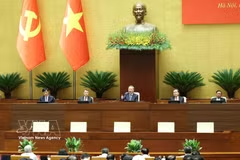
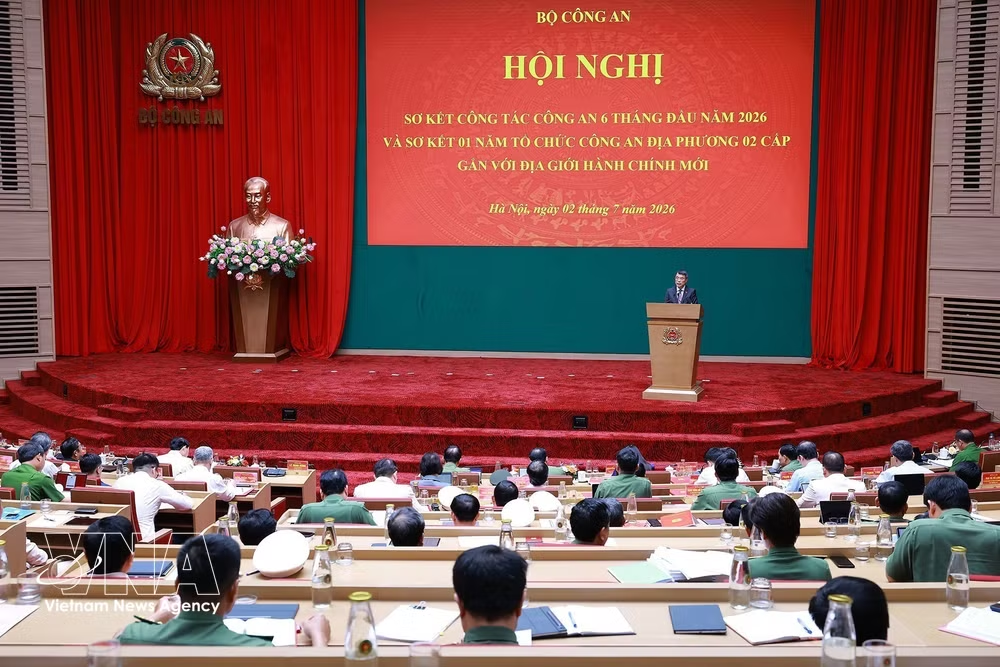
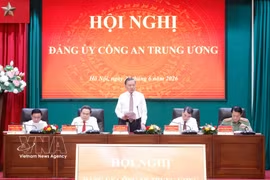
Prime Minister Le Minh Hung speaks at the conference reviewing public security work in the first six months of 2026 and one year of operating the two-tier local public security model under the new administrative boundaries in Hanoi on July 2, 2026. (Photo: VNA)

Expressing broad agreement with the priorities and tasks set for the second half of 2026, the PM urged the public security force to continue setting the standard in translating the Party’s strategic policies and the State’s laws into practice. He called on the force to take the lead in enabling development through concrete, measurable outcomes, proactively review and recommend measures to address shortcomings in institutions, policies and legislation, and focus on removing bottlenecks in order to unlock resources needed to achieve double-digit economic growth.

The leader also stressed the importance of strengthening strategic forecasting capabilities to avoid being caught off guard under any circumstances, maintaining an early and comprehensive grasp of developments at national, regional and grassroots levels, and preserving security and public order at the community level. He called for the effective mobilisation of grassroots security forces, the expansion and consolidation of drug-free communes and wards, and determination to further reduce crimes affecting public order by 10%.

PM Hung called for greater investment in science and technology, innovation, digital transformation and the security industry, describing these as strategic tools for strengthening national security capabilities.

At the same time, he said, international cooperation in public security should be further enhanced through a forward-looking approach that helps pave the way for broader engagement and builds strategic trust with international partners. Vietnam should actively participate in international cooperation mechanisms, contributing to the shaping of global security standards while fostering a peaceful and stable environment conducive to national development.
vnanet-pm-public-security.jpg
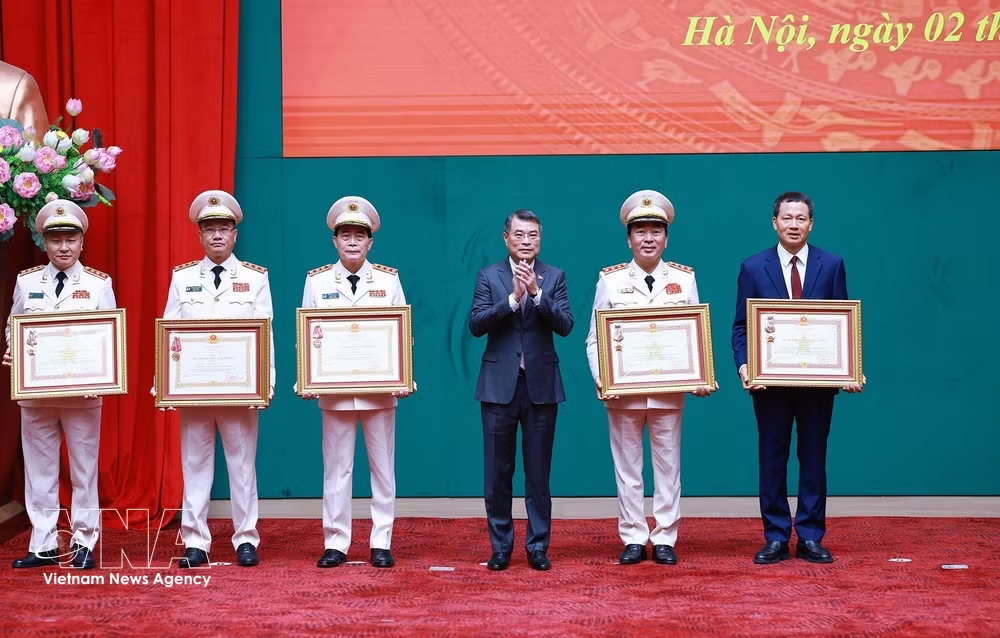
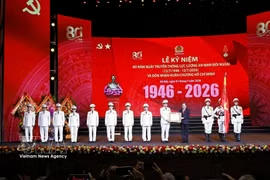
Prime Minister Le Minh Hung presents the first-class Military Exploit Order and the third-class Labour Order to individuals in recognition of their outstanding achievements at the event. (Photo: VNA)

The Government leader also highlighted the importance of enhancing the role of the people's public security force in international cooperation mechanisms, including United Nations peacekeeping operations and innitiatives on combating transnational crime, anti-money laundering, asset recovery, cybersecurity and digital sovereignty.

He affirmed that in the period to come, the force would serve not only as a steel shield protecting national security and a reliable pillar for the people, but also as a key contributor to safeguarding the country’s long-term development prospects by creating a secure environment in which Vietnam can achieve stronger growth./.
VNA

See more

Prime Minister Le Minh Hung speaks at the national political-military conference. (Photo: VNA)

Prime Minister urges military to enhance strategic advisory role, forecasting capacity

Prime Minister Le Minh Hung noted that the military has demonstrated strong strategic awareness and responsiveness, accurately assessed developments, and effectively advised the Party and State on military and defence matters. These efforts have enabled the flexible and effective handling of emerging situations, maintained a proactive posture, prevented surprises and firmly safeguarded national sovereignty and territorial integrity.

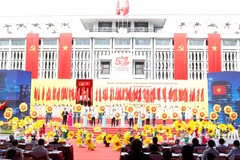
An art performance at the ceremony to mark the 50th anniversary of Saigon-Gia Dinh city being officially named after President Ho Chi Minh (July 2, 1976–2026). (Photo: VNA)

Top leader attends ceremony marking 50 years of Saigon-Gia Dinh bearing late President’s name

Ho Chi Minh City has every reason to take pride in its remarkable achievements over the past half-century. From a war-ravaged urban centre facing enormous post-war difficulties, it gradually restored production, stabilised people's livelihoods, consolidated the achievements of the revolution, built an effective system of governance, and safeguarded national defence and security, thereby laying a solid foundation for long-term development.

☀️ Morning digest on July 2

☀️ Morning digest on July 2

A conference reviewing the 18-month implementation of the Politburo’s Resolution 57, Vietnam's fruit and vegetable exports during the first half of 2026, and UOB Vietnam starting work on the first purpose-built headquarters developed by a foreign bank in the Vietnam International Financial Centre in Ho Chi Minh City are among news highlights on July 1 evening.

Party General Secretary and State President To Lam speaks at the conference. (Photo: VNA)

Top leader demands concrete output under Resolution 57

Top leader To Lam stressed that while the 14th National Party Congress’s Resolution serves as the strategic blueprint for the country's next growth stage, Resolution 57 is one of the key engines for turning that blueprint into reality.

Party General Secretary and State President To Lam (centre) chairs the conference. (Photo: VNA)

Politburo sets six priorities for implementing Resolution No. 57

After 18 months of implementing Resolution No. 57, ministries, sectors and localities have adopted innovative and effective approaches that have generated positive momentum, while winning broad support from businesses, the scientific community and the public for policies on science, technology, innovation and digital transformation.

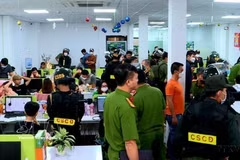
Police in Tan Binh district, Ho Chi Minh City, in coordination with the Department of Cybersecurity and High-Tech Crime Prevention under the Ministry of Public Security, searched multiple locations and placed 86 suspects in temporary criminal detention for investigation into alleged telecom and online fraud. (Photo: VNA)

New Cybersecurity Law strengthens protection of citizens' rights in digital age

The law also introduces more comprehensive provisions on data security, information system protection and measures to prevent, detect and address cybersecurity violations. It prioritises prevention, enhances early warning and incident response capabilities, and links cybersecurity with maintaining social order and security amid rapid digital transformation.

An overview of the the July 1 national conference reviewing the one-year operation of the three-tier administration model (Photo: VNA)

Localities propose reforms to improve three-tier administration model

A Hanoi official called for further decentralisation to commune-level authorities in line with resource allocation, continued streamlining of organisational structures to eliminate unnecessary intermediary layers, further refining the Party organisations’ model to align with the state administrative system, greater autonomy for non-business public service units, and wider participation of businesses and social organisations in delivering suitable public services.

Party General Secretary and State President To Lam addresses the conference on July 1. (Photo: VNA)

New administrative system must deliver new governance capacity: Top leader

The Party and State leader described the restructuring as a broad, complex and far-reaching reform affecting almost every agency and public servant from the central to grassroots levels. While praising the significant initial achievements, he stressed that the results marked only the beginning and warned against complacency.

An overview of the working session between ASEAN Committee in Canberra and the Australian Department of Home Affairs (Photo: VNA)

ASEAN Committee in Canberra seeks closer cooperation with Australia's Home Affairs Department

Vietnamese Ambassador to Australia Pham Hung Tam proposed that Australia extend the visa validity period for ASEAN graduates of master's degree programmes from two years to three years in the country from two years to three years. He also urged Australia to soon grant transit visa exemptions for Vietnamese citizens, similar to those already available to nationals of several other ASEAN countries.

The June 30 conference announcing a series of strategic plans of Quang Ninh and receive recognition of Quang Ninh as a tier-1 urban area. (Photo: VNA)

Quang Ninh unveils strategic plans, sets sights on becoming national urban hub

Under a master plan, Quang Ninh's urban development will be organised around three corridors, four socio-economic zones and five growth centres, including Ha Long, Van Don, Mong Cai, Quang Yen, and the Yen Tu–Ha Long Bay heritage complex. The province will adopt a multi-centre urban model placing people and heritage, including Ha Long Bay and the Yen Tu scenic complex, at its core.

Vietnamese Ambassador to the US Nguyen Quoc Dung (fourth, right) chairs a business rountable with three leading economic promotion organisations of Minnesota. (Photo: VNA)

Vietnamese, US localities strengthen cooperation across multiple fields

Vietnamese Ambassador to the US Nguyen Quoc Dung called on the state to continue supporting the Vietnamese community in Minnesota, encourage local businesses to expand investment and operations in Vietnam, and promote sister-city and sister-province partnerships between Minnesota and Vietnamese localities.

The conference reviews the one-year implementation of the overall organisational model of the political system and the three-tier administration model. (Photo: VNA)

Conference reviews one-year implementation of three-tier administration model

The event was held in a hybrid format, with the main venue at the Dien Hong Hall of the National Assembly building and online connection to 3,651 venues across ministries, central agencies, socio-political organisations, and headquarters of provincial, municipal, commune, ward and special-zone administrations nationwide.

General Secretary of the Communist Party of Vietnam Central Committee and President of Vietnam To Lam (L) and General Secretary of the Communist Party of China Central Committee and President of China Xi Jinping at the signing ceremony of cooperation documents between the two countries during the former’s state visit to China in April 2026. (Photo: VNA)

Congratulations extended on Communist Party of China’s 105th founding anniversary

In the message, the CPV Central Committee congratulated the CPC on its achievements over the past 105 years in uniting and leading the Chinese people to overcome numerous difficulties and challenges and secure remarkable accomplishments. These include the founding of the People's Republic of China, the implementation of the reform and opening-up policy, the advancement of socialism with Chinese characteristics into a new era, and the improvement of the role and international standing of the Party and State.