Prime Minister urges military to enhance strategic advisory role, forecasting capacity

Prime Minister Le Minh Hung noted that the military has demonstrated strong strategic awareness and responsiveness, accurately assessed developments, and effectively advised the Party and State on military and defence matters. These efforts have enabled the flexible and effective handling of emerging situations, maintained a proactive posture, prevented surprises and firmly safeguarded national sovereignty and territorial integrity.

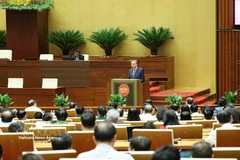
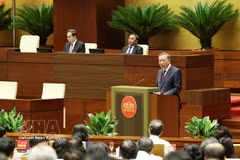
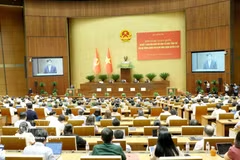
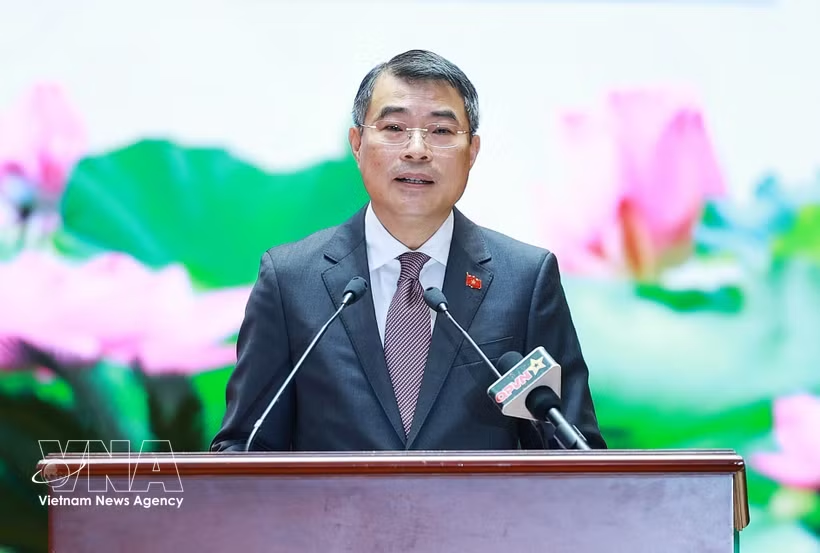
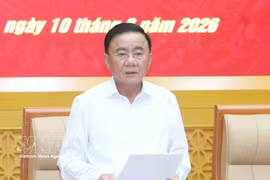
Prime Minister Le Minh Hung speaks at the national political-military conference. (Photo: VNA)

Hanoi (VNA) – Prime Minister Le Minh Hung on July 2 called on the military to strengthen its strategic advisory role, improve long-term forecasting capacity and proactively prepare for emerging traditional and non-traditional security challenges in a rapidly evolving global and regional environment.

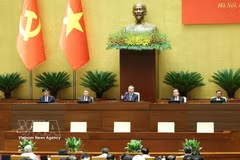
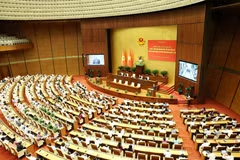
The remarks were made at a national political-military conference held in Hanoi by the Central Military Commission and the Ministry of National Defence to review military and defence tasks in the first six months of 2026 and outline priorities for the remainder of the year.

According to a report presented at the conference, the armed forces have maintained a high level of combat readiness, closely monitored developments and provided timely advice to the Party and State in handling defence and security issues.

The military has closely integrated the fulfilment of military and defence tasks with socio-economic development; mobilised the strength of the entire political system and the people to build increasingly robust all-people national defence, military-region defence and defensive zones; strengthened inspection, surveillance and management of the country's airspace, maritime areas, borders, border gates, inland areas and cyberspace; and proactively, flexibly and effectively advanced international integration and defence diplomacy.

Addressing the event, PM Hung commended the entire army for its achievements despite growing uncertainties in the international and regional landscape. He said the military has made important contributions to safeguarding political and social stability, creating favourable conditions for socio-economic development and supporting the country’s long-term strategic objectives.

The Prime Minister noted that the military has demonstrated strong strategic awareness and responsiveness, accurately assessed developments, and effectively advised the Party and State on military and defence matters. These efforts, he said, have enabled the flexible and effective handling of emerging situations, maintained a proactive posture, prevented surprises and firmly safeguarded national sovereignty and territorial integrity.

He also praised progress in building a streamlined, strong and modern army with high political steadfastness, strict discipline, professional competence and increasing technological mastery. The military, he added, has continued to advance science and technology, innovation and digital transformation, while achieving notable progress in defence industry development and contributing to the country’s two-digit economic growth goals.

Defence diplomacy continues to be carried out effectively, with the military making meaningful contributions to international forums, United Nations peacekeeping operations, search and rescue activities, and international humanitarian assistance. These efforts have further enhanced the image of the Vietnam People's Army as a professional, humane, capable and responsible force dedicated to maintaining peace and stability in the region and the world.

In particular, as an expression of profound gratitude and responsibility towards those who laid down their lives for the nation, the military has implemented the “500-day campaign” in a determined and effective manner, intensifying efforts to search for, recover and identify the remains of fallen soldiers.
vnanet-leminhhung2.jpg
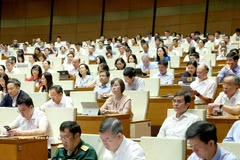
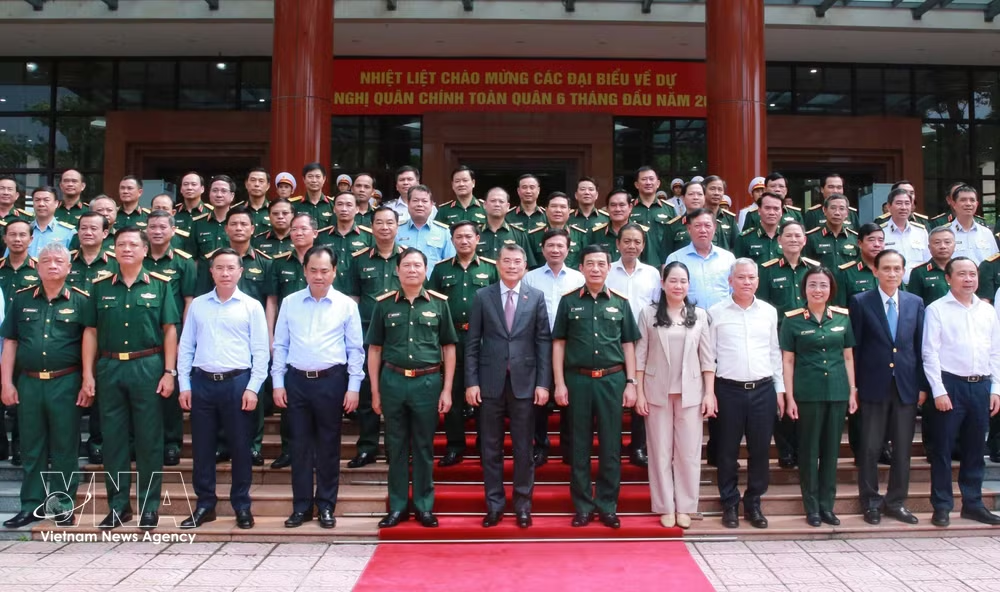
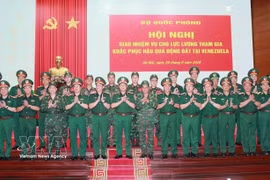
Prime Minister Le Minh Hung poses for a photo with delegates at the national political-military conference. (Photo: VNA)

For the coming period, the PM stressed that the world situation is expected to remain complex and unpredictable. He therefore urged the military to look further ahead, prepare earlier and provide deeper strategic advice, adding that it should not only assess military and defence developments but also anticipate broader economic, social and diplomatic impacts.

He called on the army to identify both traditional and non-traditional security risks, ensure that the country is not caught off guard strategically, and prevent external developments from triggering domestic crises.

PM Hung also stressed the need to continue building a revolutionary, regular, elite and modern military. He urged improvements in training, education and exercises, mastery of advanced weapons and equipment, and enhanced readiness for new forms of warfare.

The military must firmly safeguard sovereignty over waters, islands, borders, airspace, cyberspace and strategic infrastructure, while handling situations with principled determination, operational flexibility, sound legal foundations and proactive communications.

The Government leader further called for accelerated development of a self-reliant, dual-use and modern defence industry capable of becoming a spearhead sector of the national industrial base. Particular attention should be given to breakthroughs in science, technology and innovation, as well as international cooperation in defence industry development and human resources training.

He also underscored the importance of implementing policies for war veterans and martyrs’ families, organising meaningful activities marking the 79th anniversary of War Invalids and Martyrs Day (July 27), and continuing the nationwide campaign to search for, recover and identify the remains of fallen soldiers.

Expressing confidence in the military, the PM said the Vietnam People’s Army will continue to uphold its heroic traditions, successfully fulfil all assigned tasks and make greater contributions to national construction, development and defence in the years ahead./.
VNA

See more

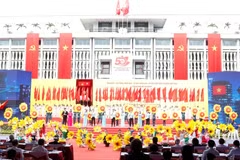
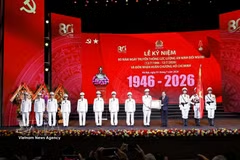
An art performance at the ceremony to mark the 50th anniversary of Saigon-Gia Dinh city being officially named after President Ho Chi Minh (July 2, 1976–2026). (Photo: VNA)

Top leader attends ceremony marking 50 years of Saigon-Gia Dinh bearing late President’s name

Ho Chi Minh City has every reason to take pride in its remarkable achievements over the past half-century. From a war-ravaged urban centre facing enormous post-war difficulties, it gradually restored production, stabilised people's livelihoods, consolidated the achievements of the revolution, built an effective system of governance, and safeguarded national defence and security, thereby laying a solid foundation for long-term development.

☀️ Morning digest on July 2

☀️ Morning digest on July 2

A conference reviewing the 18-month implementation of the Politburo’s Resolution 57, Vietnam's fruit and vegetable exports during the first half of 2026, and UOB Vietnam starting work on the first purpose-built headquarters developed by a foreign bank in the Vietnam International Financial Centre in Ho Chi Minh City are among news highlights on July 1 evening.

Party General Secretary and State President To Lam speaks at the conference. (Photo: VNA)

Top leader demands concrete output under Resolution 57

Top leader To Lam stressed that while the 14th National Party Congress’s Resolution serves as the strategic blueprint for the country's next growth stage, Resolution 57 is one of the key engines for turning that blueprint into reality.

National Assembly Chairman Tran Thanh Man presents the Ho Chi Minh Order to the external security force at the ceremony in Hanoi on July 1, in recognition of its outstanding contributions to the revolutionary cause of the Party and the nation. (Photo: VNA)

NA Chairman calls for building regular, elite, modern external security force

The NA Chairman stressed that under all circumstances, the force must remain absolutely loyal to the Party, the nation and the people, while upholding the principle of the Party’s absolute, direct and comprehensive leadership – specifically through the Central Public Security Party Committee and the leadership of the Ministry of Public Security.

Party General Secretary and State President To Lam (centre) chairs the conference. (Photo: VNA)

Politburo sets six priorities for implementing Resolution No. 57

After 18 months of implementing Resolution No. 57, ministries, sectors and localities have adopted innovative and effective approaches that have generated positive momentum, while winning broad support from businesses, the scientific community and the public for policies on science, technology, innovation and digital transformation.

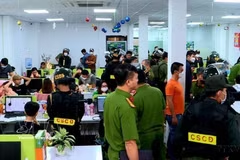
Police in Tan Binh district, Ho Chi Minh City, in coordination with the Department of Cybersecurity and High-Tech Crime Prevention under the Ministry of Public Security, searched multiple locations and placed 86 suspects in temporary criminal detention for investigation into alleged telecom and online fraud. (Photo: VNA)

New Cybersecurity Law strengthens protection of citizens' rights in digital age

The law also introduces more comprehensive provisions on data security, information system protection and measures to prevent, detect and address cybersecurity violations. It prioritises prevention, enhances early warning and incident response capabilities, and links cybersecurity with maintaining social order and security amid rapid digital transformation.

An overview of the the July 1 national conference reviewing the one-year operation of the three-tier administration model (Photo: VNA)

Localities propose reforms to improve three-tier administration model

A Hanoi official called for further decentralisation to commune-level authorities in line with resource allocation, continued streamlining of organisational structures to eliminate unnecessary intermediary layers, further refining the Party organisations’ model to align with the state administrative system, greater autonomy for non-business public service units, and wider participation of businesses and social organisations in delivering suitable public services.

Party General Secretary and State President To Lam addresses the conference on July 1. (Photo: VNA)

New administrative system must deliver new governance capacity: Top leader

The Party and State leader described the restructuring as a broad, complex and far-reaching reform affecting almost every agency and public servant from the central to grassroots levels. While praising the significant initial achievements, he stressed that the results marked only the beginning and warned against complacency.

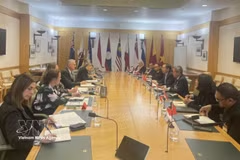
An overview of the working session between ASEAN Committee in Canberra and the Australian Department of Home Affairs (Photo: VNA)

ASEAN Committee in Canberra seeks closer cooperation with Australia's Home Affairs Department

Vietnamese Ambassador to Australia Pham Hung Tam proposed that Australia extend the visa validity period for ASEAN graduates of master's degree programmes from two years to three years in the country from two years to three years. He also urged Australia to soon grant transit visa exemptions for Vietnamese citizens, similar to those already available to nationals of several other ASEAN countries.

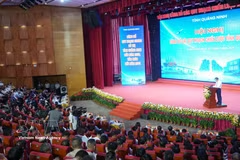
The June 30 conference announcing a series of strategic plans of Quang Ninh and receive recognition of Quang Ninh as a tier-1 urban area. (Photo: VNA)

Quang Ninh unveils strategic plans, sets sights on becoming national urban hub

Under a master plan, Quang Ninh's urban development will be organised around three corridors, four socio-economic zones and five growth centres, including Ha Long, Van Don, Mong Cai, Quang Yen, and the Yen Tu–Ha Long Bay heritage complex. The province will adopt a multi-centre urban model placing people and heritage, including Ha Long Bay and the Yen Tu scenic complex, at its core.

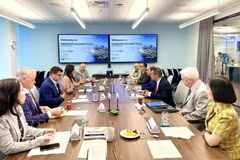
Vietnamese Ambassador to the US Nguyen Quoc Dung (fourth, right) chairs a business rountable with three leading economic promotion organisations of Minnesota. (Photo: VNA)

Vietnamese, US localities strengthen cooperation across multiple fields

Vietnamese Ambassador to the US Nguyen Quoc Dung called on the state to continue supporting the Vietnamese community in Minnesota, encourage local businesses to expand investment and operations in Vietnam, and promote sister-city and sister-province partnerships between Minnesota and Vietnamese localities.

The conference reviews the one-year implementation of the overall organisational model of the political system and the three-tier administration model. (Photo: VNA)

Conference reviews one-year implementation of three-tier administration model

The event was held in a hybrid format, with the main venue at the Dien Hong Hall of the National Assembly building and online connection to 3,651 venues across ministries, central agencies, socio-political organisations, and headquarters of provincial, municipal, commune, ward and special-zone administrations nationwide.

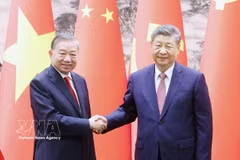
General Secretary of the Communist Party of Vietnam Central Committee and President of Vietnam To Lam (L) and General Secretary of the Communist Party of China Central Committee and President of China Xi Jinping at the signing ceremony of cooperation documents between the two countries during the former’s state visit to China in April 2026. (Photo: VNA)

Congratulations extended on Communist Party of China’s 105th founding anniversary

In the message, the CPV Central Committee congratulated the CPC on its achievements over the past 105 years in uniting and leading the Chinese people to overcome numerous difficulties and challenges and secure remarkable accomplishments. These include the founding of the People's Republic of China, the implementation of the reform and opening-up policy, the advancement of socialism with Chinese characteristics into a new era, and the improvement of the role and international standing of the Party and State.