JBIC pledges continued support for Vietnam's strategic development goals

Prime Minister Le Minh Hung said there remains ample room to expand bilateral cooperation, stressing JBIC's important role in mobilising financial resources and advancing strategic infrastructure projects to support Vietnam's long-term development goals, particularly its green transition.
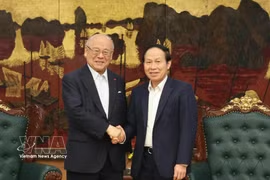
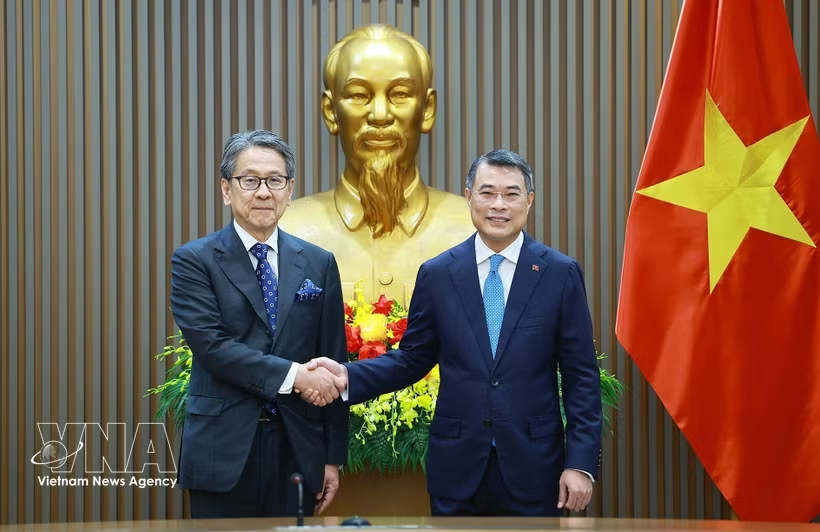
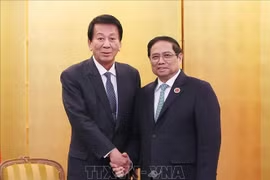
Prime Minister Le Minh Hung (R) receives Maeda Tadashi, Governor of the Japan Bank for International Cooperation (JBIC) in Hanoi on July 2 (Photo: VNA)

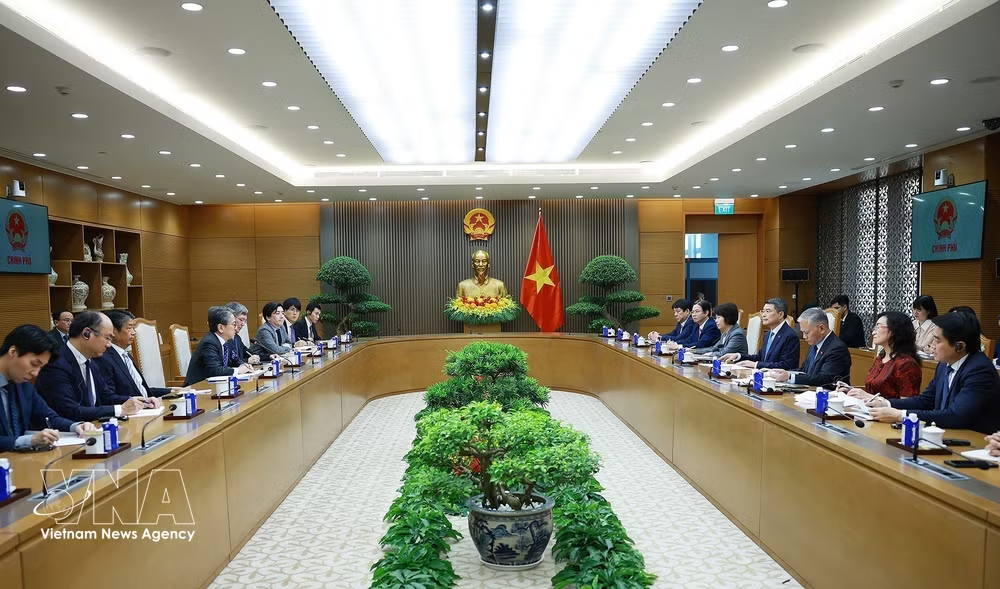
Hanoi (VNA) - Prime Minister Le Minh Hung received in Hanoi on July 2 Maeda Tadashi, Governor of the Japan Bank for International Cooperation (JBIC), who pledged that the bank will continue to support Vietnam's strategic development goals.

PM Hung expressed appreciation for Maeda's personal contributions and JBIC's continued financial support for Japanese-invested projects in Vietnam.

He expressed his delight at the increasingly substantive and effective development of the Vietnam–Japan friendship and cooperation, particularly significant progress made since the two countries upgraded ties to a Comprehensive Strategic Partnership nearly three years ago.

The PM reaffirmed that Japan remains one of Vietnam's leading economic partners, noting that cooperation in science and technology, as well as emerging fields such as semiconductors, artificial intelligence (AI), digital transformation, green transition, renewable energy and space, has also achieved notable new progress.

He highlighted the recent official visit to Vietnam by Japanese PM Takaichi Sanae, during which the two leaders agreed to further deepen bilateral ties in pursuit of sustainable development in a new era.

PM Hung said there remains ample room to expand bilateral cooperation, stressing JBIC's important role in mobilising financial resources and advancing strategic infrastructure projects to support Vietnam's long-term development goals, particularly its green transition.

vnanet-jbic1.jpg
An overview of the meeting (Photo: VNA)

To implement agreements reached during PM Takaichi's visit, he called on JBIC to continue serving as a bridge for cooperation by developing appropriate financing and investment guarantee mechanisms to support the establishment of industrial clusters, innovation hubs and high-tech manufacturing facilities in Vietnam.

Such efforts, he said, will accelerate the country's industrialisation and modernisation while supporting major national priorities, including high-quality foreign investment, private-sector development, the establishment of an international financial centre, and growth driven by science, technology, innovation and digital transformation.

He also expressed his hope that JBIC will help strengthen Vietnam's economic resilience by encouraging Japanese investment in strategic sectors such as semiconductors, AI, batteries, new materials, critical minerals and high-tech industries.

The PM urged the bank to expand financial support, investment guarantees and co-financing for new investment projects, public-private partnerships (PPPs), and mergers and acquisitions (M&A), thereby promoting technology transfer, improving corporate governance and strengthening supply chain linkages between the two countries.

The Vietnamese Government leader also called for continued support to ensure the efficient operation of the Nghi Son Refinery and Petrochemical project on the basis of mutual goodwill and shared benefits.

Welcoming progress on five of the 15 projects under the Asia Zero Emission Community (AZEC) initiative, he urged JBIC to adopt more flexible lending procedures to accelerate the remaining projects. He also encouraged the bank to explore opportunities for Vietnamese businesses under the Partnership for Energy Resilience and Resource Asia (POWERR Asia) initiative.

He noted that Vietnam is moving swiftly to implement new strategic policies and revise key legislation, welcoming feedback from foreign investors, including JBIC, to help improve the country's legal and policy framework.

For his part, Maeda shared his views on opportunities to deepen Vietnam–Japan cooperation, recommendations for attracting more financing from international financial institutions and the private sector, and recent global developments affecting Vietnam.

Agreeing with the host's proposals, he reaffirmed JBIC's commitment to advancing concrete cooperation projects based on the strong bilateral relationship, while implementing outcomes of PM Takaichi's recent visit and supporting Vietnam's long-term strategic priorities.

Maeda noted that while Japan remains Vietnam's leading provider of official development assistance (ODA), stronger economic growth will require a greater role for the private sector through PPPs, an area in which JBIC has extensive experience and is eager to support.

He said JBIC will continue working with Vietnam to advance the 15 AZEC projects, with a combined investment of around 20 billion USD, as well as power and oil and gas projects to strengthen the country's energy resilience under the POWERR Asia initiative.

Maeda also revealed that JBIC is promoting cooperation with third countries in developing semiconductor and AI industries in Vietnam, such as semiconductor supply chains and data centres. The bank is also supporting Vietnamese start-ups and young enterprises through venture capital funds, while seeking cooperation in developing Vietnam's International Financial Centre and expanding cultural exchanges./.
VNA

See more

Deputy Prime Minister Ho Quoc Dung addresses the conference (Photo: baochinhphu.vn)

Agriculture-environment urged to perform stronger legal reform, digital transformation

Another key priority is the vigorous implementation of Resolution No. 57-NQ/TW on science, technology, innovation and digital transformation. The ministry was tasked with leading a 100-day nationwide campaign to review and complete outstanding tasks related to the resolution, with detailed weekly and monthly action plans and clearly assigned responsibilities, said Deputy Prime Minister Ho Quoc Dung.

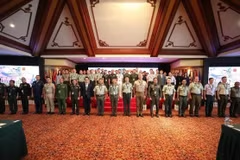
Delegates at the 22nd ASEAN Defence Ministers' Meeting-Plus (ADMM-Plus) Experts' Working Group (EWG) on Peacekeeping Operations. (Photo published by VNA)

Vietnam shares peacekeeping expertise at ADMM+ experts' meeting

The Vietnamese delegation highlighted the increasing contributions of Vietnamese female peacekeepers serving at UN missions and headquarters, noting their important role not only in fulfilling operational duties but also in supporting community engagement, civilian protection, medical services and humanitarian assistance.

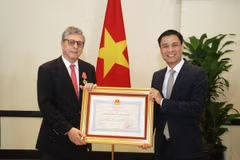
Deputy Minister of Foreign Affairs Dang Hoang Giang (R) presents the Friendship Order to Brazilian Ambassador to Vietnam Marco Farani. (Photo: Ministry of Foreign Affairs)

Brazilian Ambassador to Vietnam awarded Friendship Order

Presenting the state honour, Deputy Minister of Foreign Affairs Dang Hoang Giang said the award reflects the high regard of the Vietnamese Party, State and people for Farani’s role in strengthening the friendship and cooperation between the two nations. He praised the ambassador’s dedication, professionalism and unwavering commitment throughout his tenure in Vietnam.

☕ Afternoon briefing on July 2

☕ Afternoon briefing on July 2

A ceremony marking the 50th anniversary of Saigon - Gia Dinh city being officially named after President Ho Chi Minh, conferences reviewing the performance of military and public security tasks in H1, and Vietnam classified as an upper-middle-income country by the WB are among news highlights on July 2.

Prime Minister Le Minh Hung (right) attends the conference held by the Ministry of Public Security in Hanoi on July 2, 2026. (Photo: VNA)

Security must be linked to expanding national development space: PM

Prime Minister Le Minh Hung urged the public security force to continue setting the standard in translating the Party’s strategic policies and the State’s laws into practice. He called on the force to take the lead in enabling development through concrete, measurable outcomes, proactively review and recommend measures to address shortcomings in institutions, policies and legislation, and focus on removing bottlenecks in order to unlock resources needed to achieve double-digit economic growth.

Prime Minister Le Minh Hung speaks at the national political-military conference. (Photo: VNA)

Prime Minister urges military to enhance strategic advisory role, forecasting capacity

Prime Minister Le Minh Hung noted that the military has demonstrated strong strategic awareness and responsiveness, accurately assessed developments, and effectively advised the Party and State on military and defence matters. These efforts have enabled the flexible and effective handling of emerging situations, maintained a proactive posture, prevented surprises and firmly safeguarded national sovereignty and territorial integrity.

An art performance at the ceremony to mark the 50th anniversary of Saigon-Gia Dinh city being officially named after President Ho Chi Minh (July 2, 1976–2026). (Photo: VNA)

Top leader attends ceremony marking 50 years of Saigon-Gia Dinh bearing late President’s name

Ho Chi Minh City has every reason to take pride in its remarkable achievements over the past half-century. From a war-ravaged urban centre facing enormous post-war difficulties, it gradually restored production, stabilised people's livelihoods, consolidated the achievements of the revolution, built an effective system of governance, and safeguarded national defence and security, thereby laying a solid foundation for long-term development.

☀️ Morning digest on July 2

☀️ Morning digest on July 2

A conference reviewing the 18-month implementation of the Politburo’s Resolution 57, Vietnam's fruit and vegetable exports during the first half of 2026, and UOB Vietnam starting work on the first purpose-built headquarters developed by a foreign bank in the Vietnam International Financial Centre in Ho Chi Minh City are among news highlights on July 1 evening.

Party General Secretary and State President To Lam speaks at the conference. (Photo: VNA)

Top leader demands concrete output under Resolution 57

Top leader To Lam stressed that while the 14th National Party Congress’s Resolution serves as the strategic blueprint for the country's next growth stage, Resolution 57 is one of the key engines for turning that blueprint into reality.

National Assembly Chairman Tran Thanh Man presents the Ho Chi Minh Order to the external security force at the ceremony in Hanoi on July 1, in recognition of its outstanding contributions to the revolutionary cause of the Party and the nation. (Photo: VNA)

NA Chairman calls for building regular, elite, modern external security force

The NA Chairman stressed that under all circumstances, the force must remain absolutely loyal to the Party, the nation and the people, while upholding the principle of the Party’s absolute, direct and comprehensive leadership – specifically through the Central Public Security Party Committee and the leadership of the Ministry of Public Security.

Party General Secretary and State President To Lam (centre) chairs the conference. (Photo: VNA)

Politburo sets six priorities for implementing Resolution No. 57

After 18 months of implementing Resolution No. 57, ministries, sectors and localities have adopted innovative and effective approaches that have generated positive momentum, while winning broad support from businesses, the scientific community and the public for policies on science, technology, innovation and digital transformation.

Police in Tan Binh district, Ho Chi Minh City, in coordination with the Department of Cybersecurity and High-Tech Crime Prevention under the Ministry of Public Security, searched multiple locations and placed 86 suspects in temporary criminal detention for investigation into alleged telecom and online fraud. (Photo: VNA)

New Cybersecurity Law strengthens protection of citizens' rights in digital age

The law also introduces more comprehensive provisions on data security, information system protection and measures to prevent, detect and address cybersecurity violations. It prioritises prevention, enhances early warning and incident response capabilities, and links cybersecurity with maintaining social order and security amid rapid digital transformation.

An overview of the the July 1 national conference reviewing the one-year operation of the three-tier administration model (Photo: VNA)

Localities propose reforms to improve three-tier administration model

A Hanoi official called for further decentralisation to commune-level authorities in line with resource allocation, continued streamlining of organisational structures to eliminate unnecessary intermediary layers, further refining the Party organisations’ model to align with the state administrative system, greater autonomy for non-business public service units, and wider participation of businesses and social organisations in delivering suitable public services.

Party General Secretary and State President To Lam addresses the conference on July 1. (Photo: VNA)

New administrative system must deliver new governance capacity: Top leader

The Party and State leader described the restructuring as a broad, complex and far-reaching reform affecting almost every agency and public servant from the central to grassroots levels. While praising the significant initial achievements, he stressed that the results marked only the beginning and warned against complacency.