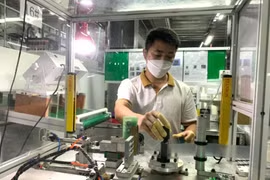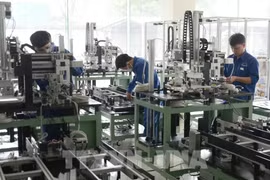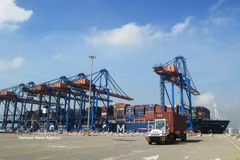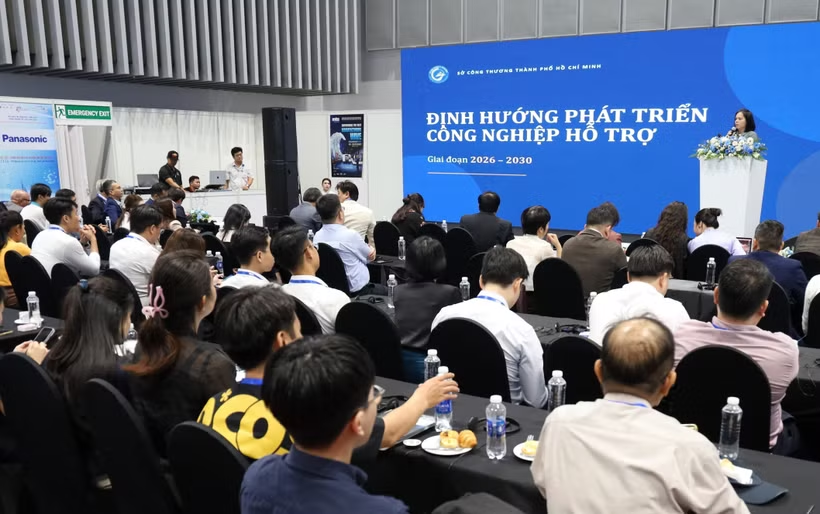
Ho Chi Minh City (VNA) - Strengthening supporting industries is essential to enhancing Vietnam's industrial competitiveness, raising localisation and reducing reliance on imported inputs, heard a forum in Ho Chi Minh City on July 2.
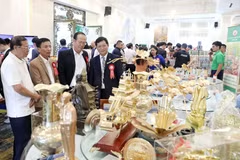
Organised by the Investment and Trade Promotion Centre of HCM City (ITPC) and the Ho Chi Minh City Supporting Industry Association (HASI), the forum brought together businesses, policymakers and experts to discuss ways to strengthen manufacturing capacity, deepen supply-chain integration and expand partnerships with strategic investors, financial institutions and foreign-invested enterprises.
In her opening remarks, ITPC Deputy Director Cao Thi Phi Van said global supply chains are being reshaped by geopolitical tensions, strategic competition among major economies, green and digital transformation, tighter sustainability requirements and the relocation of high-tech investment.
"Supporting industries are no longer simply auxiliary manufacturing sectors. They have become the foundation for enhancing industrial self-reliance, increasing localisation, improving competitiveness and enabling businesses to integrate more deeply into regional and global supply chains," she said.
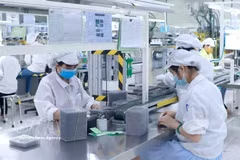
According to Van, a sustainable industrial base cannot rely solely on assembly and processing but must gradually master the production of components, materials, technologies and quality standards while building a strong domestic supplier network.
Vietnam continues to benefit from the global diversification of supply chains, she noted. Registered foreign direct investment (FDI) reached 24.81 billion USD in the first five months of 2026, up 34.9% year-on-year, with manufacturing and processing attracting 8.06 billion USD, the largest share of total FDI.
Meanwhile, the country's total trade reached nearly 496.7 billion USD as of June 15. Electronics, computers and components led exports at 63.5 billion USD, followed by machinery and equipment at nearly 30 billion USD and phones and components at 29 billion USD.
"These figures show that Vietnam remains an attractive destination as global supply chains are restructured. At the same time, the country's heavy imports of components, machinery and intermediate goods highlight both the enormous growth potential for domestic supporting industries and the urgent need to strengthen local supply chains and reduce dependence on imported inputs," Van said.
She also highlighted the Government's Supporting Industry Development Programme for 2026-35, which aims to raise average localisation rates in key industries to 40-45% by 2030 and place Vietnam among ASEAN's three most competitive industrial economies. By 2035, most supporting industry sectors are expected to achieve advanced technological capabilities and participate more deeply in global value chains.
For Ho Chi Minh City, the country's economic, commercial and innovation hub, developing supporting industries remains a strategic priority. The city is pursuing a growth model centred on productivity, technology, digital transformation and regional connectivity while promoting industry clusters, expanding domestic supplier networks and helping small and medium-sized enterprises (SMEs) improve production capacity and meet international standards.
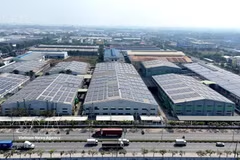
Nguyen Minh Tam, head of the Industrial Management Division under the Ho Chi Minh City Department of Industry and Trade, said the city now has 105 export processing zones and industrial parks covering more than 50,000 hectares, including 58 in operation.
Supporting industries have been identified as a key pillar for strengthening industrial competitiveness and domestic production capacity, she said.
The Saigon High-Tech Park has attracted 26 supporting industry projects worth more than 512 million USD, while localisation has increased from about 10% in 2010 to over 20%.
However, imports of computers, electronic products and components still reached 6.62 billion USD, highlighting significant opportunities for domestic manufacturers to replace imported inputs. The ongoing "China+1" supply-chain strategy is also creating opportunities for Vietnamese companies to become second- and third-tier suppliers to multinational corporations.
Nguyen Ngoc Dang Khoa, deputy director of business development at SMC Phu My Precision Mechanical Co Ltd, said compliance with international standards is essential for companies seeking to join global supply chains.
In addition to widely adopted certifications such as ISO 9001, ISO 14001, ISO 45001 and the Responsible Business Alliance (RBA) standard, manufacturers increasingly need sector-specific certifications such as IATF 16949 for automotive production, AS9100 for aerospace and ISO 13485 for medical devices.
"These certifications are not simply customer requirements. They provide the framework for standardised production systems that ensure consistent product quality across different factories," Khoa said.
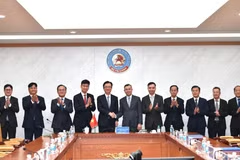
The forum also saw HASI sign three strategic memoranda of understanding with domestic and international partners. The agreements include cooperation with the Industrial Development Support Centre under the Ministry of Industry and Trade and the Centre for Industrial and Supporting Industries Development of Ho Chi Minh City to improve business competitiveness, develop industry databases and strengthen supply-chain connectivity.
HASI also signed an agreement with the Vietnamese Business Association in the Benelux to help supporting industry firms expand into European markets, while another partnership with MISA Group will support businesses in adopting digital management solutions.
During a panel discussion, participants agreed that raising the competitiveness of Vietnamese manufacturers will require stronger collaboration among SMEs, better access to financing, closer cooperation with multinational corporations, and wider adoption of digital technologies.
Experts also highlighted digital transformation, data and artificial intelligence as emerging competitive advantages that can help manufacturers improve productivity, reduce costs and meet increasingly demanding international standards./.
Supporting industries seek fresh growth momentum
Against a backdrop of global uncertainty and supply chain restructuring, the Government has introduced a range of measures aimed at injecting new momentum into domestic manufacturing. New provisions covering workforce training, testing and certification, trade promotion and technology upgrades have been implemented.