Vietnam’s economic momentum reflected in new income status

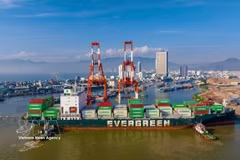
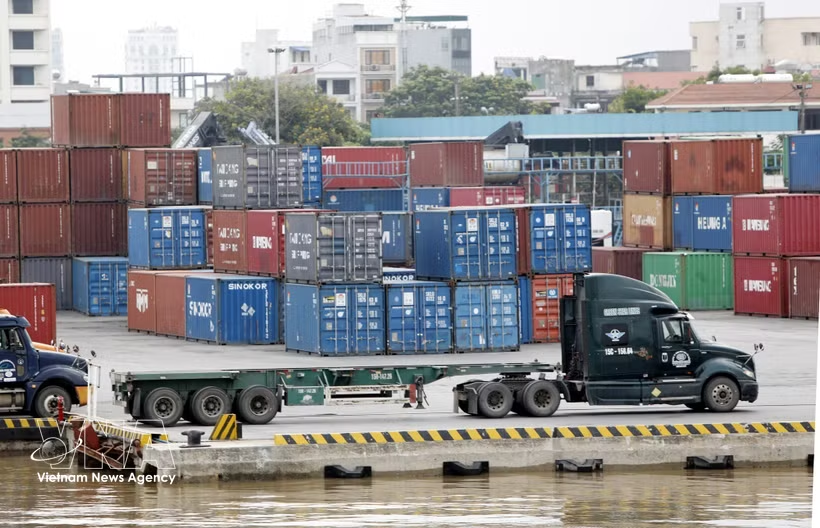
According to the WB, this performance was driven primarily by a robust recovery in exports, which expanded by more than 15% during 2024–2025, and by the country’s ability to sustain strong GDP growth of 7% and 8% in two consecutive years.

Exports are one of the key drivers of Vietnam’s economic growth. (Photo: VNA)

Hanoi (VNA) – The World Bank’s decision to classify Vietnam as an upper-middle-income country after its gross national income (GNI) per capita reached 4,970 USD in 2025 stands as a significant milestone in the country’s development journey, reflecting sustained economic progress while also highlighting the need for deeper reforms to achieve high-income status.

Between 2021 and 2025, Vietnam’s GNI recorded average annual growth of around 10%, underscoring the economy’s strong momentum.

According to the WB, this performance was driven primarily by a robust recovery in exports, which expanded by more than 15% during 2024–2025, and by the country’s ability to sustain strong GDP growth of 7% and 8% in two consecutive years.

Dr. Le Duy Binh, an economist and Managing Director of Economica Vietnam, said the WB’s reclassification represents both recognition of Vietnam’s achievements and a call for more ambitious reforms as the country pursues the high-income status.

A key distinction, he noted, lies in the indicator used by the World Bank. While GDP measures the total value of goods and services within a country’s borders, GNI provides a broader assessment by capturing the income earned by a nation’s citizens and businesses regardless of where that income is generated.

The relationship between the two indicators is reflected in the formula: GNI equals GDP plus net factor income from abroad.

Vietnam’s GNI surpassing the World Bank threshold of 4,636 USD per capita therefore suggests that the country is no longer merely a manufacturing base with a GDP of 514.7 billion USD, but is increasingly capturing a greater share of value within global supply chains.

According to Binh, the achievement reflects nearly two decades of persistent efforts. Since joining the lower-middle-income group in 2009, Vietnam has spent 17 years advancing to this new development stage. However, he cautioned that the new classification should not be viewed as an end goal.

Moving into the upper-middle-income group is a stepping stone rather than a destination, he said, stressing that economic expansion alone is insufficient. Vietnam must simultaneously strengthen the foundations of long-term growth, including scientific and technological capabilities, innovation capacity, workforce quality, and its position in higher-value segments of global production networks.

The next phase of development will present more complex challenges, requiring fundamental changes in governance and policymaking to avoid the so-called middle-income trap.

Among the challenges are population ageing, rising social welfare demands, inequality and widening income gaps that can accompany rapid growth. At the same time, a larger economy will require greater energy consumption and resource use.

To ensure sustainable development and meet increasingly demanding global standards, Vietnam will need to accelerate green growth, improve resource efficiency and reduce emissions, he said.

Nguyen Thi Mai Hanh, head of the National Accounts Department under the National Statistics Office of the Ministry of Finance, emphasised that the WB’s reclassification is primarily a change in economic categorisation and does not mean Vietnam has become a developed country or significantly narrowed its income gap with advanced economies.

She noted that labour productivity, innovation capacity and overall economic competitiveness still require substantial improvement in the coming years.

Hanh also stressed that rising income rankings should translate into tangible improvements in people’s living standards rather than remain statistical achievements. She cited the National Statistics Office as saying that average monthly income of workers reaches nearly 9 million VND (342 USD) in the second quarter of 2026, slightly down by 53,000 VND from the previous quarter.

Meanwhile, household survey data showed that more than 96% of households reported stable or higher incomes compared with the same period last year. Nearly 31% said their incomes have increased, while more than 65% reported no change.

Economists agree that the latest milestone demonstrates Vietnam’s success in moving beyond the initial stage of economic accumulation. The next chapter, however, will require a different development model focused on productivity, innovation and sustainability.

The new income classification is also expected to enhance Vietnam’s international standing. As the country’s economic scale and market size expand, its influence in international economic affairs is likely to grow accordingly.

Experts noted that larger economies generally possess greater negotiating leverage and stronger soft power in trade and economic relations. This could enable Vietnam to play a more proactive role in shaping next-generation free trade agreements and securing more favourable terms in international economic negotiations./.

VNA
See more

Pomelo is one of the five key fruit crops in Dong Nai province. (Photo: VNA)

Agro-forestry-fishery exports poised for stronger growth

By safeguarding key production areas, expanding deep processing, promoting green production and improving climate resilience, Vietnam's agro-forestry-fishery sector will be better positioned to sustain export growth and further expand its global market share.

Israel is Vietnam's largest importer of tuna in the Middle East. (Photo: VNA)

Vietnam-Israel trade set to approach 4 billion USD

Israel views Vietnam as a highly promising market of more than 100 million people and an increasingly important global manufacturing hub. Both countries identified artificial intelligence (AI), cybersecurity, agricultural technology, health care and innovation as key areas for future collaboration.

Corporate employees at Trang Due Industrial Park, Hai Phong city, register for personal income tax refunds. New tax deductions have been added to the 2025 Law on Personal Income Tax. (Photo: VNA)

Government specifies new personal income tax deductions

A taxpayer without dependents can be eligible for deductions of up to 19.4 million VND (737 USD) per month, while those with one dependent can deduct up to 25.6 million VND (974 USD) per month, if certain expenses are incurred.

VinFast EV models. (Photo: Vinfast)

VinFast launches VF 2 urban EV priced at 7,200 USD

Vietnamese electric vehicle maker VinFast on July 5 unveiled the VF 2, a compact urban electric car priced at 188 million VND (7,200 USD), including the battery, as part of its strategy to make car ownership more accessible for Vietnamese consumers.

A durian stall at APITA supermarket (Photo: VNA)

Vietnamese food wins over consumers in Hong Kong

Hong Kong remained Vietnam's fifth-largest foreign investor in 2025. Bilateral trade also recorded remarkable growth of more than 70% during the year, with Vietnam's exports to Hong Kong surging by over 90%, making Vietnam the third-largest exporter to the market after mainland China and Taiwan (China).

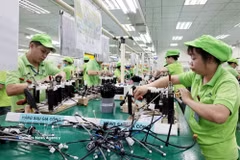
A production line for electrical wire harness assemblies at Bandai Company (Photo: VNA)

Manufacturing remains key driver of Vietnam’s economic growth in H1: NSO

The strongest first-half industrial growth since 2019 not only underscores the sector's solid recovery but also provides a firm foundation for Vietnam to sustain robust economic growth throughout 2026. With manufacturing continuing to lead, supported by improving demand, employment and production capacity, industry is expected to remain a key pillar of economic expansion.

Off the coast of Ca Mau province, average wind speeds of 6.3–7 metres per second at heights of 80–100 metres provide favourable conditions for offshore wind development, with stronger winds further offshore. (Photo: VNA)

Offshore wind poised to power Vietnam's marine economy

Resolution No. 36-NQ/TW on Vietnam’s Sustainable Marine Economic Development Strategy until 2030, with a vision to 2045, calls for a green, modern and innovation-driven marine economy built on science and technology. Within this framework, offshore wind has been identified as a strategic sector capable of creating new growth momentum.

A screenshoot of the Objectif Eco article (Photo released by VNA)

Vietnam, EU move towards high-quality economic partnership

The article also highlighted the elevation of Vietnam–EU relations to a comprehensive strategic partnership in early 2026, arguing that the upgraded framework would provide fresh momentum for cooperation in trade, investment, digital transformation, the green transition, energy, climate action and supply chain resilience.

Representatives from CPTPP members attend the online CPTPP ministerial meeting and the 10th meeting of the CPTPP Commission on June 26. (Photo: moit.gov.vn)

Vietnam advances CPTPP agenda as 2026 Chair

Vietnam, as the 2026 CPTPP Chair, hosted the online CPTPP ministerial meeting and the 10th meeting of the CPTPP Commission on June 26, reported the Ministry of Industry and Trade.

A woman shops at the Vietnamese goods section of Co.opmart Ly Thuong Kiet supermarket in Ho Chi Minh City. (Photo: VNA)

Retail sales, consumer services up nearly 13% in first half

In the first six months, total retail sales and consumer service revenue amounted to an estimated 3,889.5 trillion VND, up 12.9% year-on-year. After excluding price factors, real growth stood at 7.3%, reflecting a solid recovery in domestic purchasing power and consumer demand.

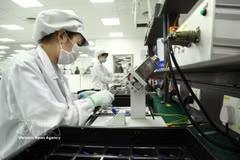
An electrical wiring harness production line at Bandai Company (Photo: VNA)

FDI disbursement hits five-year high in H1

As of June 30, total registered FDI, including newly registered capital, additional capital for existing projects and foreign investors' capital contributions and share purchases, rose 61% year-on-year to 34.65 billion USD.