Agro-forestry-fishery exports poised for stronger growth

By safeguarding key production areas, expanding deep processing, promoting green production and improving climate resilience, Vietnam's agro-forestry-fishery sector will be better positioned to sustain export growth and further expand its global market share.

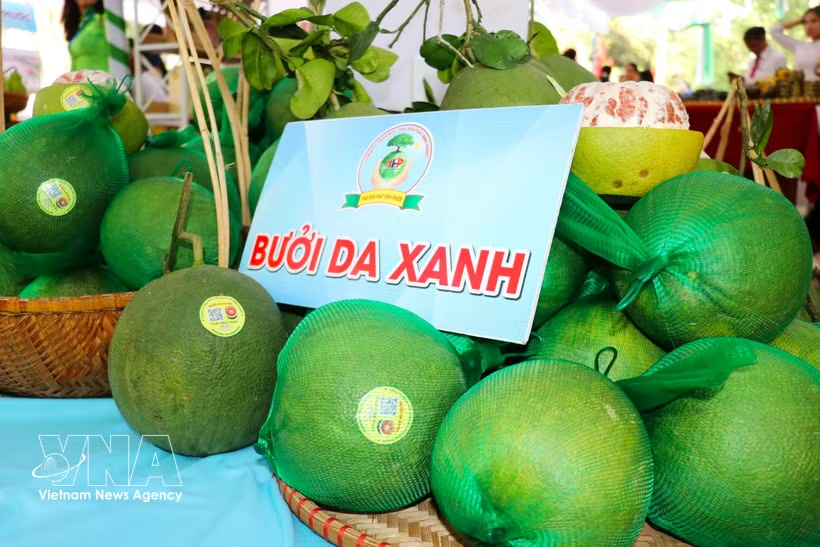
Pomelo is one of the five key fruit crops in Dong Nai province. (Photo: VNA)

Hanoi (VNA) - Despite continued volatility in global trade, Vietnam's agro-forestry-aquatic product exports maintained positive growth in the first half of 2026, laying the groundwork for stronger expansion in the remainder of the year.

Key exports, including seafood, fruit and vegetables, and rice, are well positioned to expand into new markets and increase added value. However, they also face mounting challenges from climate change, intensifying global competition and increasingly stringent technical standards.

According to Deputy Minister of Agriculture and Environment Dang Ngoc Diep, production and export performance in the first six months exceeded expectations and is on track to surpass planned targets. Stronger consumer demand in major markets during the year-end shopping season is expected to help the sector achieve its 2026 export target of 73-74 billion USD.

In the first half of the year, fruit and vegetables continued to be a standout performer, posting double-digit growth. Durian remained the leading export thanks to its off-season production advantage and the expansion of growing-area codes approved for exports to China. Traditional products such as dragon fruit, bananas, mangoes and coconuts also maintained stable market demand. Meanwhile, the signing of export protocols allowing pomelo and lemon to enter China through official channels, together with the successful shipment of the first fresh pomelo consignment to Australia, has created new growth opportunities while demonstrating Vietnamese exporters' ability to meet international standards.​

The export structure of the fruit and vegetable sector is also shifting toward higher value-added products, with processed products accounting for 35.82% of total exports. According to Dang Phuc Nguyen, Secretary General of the Vietnam Fruit and Vegetable Association, deep processing will be a key growth driver, enhancing product value while reducing exposure to trade fluctuations. Growing investment in processing and logistics across localities is also strengthening the competitiveness of Vietnamese agricultural exports.
vnanet-1-2.jpg
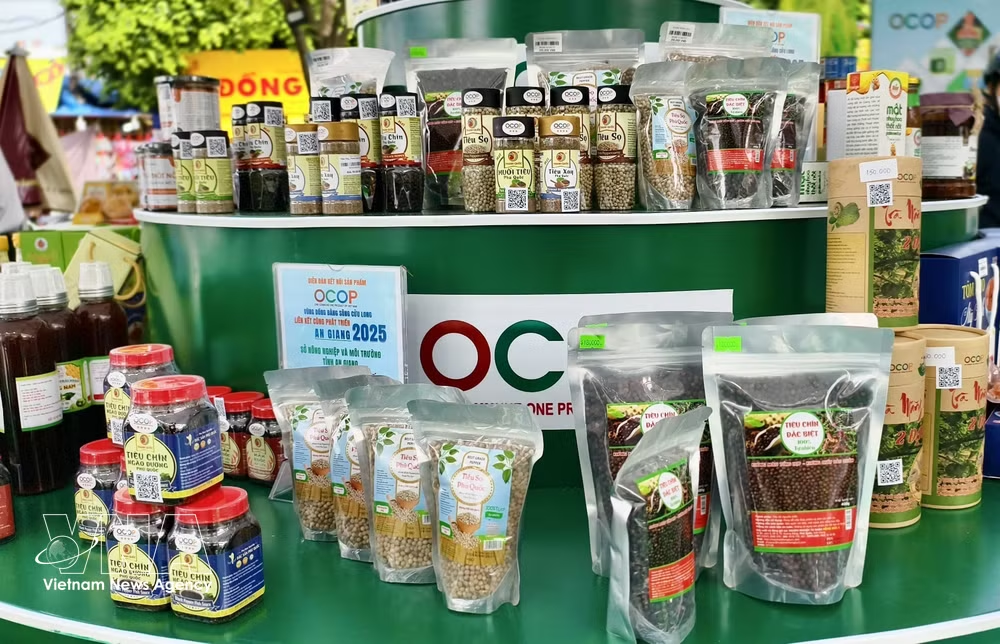
OCOP products from An Giang province are displayed at an exhibition showcasing One Commune One Product (OCOP) specialties from the Mekong Delta and other localities nationwide. (Photo: VNA)

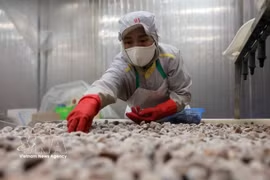
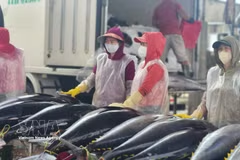
​Meanwhile, the seafood industry continues to grow but is facing increasing pressure from tariffs, technical barriers, rising production costs and stronger international competition. Le Hang, Deputy Secretary General of the Vietnam Association of Seafood Exporters and Producers, said shrimp exports remain under pressure from high input costs, adverse weather, fierce competition from Ecuador, Indonesia and India, as well as trade defence measures, particularly in the US.

​For pangasius, rising production costs are weighing on farming plans and raw material supply. However, a roughly 30% decline in global pollock output is creating opportunities for Vietnamese pangasius to expand its market share. If exporters make full use of free trade agreements and maintain their competitive edge in China, seafood exports could grow by 8-10% to over 12 billion USD in 2026. Nevertheless, the industry must continue addressing challenges related to illegal, unreported and unregulated (IUU) fishing regulations and the US’s Marine Mammal Protection Act (MMPA).

The outlook for rice exports remains relatively stable. According to Le Thanh Tung, Vice Chairman and General Secretary of the Vietnam Rice Industry Association, the industry should focus less on short-term price fluctuations and more on building stable raw material areas, improving quality, and meeting increasingly stringent requirements on traceability, food safety and sustainable production. Low-emission rice cultivation is widely seen as the key to strengthening the competitiveness of Vietnamese rice.

Alongside market opportunities, weather remains a major risk factor. Tran Gia Long, Deputy Director of the Department of Planning and Finance under the Ministry of Agriculture and Environment, warned that El Niño could affect the South Central Coast, the Central Highlands and the Mekong Delta, which together account for more than 80% of Vietnam's agro-forestry-fishery production value.​

By safeguarding key production areas, expanding deep processing, promoting green production and improving climate resilience, Vietnam's agro-forestry-fishery sector will be better positioned to sustain export growth and further expand its global market share./.

VNA

See more

Standing Deputy Prime Minister Pham Gia Tuc chairs a meeting with representatives of US business associations and companies operating in Vietnam on July 17, 2026. (Photo: baochinhphu.vn)

Standing Deputy PM meets with US business community

Chairing a meeting with representatives of US business associations and companies operating in Vietnam, Tuc praised the US business community for its substantive contributions to Vietnam's socio-economic development as well as the two countries’ relations.

Workers assembles electronic components on the production line at the Bao Sen Co., Ltd. in Bac Ninh province. (Photo: VNA)

Vietnam's economy needs to shift from quantity to quality: ADB experts

Shantanu Chakraborty, ADB Country Director for Vietnam, noted that while achieving strong growth in a single year is encouraging, maintaining both the pace and quality of growth over many years will be essential if Vietnam is to achieve its goal of becoming a high-income country by 2045.

The Long Son Petrochemical Complex, an investment project of Thailand's SCG Group, is located in Long Son commune, Ho Chi Minh City. (Photo: VNA)

Vietnam reshapes FDI strategy with focus on technology, innovation

Politburo Resolution No. 10-NQ/TW, issued on June 8, 2026, recognises the foreign-invested sector as an important component of the national economy, signalling a major shift in the country's investment attraction strategy. Rather than prioritising labour-intensive projects, Vietnam is now seeking high-quality investments capable of driving technological progress, innovation, sustainable development and stronger participation in global value chains.

International tourists love shopping for souvenirs at Hanoi's Old Quarter night market (Photo: VNA)

Hanoi aims to raise tourists' night-time spending to 30%

Hanoi will establish and operate flagship night-time economy zones supported by preferential policies, including heritage and cultural districts in Hoan Kiem, Cua Nam, Ba Dinh, Son Tay and Soc Son; modern entertainment hubs in Tay Ho-West Lake West, My Dinh and Dong Anh; creative economy zones linked to cultural industries such as theatres, cinemas and museums; and cultural tourism and resort destinations in suburban craft villages including Bat Trang, Ba Vi and Huong Son.

Vietnamese Ambassador to Laos Nguyen Minh Tam and Lao Deputy Minister of Industry and Commerce Phouthavanh Nanthavong visit the Vietnamese pavilion at VIETLAO EXPO 2026 (Photo: VNA)

VIETLAO EXPO 2026 helps boost Vietnam-Laos strategic cohesion

The Vietnam-Laos Trade Fair 2026 (VIETLAO EXPO 2026) opened on July 16 in Vientiane, serving as a key platform for businesses from both countries to showcase products, seek partnerships, transfer technologies and expand investment cooperation.

The Vietnam-EFTA FTA is one of the longest-negotiated trade agreements in Vietnam's history. (Illustrative Photo: VNA)

Vietnam-EFTA deal set to further boost bilateral trade growth

The Vietnam-EFTA FTA is one of the longest-negotiated trade agreements in Vietnam's history, reflecting its broad scope of commitments covering trade in goods and services, investment, intellectual property, government procurement, environmental protection, sustainable development, small and medium-sized enterprises (SMEs), and other areas of cooperation.

Passengers and visitors check in at Terminal 1 of Noi Bai International Airport. (Photo: VNA)

Hanoi-Ho Chi Minh City route among world’s busiest

According to IATA’s ranking of global air passenger markets, the US remained the world’s largest market in 2025, with 890.1 million passengers, up 1.6% from 2024. China, the world’s second-largest market, recorded stronger growth of 4.8%, reaching 776.1 million passengers. China is widely forecast to overtake the US and become the world’s largest air passenger market in the 2030s.

An overview of the working session between the Kazakh delegation and the Can Tho City People's Committee on July 16. (Photo: VNA)

Kazakhstan explores agricultural by-product recycling project in Can Tho city

The proposed project would use rice husks as its primary feedstock, with an estimated one million tonnes processed annually using advanced technology developed in Kazakhstan. At present, the top priority is to secure a stable supply of raw materials from rice-producing provinces across the Mekong Delta.

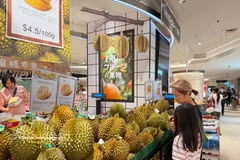
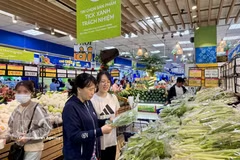
Consumers buy fruit at a supermarket in Vietnam. (Photo: VNA)

US highlights potential in Vietnam’s fruit market

The US was Vietnam's second-largest supplier of agricultural products, with export turnover reaching 4.7 billion USD in 2025, a remarkable increase from less than 3.5 billion USD in 2024, Fruitnet said, citing a new report by the US Department of Agriculture (USDA).

Vietnamese Ambassador to Thailand Pham Viet Hung (thitd, left) attends the opening ceremony of Grand Halal Bangkok 2026 (Photo: VNA)

Vietnamese firms seek global Halal opportunities at Bangkok exhibition

Ambassador Pham Viet Hung described Grand Halal Bangkok 2026 as an important opportunity for Vietnamese businesses to connect not only with Thailand's Halal industry but also with Halal food producers worldwide, while learning from experience of Thailand and international partners.

Marnufacturing garments for export at Hung Yen Jute and Garment Joint Stock Company. (Photo: VNA)

GDP expands 8.18%, with new growth drivers taking shape

According to the National Statistics Office under the Ministry of Finance, GDP expanded by 8.39% in the second quarter, up from 8.14% a year earlier. Growth for the first six months reached 8.18%, exceeding the 7.63% recorded in the same period of 2025. The performance reflected broad-based contributions from both the supply and demand sides of the economy.