Manufacturing remains key driver of Vietnam’s economic growth in H1: NSO

The strongest first-half industrial growth since 2019 not only underscores the sector's solid recovery but also provides a firm foundation for Vietnam to sustain robust economic growth throughout 2026. With manufacturing continuing to lead, supported by improving demand, employment and production capacity, industry is expected to remain a key pillar of economic expansion.

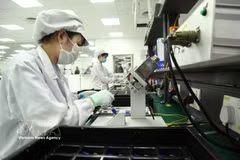
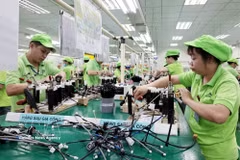
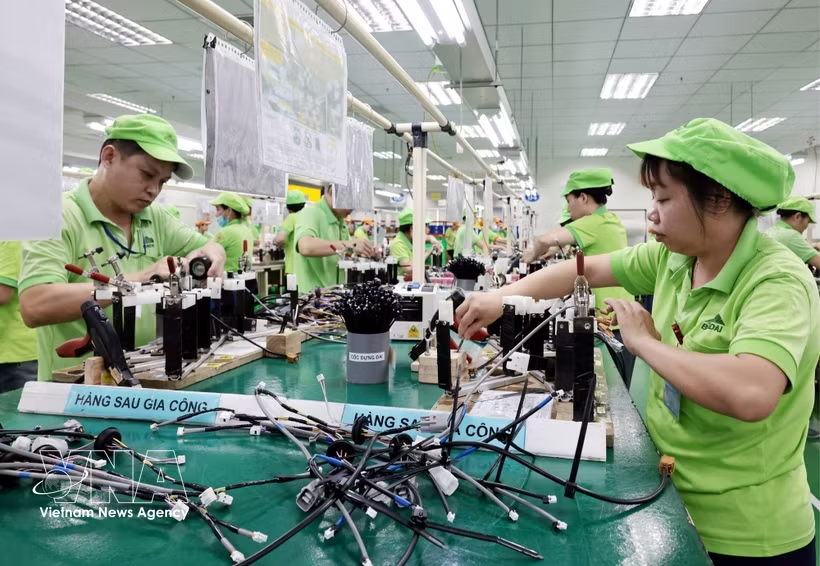
A production line for electrical wire harness assemblies at Bandai Company (Photo: VNA)

Hanoi (VNA) - Vietnam's industrial production maintained strong momentum in the second quarter and the first six months of 2026, with the Index of Industrial Production (IIP) posting its fastest first-half growth since 2019, according to the National Statistics Office (GSO) under the Ministry of Finance.

The robust performance reflects the manufacturing sector’s steady recovery and reaffirms its role as the economy’s main growth engine.

The NSO reported that the IIP in the second quarter rose an estimated 11.2% year-on-year, driven by manufacturing (up 11.3%), electricity production and distribution (12.4%), water supply and waste management (10.3%), and mining (7%).

For the first six months, the index increased 10.8% from a year earlier, surpassing the 8.7% growth recorded in the same period of 2025 and marking the highest first-half expansion since 2019.

This indicates that industrial production is recovering broadly, supported by stronger domestic consumption, exports and investment, said NSO Director Nguyen Thi Huong.

Manufacturing remained the largest contributor, expanding 11.4% and contributing 8.9 percentage points to the overall industrial growth.

Electricity production and distribution rose 9.6%, while mining increased 5.8%, reversing its decline in the same period last year.

Many manufacturing subsectors posted outstanding growth, including basic metals (21.5%), motor vehicles (17.7%), beverages (15.4%), other transport equipment (15%), non-metallic mineral products (14.9%), chemicals (14.8%), and fabricated metal products (13.9%).

Some others recorded weaker growth or contraction, however. Leather and related products rose only 4%, while hard coal and lignite mining fell 5.7%, highlighting uneven performance across industries despite the broader recovery.

Industrial production increased across all 34 provinces and cities, with strong growth in manufacturing and electricity generation driving local performance. Manufacturing output surged in Quang Ninh (37.8%), Ha Tinh (30.7%), Ninh Binh (27.7%), Phu Tho (25.8%), and Nghe An (25%).

Electricity production recorded notable increases in Ha Tinh (48.3%), Phu Tho (18.3%), and Dien Bien (15.6%), reflecting the broadening momentum of industrial growth nationwide.

Output of major industrial products also recorded strong growth, including motorcycles (32.9%), automobiles (26.9%), rolled steel (23.3%), processed seafood (21.6%), refined sugar (16.8%), beer (14.4%), chemical paints (14%), and crude oil (13.1%). Production of NPK fertiliser, monosodium glutamate, clean coal and leather footwear declined.
vnanet-thuysan.jpg
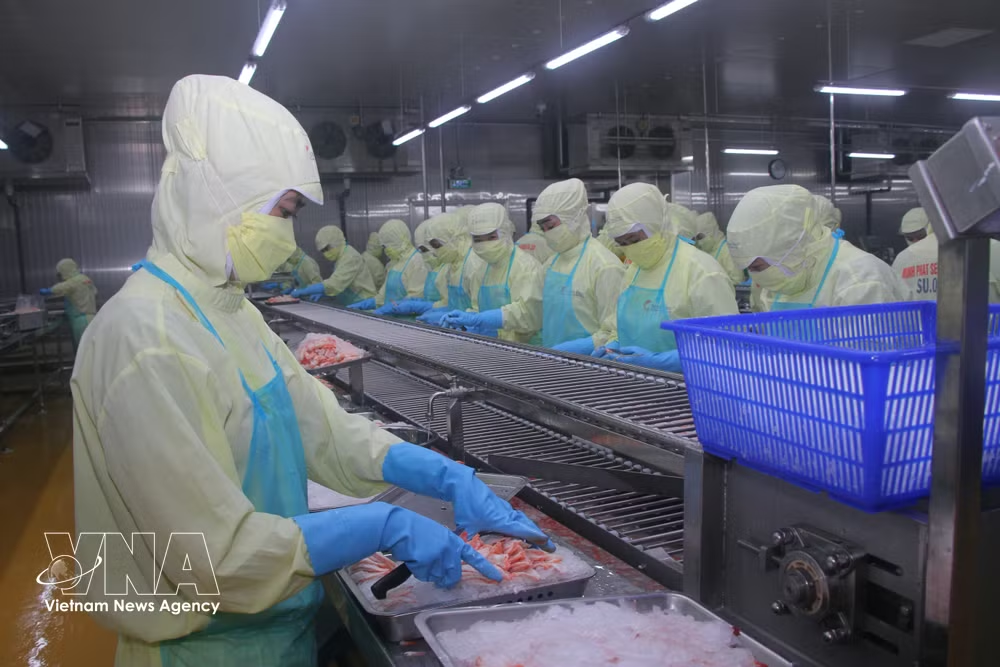
Ca Mau province has nearly 90 seafood processing plants for export (Photo: VNA)

Meanwhile, market demand also continued to improve. The manufacturing consumption index rose 10.8% in the first half, exceeding the growth recorded a year earlier, while the average inventory ratio fell to 82.2%, down from 85.7% in the same period last year, indicating stronger sales and faster production turnover.

The labour market also showed positive signs, with employment at industrial enterprises increasing 3.1% year-on-year, including a 3.2% rise in manufacturing, reflecting business confidence in further production expansion.

The strongest first-half industrial growth since 2019 not only underscores the sector's solid recovery but also provides a firm foundation for Vietnam to sustain robust economic growth throughout 2026. With manufacturing continuing to lead, supported by improving demand, employment and production capacity, industry is expected to remain a key pillar of economic expansion./.

VNA

See more

A durian stall at APITA supermarket (Photo: VNA)

Vietnamese food wins over consumers in Hong Kong

Hong Kong remained Vietnam's fifth-largest foreign investor in 2025. Bilateral trade also recorded remarkable growth of more than 70% during the year, with Vietnam's exports to Hong Kong surging by over 90%, making Vietnam the third-largest exporter to the market after mainland China and Taiwan (China).

Off the coast of Ca Mau province, average wind speeds of 6.3–7 metres per second at heights of 80–100 metres provide favourable conditions for offshore wind development, with stronger winds further offshore. (Photo: VNA)

Offshore wind poised to power Vietnam's marine economy

Resolution No. 36-NQ/TW on Vietnam’s Sustainable Marine Economic Development Strategy until 2030, with a vision to 2045, calls for a green, modern and innovation-driven marine economy built on science and technology. Within this framework, offshore wind has been identified as a strategic sector capable of creating new growth momentum.

A screenshoot of the Objectif Eco article (Photo released by VNA)

Vietnam, EU move towards high-quality economic partnership

The article also highlighted the elevation of Vietnam–EU relations to a comprehensive strategic partnership in early 2026, arguing that the upgraded framework would provide fresh momentum for cooperation in trade, investment, digital transformation, the green transition, energy, climate action and supply chain resilience.

Representatives from CPTPP members attend the online CPTPP ministerial meeting and the 10th meeting of the CPTPP Commission on June 26. (Photo: moit.gov.vn)

Vietnam advances CPTPP agenda as 2026 Chair

Vietnam, as the 2026 CPTPP Chair, hosted the online CPTPP ministerial meeting and the 10th meeting of the CPTPP Commission on June 26, reported the Ministry of Industry and Trade.

A woman shops at the Vietnamese goods section of Co.opmart Ly Thuong Kiet supermarket in Ho Chi Minh City. (Photo: VNA)

Retail sales, consumer services up nearly 13% in first half

In the first six months, total retail sales and consumer service revenue amounted to an estimated 3,889.5 trillion VND, up 12.9% year-on-year. After excluding price factors, real growth stood at 7.3%, reflecting a solid recovery in domestic purchasing power and consumer demand.

An electrical wiring harness production line at Bandai Company (Photo: VNA)

FDI disbursement hits five-year high in H1

As of June 30, total registered FDI, including newly registered capital, additional capital for existing projects and foreign investors' capital contributions and share purchases, rose 61% year-on-year to 34.65 billion USD.

Production chain of Karcher Vietnam Technology cleaning equipment plant, phase II, in Nui Thanh commune of Da Nang (Photo: VNA)

Da Nang attracts nearly 51 trillion VND in investment in H1

According to the Da Nang Statistics Office, total social investment exceeded 50.98 trillion VND (about 1.94 billion USD) in the first six months, up 31.5% from the same period last year. The strong growth reflects investors' confidence in the city's business environment, as well as the effectiveness of its investment promotion policies and efforts to accelerate project implementation.

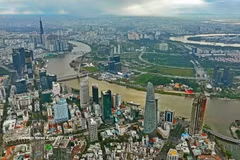
A view of Ho Chi Minh City - Vietnam's leading economic, cultural and tourism hub. (Photo: VNA)

Ho Chi Minh City's economy expands 8.55% in H1

Services remained the key growth driver, expanding 8.89% in the first six months and accounting for 54% of GRDP while contributing 56% of overall growth. Transport recorded the strongest performance with growth of 13.68%, followed by trade at 8.4% and finance at 8.21%. Meanwhile, the real estate sector continued to face difficulties.

Public charging stations for electric vehicles in in Hanoi (Photo: VNA)

Vietnam auto market sees strong growth in EVs

Private passenger vehicles account for the overwhelming majority, with 369,849 battery electric passenger cars in operation, alongside 3,396 electric trucks and 1,571 electric buses.

At the Ho Chi Minh City forum on supporting industries (Photo: VNA)

Supporting industries set to drive industrial growth

Supporting industries are no longer simply auxiliary manufacturing sectors. They have become the foundation for enhancing industrial self-reliance, increasing localisation, improving competitiveness and enabling businesses to integrate more deeply into regional and global supply chains.