Vietnam lays groundwork for transparent carbon market

Experts say the launch of the trading platform is only the first step. The long-term success of the market will depend on a transparent system backed by robust measurement, reporting and verification (MRV) standards to ensure every transaction reflects genuine emissions reductions.

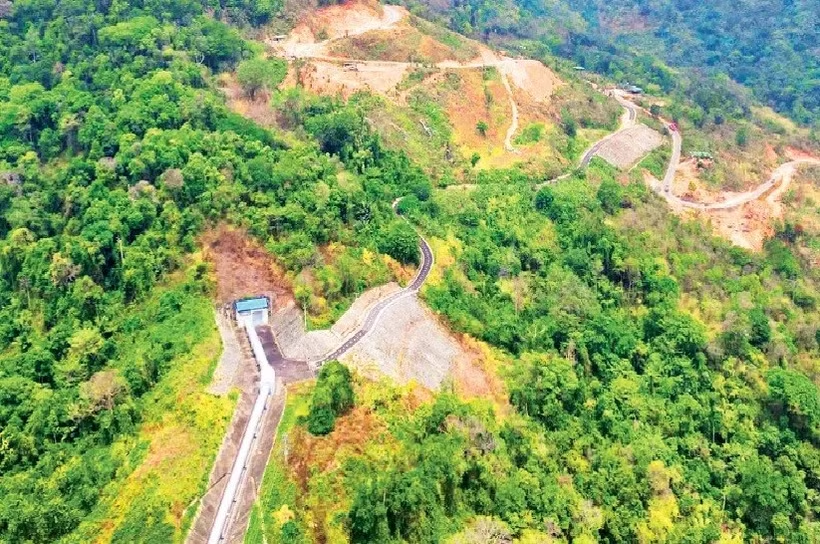
Forest development in Phan Son commune, Lam Dong province. (Photo: nhandan.vn)

Hanoi (VNA) – Vietnam is entering a new phase in developing its carbon market by launching domestic trading of greenhouse gas emission allowances and carbon credits, creating a market-based mechanism to drive emissions reduction, foster technological innovation, and strengthen business competitiveness as the country transitions towards a green economy.

Building the foundation for a carbon market

The Ministry of Finance (MoF) and the Ministry of Agriculture and Environment (MAE) have officially launched Vietnam's domestic carbon exchange, marking a major milestone in the country's efforts to establish a carbon market. Beyond supporting Vietnam's goal of achieving net-zero emissions by 2050, the exchange provides businesses with a mechanism to proactively manage emissions by trading emission allowances and carbon credits.

Nguyen Tuan Quang, Deputy Director of the MAE’s Department of Climate Change, said the market's technical infrastructure comprises three key components: the national registry for greenhouse gas emission allowances and carbon credits, the carbon trading platform, and the repository and settlement system.

Alongside infrastructure development, the Government has approved a pilot greenhouse gas emission allowance cap for the 2025–2026 period and allocated more than 511 million tonnes of CO₂ equivalent to 110 facilities. This forms the initial supply for Vietnam's domestic carbon market.

Under the cap-and-trade mechanism, businesses exceeding their allocated emission allowances must purchase additional allowances or use carbon credits to offset excess emissions, while those that cut emissions beyond their targets can sell surplus allowances.

Carbon credits, meanwhile, are generated through projects that deliver additional emissions reductions or greenhouse gas removals, including afforestation and forest restoration, renewable energy development, and waste treatment.

untitled.jpg
Officials mark the launch of Vietnam's domestic carbon exchange on June 29, 2026. (Photo: Ministry of Agriculture and Environment Portal)

Transparency key to building market confidence

Experts say the launch of the trading platform is only the first step. The long-term success of the market will depend on a transparent system backed by robust measurement, reporting and verification (MRV) standards to ensure every transaction reflects genuine emissions reductions.

During the initial phase, the market will focus on high-emitting sectors such as thermal power, cement and steel production. Over the longer term, many experts have proposed gradually introducing auctions for emission allowances to better reflect the true cost of carbon while generating resources to support the green transition.

According to Tran Duc Phu of the Foreign Trade University, Vietnam currently has around 116 carbon projects at various stages of development, including 40 that have already been certified, with annual carbon credit issuance estimated at about 10.7 million credits. However, most of these credits are still sold to international buyers, while improvements are needed in the MRV system and benefit-sharing mechanisms to strengthen investor confidence.

From the business perspective, Doan Hong Nhung of the University of Law under the Vietnam National University, Hanoi, said complex MRV requirements, limited digital infrastructure and an incomplete carbon credit database have increased compliance costs, particularly for small and medium-sized enterprises. She called for standardised MRV procedures, a centralised carbon registry, measures to prevent double counting of credits, and stronger incentives such as green finance and tax preferences.

Meanwhile, Phan Duy Hoa of the Foreign Trade University noted that carbon credits have yet to be clearly recognised as property rights under Vietnamese law, making it difficult for businesses to transfer, account for or use them as collateral to access green financing. Establishing a clear legal status for carbon credits, he said, will help unlock the market's full potential.

As climate-related trade measures such as the EU's Carbon Border Adjustment Mechanism (CBAM) increasingly affect exports, a transparent domestic carbon market supported by verified emissions data will help businesses adapt, reduce compliance costs and enhance competitiveness. Without transparency and market confidence, however, carbon trading risks becoming a transactional exercise rather than an effective driver of real emissions reductions./.


VNA

See more

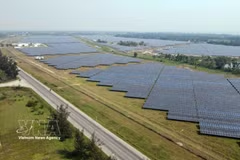
The approval of the two solar power projects marks the start of Lam Dong province's implementation of the revised Power Development Plan VIII (PDP VIII). (Illustrative image: VNA)

Lam Dong approves over 5.7 trillion VND in solar power investment

The larger project, the Dong Nai 2 Hydropower Reservoir Floating Solar Power Plant, will be developed by Trung Nam Hydroelectric Corp with an investment of more than 4.92 trillion VND (188.2 million USD). The 240-MW plant is expected to generate about 464.19 million kWh of electricity annually using the surface of the Dong Nai 2 hydropower reservoir.

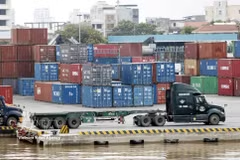
Hai Phong Port ensures a smooth flow of goods (Photo: VNA)

Vietnam upgrades seaport network to strengthen maritime competitiveness

The country's growing maritime standing was highlighted in the Container Port Performance Index (CPPI) 2025, jointly released by the World Bank (WB) and S&P Global Market Intelligence. For the second consecutive year, Cai Mep Port and Hai Phong Port ranked among the world's 20 most efficient container ports, with Cai Mep placed 11th and Hai Phong 13th.

Exports are one of the key drivers of Vietnam’s economic growth. (Photo: VNA)

Vietnam’s economic momentum reflected in new income status

According to the WB, this performance was driven primarily by a robust recovery in exports, which expanded by more than 15% during 2024–2025, and by the country’s ability to sustain strong GDP growth of 7% and 8% in two consecutive years.

Pomelo is one of the five key fruit crops in Dong Nai province. (Photo: VNA)

Agro-forestry-fishery exports poised for stronger growth

By safeguarding key production areas, expanding deep processing, promoting green production and improving climate resilience, Vietnam's agro-forestry-fishery sector will be better positioned to sustain export growth and further expand its global market share.

Israel is Vietnam's largest importer of tuna in the Middle East. (Photo: VNA)

Vietnam-Israel trade set to approach 4 billion USD

Israel views Vietnam as a highly promising market of more than 100 million people and an increasingly important global manufacturing hub. Both countries identified artificial intelligence (AI), cybersecurity, agricultural technology, health care and innovation as key areas for future collaboration.

Corporate employees at Trang Due Industrial Park, Hai Phong city, register for personal income tax refunds. New tax deductions have been added to the 2025 Law on Personal Income Tax. (Photo: VNA)

Government specifies new personal income tax deductions

A taxpayer without dependents can be eligible for deductions of up to 19.4 million VND (737 USD) per month, while those with one dependent can deduct up to 25.6 million VND (974 USD) per month, if certain expenses are incurred.

VinFast EV models. (Photo: Vinfast)

VinFast launches VF 2 urban EV priced at 7,200 USD

Vietnamese electric vehicle maker VinFast on July 5 unveiled the VF 2, a compact urban electric car priced at 188 million VND (7,200 USD), including the battery, as part of its strategy to make car ownership more accessible for Vietnamese consumers.

A durian stall at APITA supermarket (Photo: VNA)

Vietnamese food wins over consumers in Hong Kong

Hong Kong remained Vietnam's fifth-largest foreign investor in 2025. Bilateral trade also recorded remarkable growth of more than 70% during the year, with Vietnam's exports to Hong Kong surging by over 90%, making Vietnam the third-largest exporter to the market after mainland China and Taiwan (China).

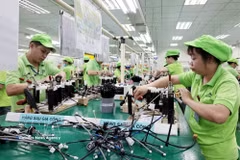
A production line for electrical wire harness assemblies at Bandai Company (Photo: VNA)

Manufacturing remains key driver of Vietnam’s economic growth in H1: NSO

The strongest first-half industrial growth since 2019 not only underscores the sector's solid recovery but also provides a firm foundation for Vietnam to sustain robust economic growth throughout 2026. With manufacturing continuing to lead, supported by improving demand, employment and production capacity, industry is expected to remain a key pillar of economic expansion.