Vietnamese fruit expands foothold in Chinese market

Thanks to its strategic location bordering Vietnam and other ASEAN countries, Guangxi remains a major gateway for tropical fruit entering China. Chinese media have also identified Vietnamese lychees as one of the country's favourite seasonal fruits.

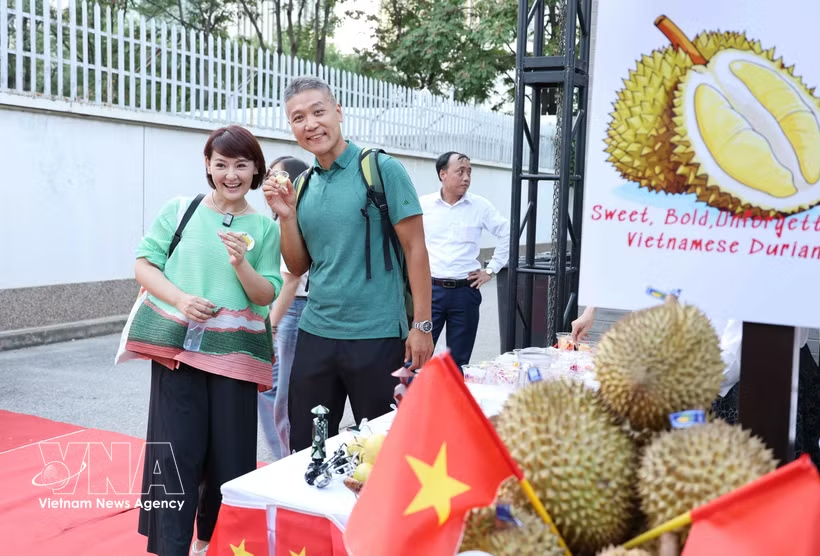
Vietnamese durian is promoted at an event in Beijing. (Photo: VNA)

Beijing (VNA) – Vietnamese fruit is gaining a stronger foothold in China as rising consumer demand, improved cross-border logistics and trade facilitation measures continue to boost exports, Chinese media have reported.

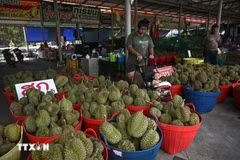
The Economic Daily said imported fruit from the Association of Southeast Asian Nations (ASEAN), including durian, mangosteen and particularly Vietnamese lychees, has become increasingly popular at wholesale markets and fruit retailers in Nanning, capital of China's Guangxi Zhuang Autonomous Region, during the summer season. Monthong durian is currently retailing at 20–25 RMB (about 3–3.7 USD) per 500g, while mangosteen sells for 13–16 RMB per 500g.

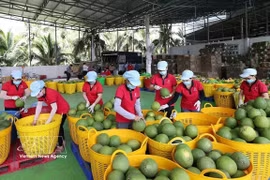
Thanks to its strategic location bordering Vietnam and other ASEAN countries, Guangxi remains a major gateway for tropical fruit entering China. Official data cited by the newspaper show that one in every two imported durians sold in China is cleared through Guangxi's border checkpoints. Chinese media have also identified Vietnamese lychees as one of the country's favourite seasonal fruits. Together with durian, dragon fruit, bananas and other tropical produce, Vietnamese fruit is enriching supplies for China's 1.4-billion-strong consumer market.

According to Zhu Yanling, Deputy Director General of the Guangxi Department of Commerce, fruit imports from ASEAN through Guangxi exceeded 40 billion RMB (around 5.9 billion USD) in 2025, an increase of 20% year-on-year, accounting for more than one-third of China's total fruit imports from ASEAN. In the first five months of 2026, the region imported 1.25 million tonnes of fruit from ASEAN, up 13.5% compared with the same period last year.

Chinese media noted that the upgrading of the China-ASEAN Free Trade Area (ACFTA) to Version 3.0, coupled with the implementation of the Regional Comprehensive Economic Partnership (RCEP), is injecting fresh momentum into agricultural trade between China and ASEAN, with Vietnam playing an increasingly important role as a supplier.

To support growing trade flows, Guangxi has expanded infrastructure at the Youyi Guan border gate, Qinzhou Port and Nanning Wuxu International Airport, while establishing 12 monitoring points for fruit imports across road, sea, rail and air routes. Nanning Customs has also rolled out a dedicated "green lane" and smart quarantine procedures for imported fruit, cutting customs clearance times by around 40%.

At the same time, the region has strengthened its cold-chain logistics network through dedicated refrigerated freight services, refrigerated containers and modern cold-storage facilities, helping reduce transport times, minimise spoilage and maintain fruit quality.

Chinese media said ongoing improvements in logistics, customs efficiency and trade promotion are expected to further expand the market share of Vietnamese fruit in China, providing fresh momentum for agricultural trade between the two neighbouring countries./.
VNA

See more

Indonesian President Prabowo Subianto (right) and Indian Prime Minister Narendra Modi at the Merdeka Palace in Jakarta on July 7, 2026. (Photo: VNA)

Indonesia, India expand cooperation across key strategic sectors

The two leaders agreed to intensify state visits and high-level talks, foster closer coordination through bilateral consultation mechanisms, and strengthen institutional cooperation involving think tanks and the newly formed interparliamentary friendship group.

Indonesian President Prabowo Subianto (R) welcomes Singaporean Prime Minister Lawrence Wong in Jakarta on July 6. (Photo: VNA)

Indonesia, Singapore deepen comprehensive cooperation

Indonesia and Singapore signed 26 cooperation agreements, including 18 government-to-government agreements and eight business ones. The deals focus on emerging drivers of bilateral cooperation, including trade, investment, energy, the digital economy, cybersecurity, food supply chain development, environmental cooperation and carbon trading.

An Aedes aegypti mosquito. (Photo: Xinhua/VNA)

Malaysia's dengue-related deaths rise nearly 70% in first half of 2026

Health authorities attributed the increase partly to a shift in the dominant dengue virus strain from DENV-2 to DENV-3. Rapid urbanisation, favourable weather conditions, mosquito breeding sites and increased population mobility have also contributed to the spread of the disease.

Malaysia targets 50% cut in food imports by 2050

Malaysia targets 50% cut in food imports by 2050

Malaysia has set a target of reducing its reliance on imported food by 50% by 2050 as part of efforts to strengthen national food security. The goal comes as the country's annual food import bill has reached around 80 billion MYR (20 billion USD).

Statistics show that Malaysia records GDP growth of 5.4% in the first quarter, while research organisations forecast growth of 4.6–4.9% in the second quarter. ( Illustrative photo: XINHUA/VNA)

Malaysia's economy projected to grow faster in 2026

Despite the positive outlook, economists cautioned that downside risks remain in the second half of the year, requiring Malaysia to closely monitor geopolitical developments and uncertainties in global trade.

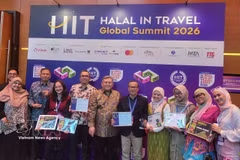
Many travel companies have been granted halal certifications. (Photo: VNA)

Indonesia eyes larger share of global Muslim tourism market by 2030

Indonesia boasts strong advantages in developing the sector as the country is home to 11.3% of the world's Muslim population, 17% of Asia's, and 86% of ASEAN's. Nineteen provinces have Muslim populations exceeding 90%, providing a solid foundation for tailored tourism products.

Electric vehicles produced by Chinese automaker BYD. (Photo: Xinhua/VNA)

Thailand attracts over 4.1 billion USD in EV investment

In 2025, electrified vehicles accounted for more than 44% of new vehicle registrations in Thailand, up sharply from 3% five years earlier. Hybrid vehicles represented 21.8% of new registrations, followed by BEVs at 19.6% and PHEVs at 2.9%.

President of the Lao National Assembly Xaysomphone Phomvihane delivers the opening remarks at the first extraordinary session on July 6, 2026. (Photo: VNA)

Laos' 10th National Assembly opens first extraordinary session

The 10th National Assembly of Laos officially opened its first extraordinary session on July 6 in Vientiane, focusing on several key national issues, including the Government's report on the implementation of the national socio-economic development plan, the state budget and monetary policy during the first half of 2026, as well as priorities for the remainder of the year.

Thailand steps up security in 21 border provinces

Thailand steps up security in 21 border provinces

The Border Security Coordination Centre, chaired by Commander-in-Chief of the Royal Thai Armed Forces Gen. Ukrit Boontanon, has agreed on measures to tackle three pressing security threats along the country's borders: call centre scam syndicates, online gambling, and human trafficking and drug-related crimes.

Singapore, Indonesia work on carbon credits, cross-border trade

Singapore, Indonesia work on carbon credits, cross-border trade

The two countries will collaborate on carbon credits under a memorandum of understanding (MOU) signed on July 6 at the annual Singapore – Indonesia Leaders’ Retreat held in Jakarta, where Singaporean Prime Minister Lawrence Wong met Indonesian President Prabowo Subianto.