Indonesia, India expand cooperation across key strategic sectors

The two leaders agreed to intensify state visits and high-level talks, foster closer coordination through bilateral consultation mechanisms, and strengthen institutional cooperation involving think tanks and the newly formed interparliamentary friendship group.

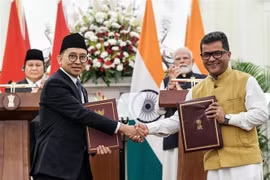
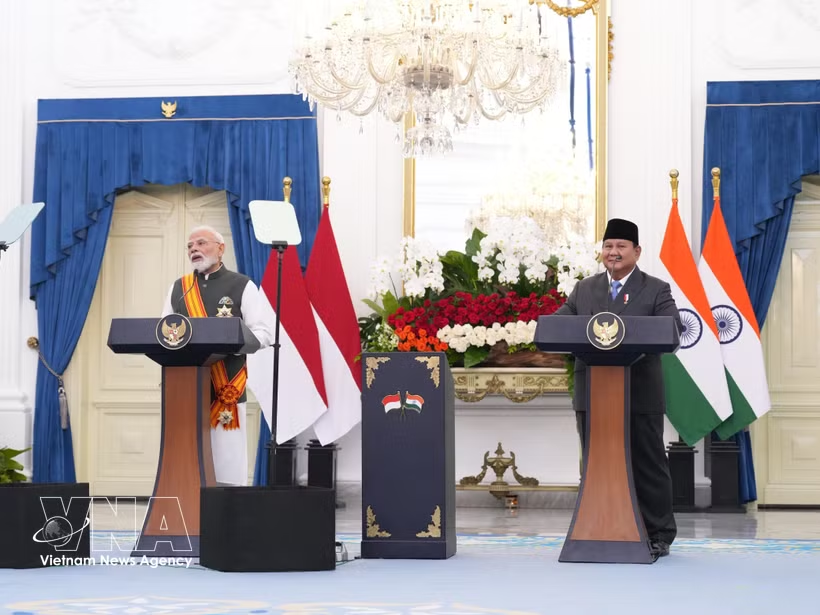
Indonesian President Prabowo Subianto (right) and Indian Prime Minister Narendra Modi at the Merdeka Palace in Jakarta on July 7, 2026. (Photo: VNA)

Jakarta (VNA) – Indonesian President Prabowo Subianto and Indian Prime Minister Narendra Modi have agreed to strengthen the two countries' comprehensive strategic partnership by expanding cooperation across a wide range of strategic sectors, including defence, economy, trade, digital transformation, education and human resource development.

Speaking at a joint press conference following their talks in Jakarta on July 7, President Prabowo said the discussions focused on strategic issues of mutual interest and future directions for bilateral cooperation. The two leaders agreed to intensify state visits and high-level talks, foster closer coordination through bilateral consultation mechanisms, and strengthen institutional cooperation involving think tanks and the newly formed interparliamentary friendship group.

On the occasion, they witnessed the signing and announcement of 16 cooperation documents between government agencies and businesses from both countries, covering defence, space exploration, healthcare, agriculture, telecommunications, education, critical minerals, metallurgy and business cooperation.

The agreements include a procurement contract for the BrahMos missile system between BrahMos Aerospace and Indonesia's Defence Ministry.

The two sides also agreed to deepen cooperation in digital technology, artificial intelligence (AI), innovation-driven start-ups and education. A notable initiative is the planned establishment of a campus in Indonesia by the Indian Institute of Management Bangalore./.

VNA

See more

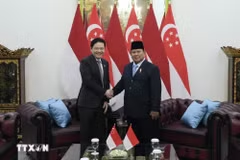
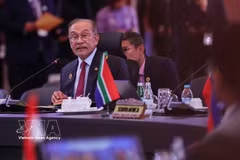
Indonesian President Prabowo Subianto (R) welcomes Singaporean Prime Minister Lawrence Wong in Jakarta on July 6. (Photo: VNA)

Indonesia, Singapore deepen comprehensive cooperation

Indonesia and Singapore signed 26 cooperation agreements, including 18 government-to-government agreements and eight business ones. The deals focus on emerging drivers of bilateral cooperation, including trade, investment, energy, the digital economy, cybersecurity, food supply chain development, environmental cooperation and carbon trading.

An Aedes aegypti mosquito. (Photo: Xinhua/VNA)

Malaysia's dengue-related deaths rise nearly 70% in first half of 2026

Health authorities attributed the increase partly to a shift in the dominant dengue virus strain from DENV-2 to DENV-3. Rapid urbanisation, favourable weather conditions, mosquito breeding sites and increased population mobility have also contributed to the spread of the disease.

Malaysia targets 50% cut in food imports by 2050

Malaysia targets 50% cut in food imports by 2050

Malaysia has set a target of reducing its reliance on imported food by 50% by 2050 as part of efforts to strengthen national food security. The goal comes as the country's annual food import bill has reached around 80 billion MYR (20 billion USD).

Statistics show that Malaysia records GDP growth of 5.4% in the first quarter, while research organisations forecast growth of 4.6–4.9% in the second quarter. ( Illustrative photo: XINHUA/VNA)

Malaysia's economy projected to grow faster in 2026

Despite the positive outlook, economists cautioned that downside risks remain in the second half of the year, requiring Malaysia to closely monitor geopolitical developments and uncertainties in global trade.

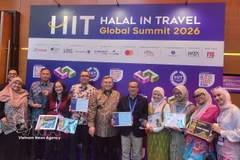
Many travel companies have been granted halal certifications. (Photo: VNA)

Indonesia eyes larger share of global Muslim tourism market by 2030

Indonesia boasts strong advantages in developing the sector as the country is home to 11.3% of the world's Muslim population, 17% of Asia's, and 86% of ASEAN's. Nineteen provinces have Muslim populations exceeding 90%, providing a solid foundation for tailored tourism products.

Electric vehicles produced by Chinese automaker BYD. (Photo: Xinhua/VNA)

Thailand attracts over 4.1 billion USD in EV investment

In 2025, electrified vehicles accounted for more than 44% of new vehicle registrations in Thailand, up sharply from 3% five years earlier. Hybrid vehicles represented 21.8% of new registrations, followed by BEVs at 19.6% and PHEVs at 2.9%.

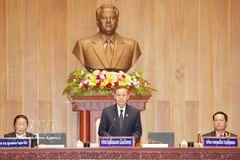
President of the Lao National Assembly Xaysomphone Phomvihane delivers the opening remarks at the first extraordinary session on July 6, 2026. (Photo: VNA)

Laos' 10th National Assembly opens first extraordinary session

The 10th National Assembly of Laos officially opened its first extraordinary session on July 6 in Vientiane, focusing on several key national issues, including the Government's report on the implementation of the national socio-economic development plan, the state budget and monetary policy during the first half of 2026, as well as priorities for the remainder of the year.

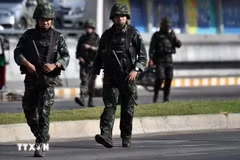
Thailand steps up security in 21 border provinces

Thailand steps up security in 21 border provinces

The Border Security Coordination Centre, chaired by Commander-in-Chief of the Royal Thai Armed Forces Gen. Ukrit Boontanon, has agreed on measures to tackle three pressing security threats along the country's borders: call centre scam syndicates, online gambling, and human trafficking and drug-related crimes.

Singapore, Indonesia work on carbon credits, cross-border trade

Singapore, Indonesia work on carbon credits, cross-border trade

The two countries will collaborate on carbon credits under a memorandum of understanding (MOU) signed on July 6 at the annual Singapore – Indonesia Leaders’ Retreat held in Jakarta, where Singaporean Prime Minister Lawrence Wong met Indonesian President Prabowo Subianto.

FAO helps Laos push chilli exports

FAO helps Laos push chilli exports

Through the FAO-supported initiative, Laos aims to develop a modern chilli pepper industry that complies with international standards, expands exports and raises farmers' incomes.