Philippines earthquake leaves initial casualties, triggers tsunami alerts across region

According to the German Research Centre for Geosciences (GFZ), the earthquake measured 7.8 in magnitude and occurred at a depth of about 10km.

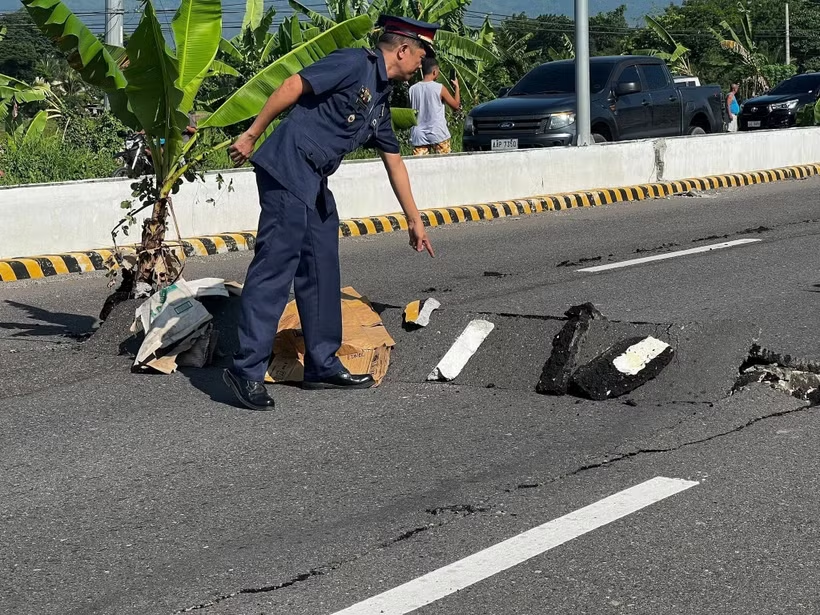
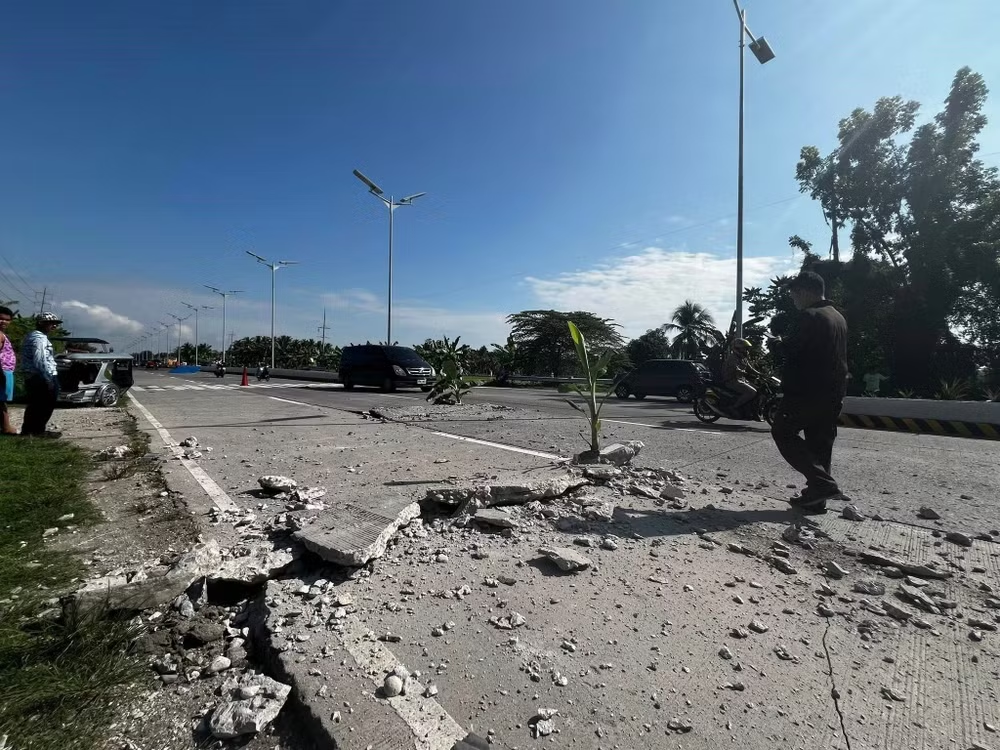
A section of road cracked following the earthquake in South Cotabato province, the Philippines, on June 8, 2026. (Photo: Xinhua/VNA)

Hanoi (VNA) – At least one person was killed and four others injured after a powerful earthquake struck off the coast of Mindanao, south of the Philippines, on the morning of June 8.

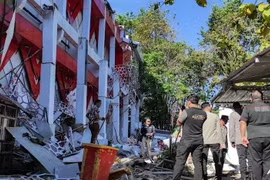
Local police reported that the earthquake damaged numerous structures, with several buildings collapsing. Videos shared on social media showed a shopping mall in General Santos city, Sarangani province, reduced to rubble. A building within a school compound was also reportedly destroyed.

Rescue teams have been deployed to search for survivors while power outages were reported in many affected areas.

According to the German Research Centre for Geosciences (GFZ), the earthquake measured 7.8 in magnitude and occurred at a depth of about 10km.

The Philippine Institute of Volcanology and Seismology (Phivolcs) issued a tsunami warning, saying waves exceeding one metre can affect coastal areas for several hours. The first waves were expected to reach shore between 7:37 am and 9:37 am local time. Authorities urged residents in coastal areas of nine provinces to move to higher ground or evacuate further inland.

Meanwhile, the Pacific Tsunami Warning Centre issued tsunami alerts for a number of coastal areas across the western Pacific. Initial assessments indicated that tsunami waves of up to three metres could strike parts of the Philippines while waves of up to one metre could affect coastal areas of Indonesia and Malaysia. Smaller waves were also forecast for Japan, Taiwan (China), Papua New Guinea and several Pacific island nations.

Authorities across the region advised residents in vulnerable coastal areas to seek higher ground or move inland as a precaution. The US Tsunami Warning System also issued warnings following the earthquake.
potal-dong-dat-o-ngoai-khoi-philippines-khien-it-nhat-5-nguoi-thuong-vong-8811730.jpg
A section of road cracked following the earthquake in South Cotabato province, the Philippines, on June 8, 2026. (Photo: Xinhua/VNA)

The US Geological Survey reported multiple aftershocks following the main quake, including some measuring up to 6.1 in magnitude. Strong tremors were also felt in Indonesia’s North Sulawesi and North Maluku provinces.

The Philippines is among the world's most disaster-prone countries due to its location along the Pacific Ring of Fire, a region characterised by intense seismic and volcanic activity. In addition to frequent tropical storms, the country regularly experiences strong earthquakes and volcanic eruptions.

Mindanao lies near the convergence of several major tectonic plates within the Pacific Ring of Fire, one of the most seismically active zones on the planet./.
VNA

See more

Laos intensifies business environment reforms

The latest Provincial Facilitation for Investment and Trade Index report indicates that since 2018, the public sector has clearly defined timelines for document approval, reducing the time required to establish a business to just 17 days, including 10 days for the issuance of a business registration certificate, five days for seal engraving, and two days for social insurance registration.

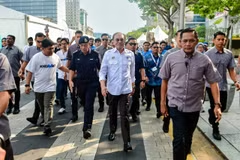
Datuk Seri Anwar Ibrahim attends the National TVET Day 2026 celebration at Dataran Putrajaya today. (Photo: Bernama)

Malaysia strengthens vocational training in technology and energy sectors

Malaysia is ramping up technical and vocational education and training (TVET) as a cornerstone of its economic transformation and talent development strategy, preparing its workforce for emerging fields such as artificial intelligence (AI), cryptocurrency technology and the global energy transition.

Indonesia eyes trade breakthrough with EAEU via FTA

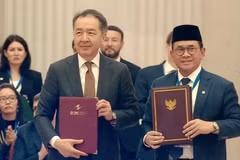
Indonesia eyes trade breakthrough with EAEU via FTA

Indonesia seeks to develop relations with all countries and sees itself as a bridge between different regions of the world. Against a backdrop of growing geopolitical and global economic uncertainty, strengthening international cooperation and building reliable supply chains have become more important than ever.

Thai Prime Minister Anutin Charnvirakul (R) at Nation TV’s 26th anniversary event on June 4, 2026. (Photo: nationthailand.com)

Thailand prioritises OECD accession

Thai Prime Minister Anutin Charnvirakul the country’s bid to join the Organisation for Economic Co-operation and Development, or OECD, is central to the government’s economic agenda.

ASEAN aims to become global digital economy hub

ASEAN aims to become global digital economy hub

Studies indicate that the ASEAN Digital Economy Framework Agreement (DEFA) could help raise ASEAN’s digital economy value to 2 trillion USD by 2030 while transforming the region into a connected, comprehensive and sustainable digital economy hub on the global stage.

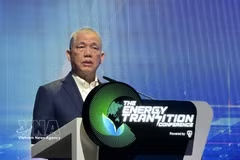
Malaysian Deputy Prime Minister and Minister of Energy Transition and Water Transformation Seri Fadillah Yusof speaks at the Energy Transition Conference 2026 (ETCon26) in Kuala Lumpur on June 3. (Photo: VNA)

Malaysia accelerates energy transition

Malaysian Deputy Prime Minister and Minister of Energy Transition and Water Transformation Seri Fadillah Yusof noted that for both Malaysia and ASEAN, the transition is not only an environmental imperative but also an economic necessity and a strategic priority.

A pregnant woman receives a routine pregnancy check-up at a hospital. (Photo: VNA)

ILO report highlights gaps in maternity benefits across ASEAN

The report calls for extending maternity protection to all women, including workers in the informal economy; strengthening financing mechanisms to ensure sustainability and adequacy of benefits; and aligning maternity protection policies with broader social protection, health and care policies.

President of Timor-Leste José Ramos-Horta (L) at the leadership lecture in Jakarta on June 2 hosted by the ERIA School of Government under the Economic Research Institute for ASEAN and East Asia (ERIA). (Photo: ERIA)

Timor-Leste President shares vision for peacebuilding, ASEAN integration

Drawing on his experience as a diplomat and Nobel Peace Prize laureate, Ramos-Horta cited the reconciliation process between Timor-Leste and Indonesia as a model for peacebuilding. He paid tribute to former Indonesian leaders for their contributions to normalising bilateral ties, stressing that friendship and cooperation ultimately prevailed over past divisions and laid the foundation for Southeast Asia's stability today.

Southeast Asia tourism sustains rebound

Southeast Asia tourism sustains rebound

Indonesia welcomed 4.68 million foreigners in the first four months, an 8.24% hike from a year earlier and the highest tally for the period since the COVID-19 outbreak, its Central Bureau of Statistics said on June 3.