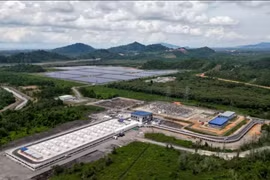
Malaysia allocates over 2.7 billion USD to upgrade nationwide airport network

Malaysia Airports Holdings Berhad (MAHB) plans to invest about 11 billion MYR (over 2.7 billion USD) over the next five years to expand capacity and upgrade infrastructure across its airport network nationwide.

Kuala Lumpur (VNA) – Malaysia Airports Holdings Berhad (MAHB) plans to invest about 11 billion MYR (over 2.7 billion USD) over the next five years to expand capacity and upgrade infrastructure across its airport network nationwide.

The airport operator on June 4 announced this during its inaugural procurement and project showcase, a new recurring industry engagement platform aimed at strengthening ecosystem readiness ahead of a growing pipeline of airport development projects nationwide.

Managing director of MAHB Datuk Mohd Izani Ghani said the industry ecosystem must keep pace as airport infrastructure projects become increasingly large and complex.

He said this platform offers players operating in the industry better insight into future project opportunities, allowing them to plan ahead, invest in capacity building and position themselves for upcoming developments.

At the same time, MAHB benefits from a more prepared and capable ecosystem that can support faster, safer, and higher-quality project delivery, he said.

Regarding the capacity expansion and future growth segment, the showcase highlighted several key infrastructure developments, including the development plan of Kuala Lumpur International Airport (KLIA). The plan outlines a KLIA long-term expansion strategy to increase the airport’s capacity to more than 100 million passengers annually.

It also featured the expansion of Penang International Airport, which will raise terminal capacity from 6.5 million to 12 million passengers annually.

The proposed upgrading and expansion works at Kota Kinabalu International Airport (KKIA) will increase capacity to 12 million passengers from nine million annually, supporting Sabah's continued development as a regional gateway.

MAHB chief development officer Steven Andersen said the initiative aims to strengthen alignment between project planning, delivery capabilities and long-term industry development./.
VNA

See more

ASEAN aims to become global digital economy hub

ASEAN aims to become global digital economy hub

Studies indicate that the ASEAN Digital Economy Framework Agreement (DEFA) could help raise ASEAN’s digital economy value to 2 trillion USD by 2030 while transforming the region into a connected, comprehensive and sustainable digital economy hub on the global stage.

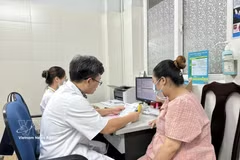
A pregnant woman receives a routine pregnancy check-up at a hospital. (Photo: VNA)

ILO report highlights gaps in maternity benefits across ASEAN

The report calls for extending maternity protection to all women, including workers in the informal economy; strengthening financing mechanisms to ensure sustainability and adequacy of benefits; and aligning maternity protection policies with broader social protection, health and care policies.

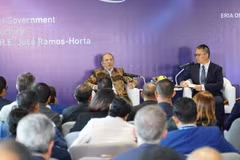
President of Timor-Leste José Ramos-Horta (L) at the leadership lecture in Jakarta on June 2 hosted by the ERIA School of Government under the Economic Research Institute for ASEAN and East Asia (ERIA). (Photo: ERIA)

Timor-Leste President shares vision for peacebuilding, ASEAN integration

Drawing on his experience as a diplomat and Nobel Peace Prize laureate, Ramos-Horta cited the reconciliation process between Timor-Leste and Indonesia as a model for peacebuilding. He paid tribute to former Indonesian leaders for their contributions to normalising bilateral ties, stressing that friendship and cooperation ultimately prevailed over past divisions and laid the foundation for Southeast Asia's stability today.

Southeast Asia tourism sustains rebound

Southeast Asia tourism sustains rebound

Indonesia welcomed 4.68 million foreigners in the first four months, an 8.24% hike from a year earlier and the highest tally for the period since the COVID-19 outbreak, its Central Bureau of Statistics said on June 3.

 Indonesia replaces free school meal programme chief after food poisoning scandals

Indonesia replaces free school meal programme chief after food poisoning scandals

The free meal initiative forms part of Indonesia’s broader effort to tackle chronic malnutrition, with more than 20% of children in the country still affected by stunting caused by inadequate nutrition. Jakarta’s long-term goal is to provide meals to around 82.9 million children, pregnant women and breastfeeding mothers, equivalent to more than 30% of the national population.

SAANSOOK application supports holistic health management and promotes workplace wellness to help reduce non-communicable diseases among working-age people. (Photo: SAANSOOK)

Thailand launches AI-powered tool to combat non-communicable diseases

Developed under the “DOPA” strategy – Data, Outcomes, Partners and AI-driven, the SAANSOOK application tracks four key health behaviours: eating, sleeping, exercising and relaxation. It encourages users to adopt healthier lifestyles through challenges and rewards aimed at sustaining long-term behavioural change.

Indonesia moves to diversify tourism investment flows

Indonesia moves to diversify tourism investment flows

Tourism Minister Widiyanti Putri Wardhana stressed that Indonesia is not just Bali, it has numerous top destinations with vast tourist and investment potential, which are waiting for responsible and sustainable development efforts.

Biodiesel – Malaysia’s energy security buffer: Expert

Biodiesel – Malaysia’s energy security buffer: Expert

Malaysia has officially increased the biodiesel blending mandate in Peninsular Malaysia from B10 to B15. Under the new policy, diesel sold on the domestic market contains 15% biofuel and 85% petroleum-based diesel, economist and international relations expert, senior adviser at Global Asia Consulting Samirul Ariff Othman told the Vietnam News Agency's correspondent in Kuala Lumpur.