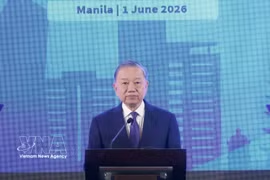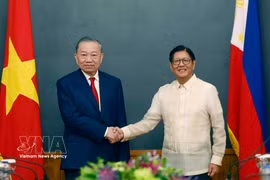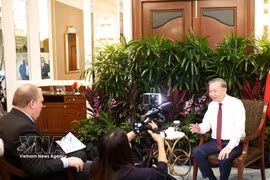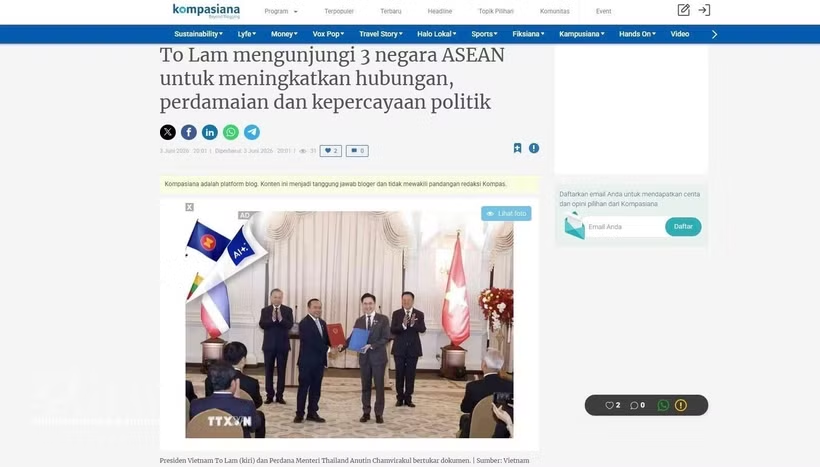
Jakarta (VNA) – Indonesian newspaper Kompasiana has described General Secretary of the Communist Party of Vietnam Central Committee and State President To Lam’s recent visits to Thailand, Singapore and the Philippines as a significant diplomatic move that contributes to promoting peace, strengthening political trust and expanding economic cooperation in ASEAN.
The tour reflected not only Vietnam’s foreign policy orientation in a new stage of development but also the country’s increasingly proactive, practical and results-oriented approach to diplomacy, according to a commentary published by the site on June 3.
The article noted that the top Vietnamese leader’s engagements in the three countries underscored the growing role of high-level diplomacy in shaping strategic directions for bilateral relations, and laid foundations for long-term cooperation between Vietnam and its regional partners.
Kompasiana highlighted the warm and high-level receptions accorded to General Secretary and President Lam in all three countries as evidence of Vietnam’s rising standing within ASEAN. His meetings and talks with the leaders of Thailand, Singapore and the Philippines opened up new avenues for cooperation at a time when all four nations are entering new development phases and adapting to an increasingly complex regional and international environment.
According to the article, one of the most notable outcomes was Vietnam’s continued efforts to elevate and deepen relations with key ASEAN partners. Vietnam and Thailand advanced their Comprehensive Strategic Partnership through long-term cooperation orientations, while ties with Singapore were strengthened through the establishment of a strategic dialogue mechanism between the two ruling parties. Meanwhile, relations between Vietnam and the Philippines were upgraded to an Enhanced Strategic Partnership.
The article also highlighted agreements to establish new cooperation mechanisms aimed at reinforcing political trust and creating frameworks for more substantive collaboration in the future. These include the Action Programme for implementing the Vietnam–Thailand Comprehensive Strategic Partnership for the 2026–2031 period and the Strategic Dialogue mechanism between the Communist Party of Vietnam and Singapore’s People’s Action Party.
In addition, the newspaper praised business connectivity and innovation-related activities conducted during the visits, viewing them as important steps toward expanding economic cooperation and fostering new growth opportunities.
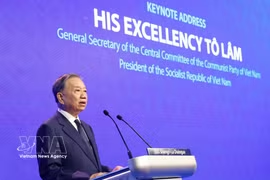
One aspect of the trip that received particular attention was the top Vietnamese leader’s keynote address at the 23rd Shangri-La Dialogue in Singapore, one of the Asia-Pacific region’s premier security and defence forums, which brought together around 500 delegates from more than 40 countries.
According to Kompasiana, a central message of the speech was the call for greater dialogue, confidence-building and respect for international law as means of preventing conflicts. The Vietnamese leader stressed the need to develop more effective consultation, mediation and crisis-management mechanisms, and expand confidence-building initiatives among defence, security and maritime law enforcement agencies, as well as academic and business communities.
The article said Vietnam’s views at the dialogue clearly reflected its approach to contemporary security challenges, emphasising preventive diplomacy, regional cooperation and the role of international law in maintaining peace and stability.
Particular attention was also given to Vietnam’s emphasis on ASEAN centrality. The Indonesian newspaper described the message as especially relevant at a time of intensifying strategic competition in the region, arguing that ASEAN’s central role can only be sustained through unity, strategic autonomy and the capacity to shape a common regional agenda.
The article concluded that these visits helped communicate Vietnam’s development vision, strategic priorities and foreign policy orientations more clearly to regional partners, while conveying the message that Vietnam remains committed to working with countries both within and beyond the region to strengthen trust, promote dialogue, enhance cooperation and contribute to a peaceful, stable and sustainable Asia-Pacific region./.
See more
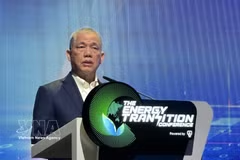
Malaysia accelerates energy transition
Malaysian Deputy Prime Minister and Minister of Energy Transition and Water Transformation Seri Fadillah Yusof noted that for both Malaysia and ASEAN, the transition is not only an environmental imperative but also an economic necessity and a strategic priority.
ILO report highlights gaps in maternity benefits across ASEAN
The report calls for extending maternity protection to all women, including workers in the informal economy; strengthening financing mechanisms to ensure sustainability and adequacy of benefits; and aligning maternity protection policies with broader social protection, health and care policies.
E-commerce boom puts pressure on Malaysia’s transport infrastructure
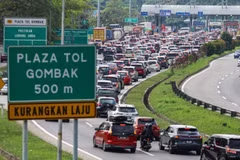
The surge in online shopping in Malaysia has significantly increased freight movement nationwide, particularly during weekends and holiday periods when logistics operators must meet rising demand for fast deliveries in the digital economy.
Thailand welcomes over 14 million foreign visitors in five months
China remained Thailand’s largest source market in the first five months with 2.32 million visitors, followed by Malaysia with 1.74 million, India 1.06 million, Russia 946,732 and the Republic of Korea 539,848.
Timor-Leste President shares vision for peacebuilding, ASEAN integration
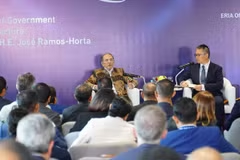
Drawing on his experience as a diplomat and Nobel Peace Prize laureate, Ramos-Horta cited the reconciliation process between Timor-Leste and Indonesia as a model for peacebuilding. He paid tribute to former Indonesian leaders for their contributions to normalising bilateral ties, stressing that friendship and cooperation ultimately prevailed over past divisions and laid the foundation for Southeast Asia's stability today.
Southeast Asia tourism sustains rebound
Indonesia welcomed 4.68 million foreigners in the first four months, an 8.24% hike from a year earlier and the highest tally for the period since the COVID-19 outbreak, its Central Bureau of Statistics said on June 3.
Former Thai Prime Minister Thaksin Shinawatra granted royal pardon
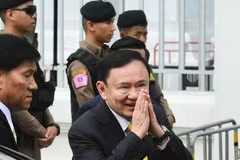
Thaksin was released from Khlong Prem Central Prison on May 11 after serving two-thirds of his one-year prison sentence.
Indonesia replaces free school meal programme chief after food poisoning scandals
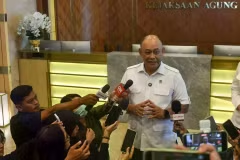
The free meal initiative forms part of Indonesia’s broader effort to tackle chronic malnutrition, with more than 20% of children in the country still affected by stunting caused by inadequate nutrition. Jakarta’s long-term goal is to provide meals to around 82.9 million children, pregnant women and breastfeeding mothers, equivalent to more than 30% of the national population.
Thailand launches AI-powered tool to combat non-communicable diseases
Developed under the “DOPA” strategy – Data, Outcomes, Partners and AI-driven, the SAANSOOK application tracks four key health behaviours: eating, sleeping, exercising and relaxation. It encourages users to adopt healthier lifestyles through challenges and rewards aimed at sustaining long-term behavioural change.
Indonesia moves to diversify tourism investment flows
Tourism Minister Widiyanti Putri Wardhana stressed that Indonesia is not just Bali, it has numerous top destinations with vast tourist and investment potential, which are waiting for responsible and sustainable development efforts.
Biodiesel – Malaysia’s energy security buffer: Expert
Malaysia has officially increased the biodiesel blending mandate in Peninsular Malaysia from B10 to B15. Under the new policy, diesel sold on the domestic market contains 15% biofuel and 85% petroleum-based diesel, economist and international relations expert, senior adviser at Global Asia Consulting Samirul Ariff Othman told the Vietnam News Agency's correspondent in Kuala Lumpur.
Thailand pushes end-of-life vehicle recycling project
The ELV project aligns with Thailand's bio-, circular and green (BCG) economic development model, promoted by Industry Minister Varawut Silpa-archa.
Malaysian airlines adjust operations amid rising cost pressures
Chief executive officer AirAsia X Bo Lingam acknowledged that the industry continues to face substantial cost pressures stemming from higher global fuel prices and supply chain disruptions.
ASEAN+3 economies face twin pressures from oil prices, supply chain disruptions
If Brent crude oil prices average 125 USD per barrel in 2026, compared with a baseline forecast of 95 USD, and supply chain disruptions intensify, ASEAN+3 economic growth could slow sharply to 2.5% while inflation could rise to 3.5%.
India, Myanmar strengthen cooperation in security, connectivity and trade
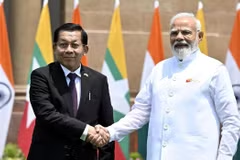
Indian Prime Minister Narendra Modi held talks with Myanmar President U Min Aung Hlaing on June 1 as part of the latter’s five-day visit to India, aimed at advancing bilateral relations in security, defence, trade, connectivity, energy and emerging technologies.
Malaysia’s economy faces growing pressure from supply chain disruptions
According to a report by the Southeast Asian Futures Initiative Centre (Seafic), a total of 106 types of Malaysian imports pass through this strategic maritime chokepoint, ranging from essential energy supplies to manufacturing inputs and consumer food products.
Indonesia earmarks 71.3 billion USD for mega solar power project
Indonesian President Prabowo Subianto set a target of developing 100 GW of solar power between 2026 and 2028.
Indonesia: Major fire breaks out in densely populated area of Jakarta
Authorities are investigating the cause of the fire. No casualties have been reported so far.
Indonesia tightens control over e-cigarettes
The head of Indonesia's Food and Drug Agency (BPOM), Taruna Ikrar, warned that the country is facing an "emergency" related to youth smoking and e-cigarette use. According to the agency, the smoking rate among children and adolescents has reached 7.4%, equivalent to more than 5 million minors nationwide.
Malaysia tightens public spending to channel savings into public welfare programmes
PM Anwar Ibrahim stressed that prudent spending and sound financial management are essential to safeguarding Malaysia’s fiscal stability and preventing future difficulties.