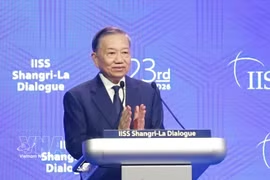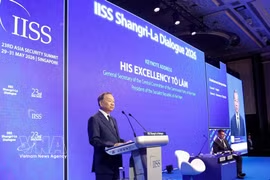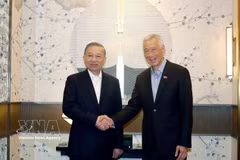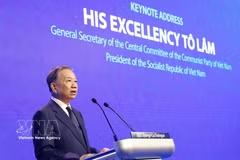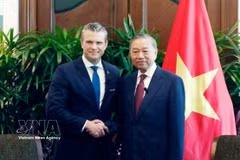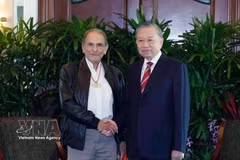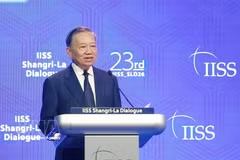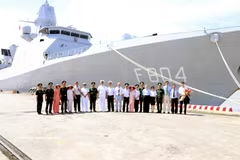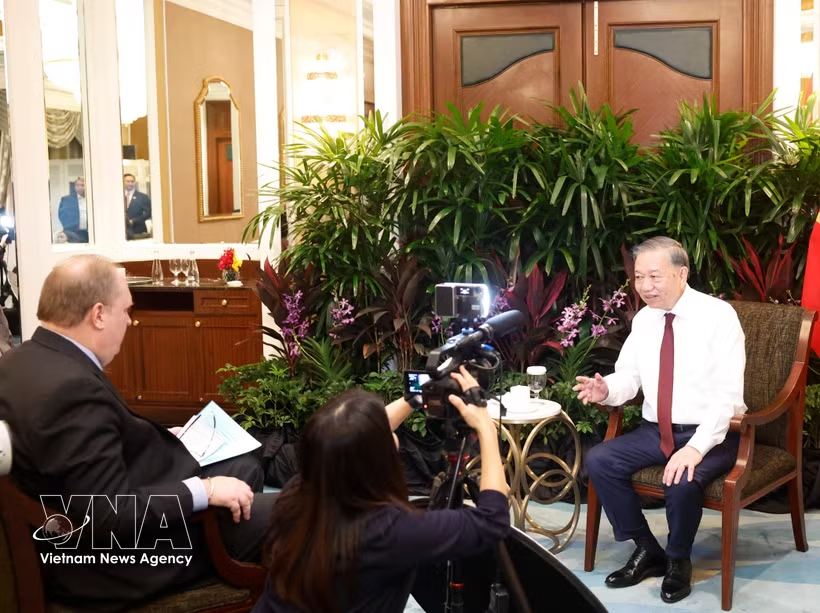
Singapore (VNA) - Vietnam maintains good relations with major powers in order to jointly address important and essential issues, affirmed General Secretary of the Communist Party of Vietnam Central Committee and State President To Lam in his first interview to international media in his current position.
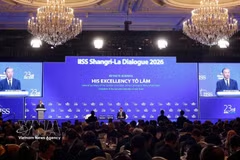
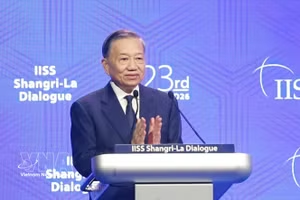
In an interview with Reuters on the sidelines of the 23rd Shangri-La Dialogue in Singapore, General Secretary and State President To Lam emphasised that Vietnam’s policy is not to cooperate with one country in a manner that harms or creates difficulties for another.
Regarding US-China relations, he noted that competition among major powers is an objective reality. Vietnam neither views its relations with major powers through a security lens nor aligns itself with any particular side. Therefore, it has maintained and continues to maintain good relations with both the US and China, bringing benefits to all parties while contributing to regional peace and stability.
Regarding relations with China specifically, he affirmed that Vietnam and China are neighbouring countries with a long-standing and close relationship. Currently, the two countries are implementing substantive cooperation across many important areas. Vietnam’s policy is to continue fostering fine relations with China, as China possesses all the characteristics of a priority partner in Vietnam’s foreign policy: a neighbouring country, an important partner, and a nation that shares numerous common interests and similarities with Vietnam.
According to General Secretary and State President To Lam, maintaining peaceful, stable, and cooperative relations with China not only benefits both countries but also makes an important contribution to regional peace and stability.
Regarding the East Sea (or South China Sea) issue, the Vietnamese leader reaffirmed Vietnam’s clear and consistent position of firmly safeguarding its sovereignty and territorial integrity, while advocating for the peaceful settlement of disputes based on international law, particularly the 1982 United Nations Convention on the Law of the Sea (UNCLOS). He emphasised that maintaining good relations with China, protecting sovereignty, and addressing issues in the East Sea are complementary objectives rather than mutually exclusive ones.
When asked about Vietnam’s goal of achieving double-digit economic growth, General Secretary and State President To Lam stated that the country’s aspiration for development is shared by the entire nation. Vietnam has clearly defined its objective of becoming a developed, high-income country by 2045. This goal was established many years ago and has been consistently reaffirmed, including in the Political Report presented at the 14th National Congress of the Communist Party of Vietnam.
According to the top leader of Vietnam, both international experience and development rules indicate that to become a developed, high-income country by 2045, Vietnam must sustain a double-digit growth rate, meaning at least 10% annually. This target has been carefully studied and considered. Vietnam fully recognises that it is highly ambitious and challenging. Nevertheless, driven by a strong commitment to achieving it, the country has been implementing a range of important practical measures.
He noted that Vietnam has reassessed its national capabilities and redefined its development and growth model. This model must be built on the foundations of self-reliance, resilience, and strategic autonomy. Vietnam has reviewed all resources available for development, providing a solid basis for optimism.
According to the General Secretary and State President, confidence stems from the strong determination of the entire political system: the firm commitment of the Party and the State, broad public consensus, and the active participation of businesses, manufacturers, the private sector, workers, and farmers. Vietnamese society has demonstrated significant consensus regarding this ambitious objective.
He further said that when the target was initially set, Vietnam had not yet faced some of the challenges that exist today. However, many difficulties had already been anticipated, including global political instability, economic challenges worldwide, supply chain disruptions, energy pressures, and fluctuations in international markets. Despite these obstacles, the country remains optimistic based on its development trajectory in recent years.
According to the leader, Vietnam has introduced numerous new measures and is building a new development and growth model for the current period. This model is based on high-quality human resources, the strengths of the Vietnamese people, self-reliance, resilience, innovation, science and technology, and digital transformation.
Vietnam has carefully studied the development experiences of successful countries and translated those lessons into concrete policies. At the same time, the country is reviewing its institutional framework, identifying bottlenecks, and implementing necessary reforms to remove barriers to growth and better serve its long-term development objectives.
The results achieved in 2025, and particularly during the first six months of 2026, demonstrate that despite remaining challenges and the need for certain adjustments, the core objectives remain within reach.
When asked whether Vietnam would adjust its growth target, General Secretary and State President To Lam firmly stated that Vietnam would not revise the target downward. The country remains committed not only to its 2026 growth objective but also to sustaining that growth trajectory in the years ahead, as this is essential for achieving its development milestones.
He stressed that Vietnam’s vision extends beyond 2045. The country is planning not only for its100th founding anniversary but also for the century of development that follows, with even greater aspirations in the future./.
VNA