US, Philippines deepen cooperation on disaster response, cybersecurity

The "Exercise Tempest 41-2026" officially commenced on June 5 under the framework of the Multinational Planning Augmentation Team (MPAT) Programme. The exercise aims to enhance coordination capabilities in humanitarian assistance and disaster relief operations.

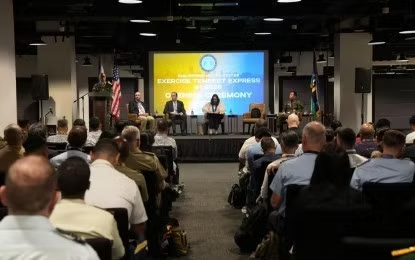
The Armed Forces of the Philippines, the United States Indo-Pacific Command and other participating nations during the opening ceremony of Exercise Tempest Express 41-2026 at Manila Marriott Hotel in Pasay City on June 3, 2026. The disaster response drills will run until June 11. (Photo courtesy of AFP)

Hanoi (VNA) – The Armed Forces of the Philippines (AFP) and the US Indo-Pacific Command (USINDOPACOM) are strengthening cooperation in disaster response and cybersecurity through a series of joint exercises, as the region continues to face frequent natural disasters and increasingly complex non-traditional security challenges.

The "Exercise Tempest 41-2026" officially commenced on June 5 under the framework of the Multinational Planning Augmentation Team (MPAT) Programme. The exercise aims to enhance coordination capabilities in humanitarian assistance and disaster relief operations.

AFP Public Affairs Office chief Colonel Xerxes Trinidad said the exercise brings together representatives from 17 MPAT member countries, as well as humanitarian organisations and civilian agencies. Activities focus on crisis response planning, improving interoperability among participating forces and strengthening coordination mechanisms for large-scale natural disasters and emergency situations.

Established in 2000, MPAT seeks to promote military cooperation and crisis response across the Asia-Pacific region. The programme currently includes 31 member countries, including the Philippines, the US, Japan, the Republic of Korea, Singapore, the UK, France, Canada, Germany and New Zealand.

The AFP said that the participation in Tempest 41-2026 is particularly significant as the Philippine military serves as the country's primary force for search and rescue, disaster relief and humanitarian assistance operations. The exercise also supports the Philippine government's comprehensive approach to disaster risk management and reduction.

Colonel Trinidad said the activity demonstrates the AFP's commitment to building sustainable partnerships and enhancing regional cooperation to improve collective preparedness and response capabilities for natural disasters and complex emergencies.

In addition to disaster relief cooperation, the Philippine and US militaries are also expanding collaboration in cybersecurity.

The Philippine Army recently completed a three-week exercise with the US Army Pacific (USARPAC) under Phase 2 of the Salaknib military exercise.

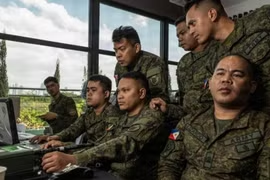
Philippine Army spokesperson Colonel Louie Dema-ala said the CyberEx FTA training programme was conducted from May 12 - 29 in Taguig City, focusing on strengthening cyber defence capabilities, cyber incident investigations, data traffic analysis and responses to simulated cyberattacks.

According to the AFP, the training activities helped enhance the technical expertise and cyber readiness of participating units.

Philippine Army Commander Lieutenant General Antonio Nafarrete said the military is accelerating efforts to modernise its cybersecurity capabilities through system upgrades and personnel training in order to meet the increasingly demanding requirements of the modern security environment./.

VNA

See more

ASEAN aims to become global digital economy hub

ASEAN aims to become global digital economy hub

Studies indicate that the ASEAN Digital Economy Framework Agreement (DEFA) could help raise ASEAN’s digital economy value to 2 trillion USD by 2030 while transforming the region into a connected, comprehensive and sustainable digital economy hub on the global stage.

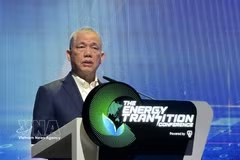
Malaysian Deputy Prime Minister and Minister of Energy Transition and Water Transformation Seri Fadillah Yusof speaks at the Energy Transition Conference 2026 (ETCon26) in Kuala Lumpur on June 3. (Photo: VNA)

Malaysia accelerates energy transition

Malaysian Deputy Prime Minister and Minister of Energy Transition and Water Transformation Seri Fadillah Yusof noted that for both Malaysia and ASEAN, the transition is not only an environmental imperative but also an economic necessity and a strategic priority.

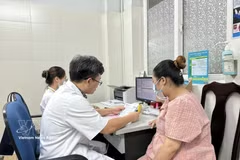
A pregnant woman receives a routine pregnancy check-up at a hospital. (Photo: VNA)

ILO report highlights gaps in maternity benefits across ASEAN

The report calls for extending maternity protection to all women, including workers in the informal economy; strengthening financing mechanisms to ensure sustainability and adequacy of benefits; and aligning maternity protection policies with broader social protection, health and care policies.

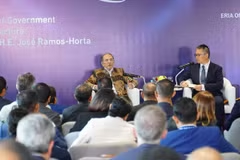
President of Timor-Leste José Ramos-Horta (L) at the leadership lecture in Jakarta on June 2 hosted by the ERIA School of Government under the Economic Research Institute for ASEAN and East Asia (ERIA). (Photo: ERIA)

Timor-Leste President shares vision for peacebuilding, ASEAN integration

Drawing on his experience as a diplomat and Nobel Peace Prize laureate, Ramos-Horta cited the reconciliation process between Timor-Leste and Indonesia as a model for peacebuilding. He paid tribute to former Indonesian leaders for their contributions to normalising bilateral ties, stressing that friendship and cooperation ultimately prevailed over past divisions and laid the foundation for Southeast Asia's stability today.

Southeast Asia tourism sustains rebound

Southeast Asia tourism sustains rebound

Indonesia welcomed 4.68 million foreigners in the first four months, an 8.24% hike from a year earlier and the highest tally for the period since the COVID-19 outbreak, its Central Bureau of Statistics said on June 3.

 Indonesia replaces free school meal programme chief after food poisoning scandals

Indonesia replaces free school meal programme chief after food poisoning scandals

The free meal initiative forms part of Indonesia’s broader effort to tackle chronic malnutrition, with more than 20% of children in the country still affected by stunting caused by inadequate nutrition. Jakarta’s long-term goal is to provide meals to around 82.9 million children, pregnant women and breastfeeding mothers, equivalent to more than 30% of the national population.

SAANSOOK application supports holistic health management and promotes workplace wellness to help reduce non-communicable diseases among working-age people. (Photo: SAANSOOK)

Thailand launches AI-powered tool to combat non-communicable diseases

Developed under the “DOPA” strategy – Data, Outcomes, Partners and AI-driven, the SAANSOOK application tracks four key health behaviours: eating, sleeping, exercising and relaxation. It encourages users to adopt healthier lifestyles through challenges and rewards aimed at sustaining long-term behavioural change.

Indonesia moves to diversify tourism investment flows

Indonesia moves to diversify tourism investment flows

Tourism Minister Widiyanti Putri Wardhana stressed that Indonesia is not just Bali, it has numerous top destinations with vast tourist and investment potential, which are waiting for responsible and sustainable development efforts.

Biodiesel – Malaysia’s energy security buffer: Expert

Biodiesel – Malaysia’s energy security buffer: Expert

Malaysia has officially increased the biodiesel blending mandate in Peninsular Malaysia from B10 to B15. Under the new policy, diesel sold on the domestic market contains 15% biofuel and 85% petroleum-based diesel, economist and international relations expert, senior adviser at Global Asia Consulting Samirul Ariff Othman told the Vietnam News Agency's correspondent in Kuala Lumpur.