Singapore, Japan strengthen cooperation in the space sector

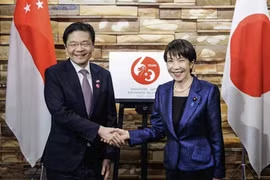
It is the first bilateral space agency agreement between Singapore and Japan, following commitments by Singapore's Prime Minister Lawrence Wong and his Japanese counterpart Sanae Takaichi earlier this year.

Singapore (VNA) – The National Space Agency of Singapore (NSAS) and the Japan Aerospace Exploration Agency (JAXA) signed a Memorandum of Cooperation (MoC) on July 6 to strengthen collaboration in space technology development, research and space exploration.

It is the first bilateral space agency agreement between Singapore and Japan, following commitments by Singapore's Prime Minister Lawrence Wong and his Japanese counterpart Sanae Takaichi earlier this year.

Under the deal, the two agencies will exchange information and explore opportunities for cooperation in areas such as space technology development and applications, space science and exploration, industry development, education, as well as policy and regulatory exchanges.

At the Spacetide 2026 conference in Tokyo, a global platform which brings together key players from various industries, the two agencies also exchanged letters on business and industrial promotion cooperation under the JAXA’s Co-funded Business Promotion Framework (CBPF). Singapore is the third partner country under this framework, after the UK and France.

According to the NSAS, through the CBPF, both agencies will support greater collaboration between Singaporean and Japanese companies and facilitate partnerships in areas of mutual interest.

Another Memorandum of Understanding was signed between Nanyang Technological University and Fusic, a Japanese custom software development company.

They aim to explore how artificial intelligence can assist ground-control teams with routine satellite operations, mission scheduling, ground-station allocation and the early detection of technical problems./.
VNA

See more

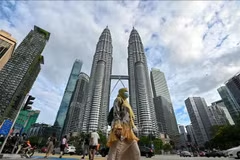
Statistics show that Malaysia records GDP growth of 5.4% in the first quarter, while research organisations forecast growth of 4.6–4.9% in the second quarter. ( Illustrative photo: XINHUA/VNA)

Malaysia's economy projected to grow faster in 2026

Despite the positive outlook, economists cautioned that downside risks remain in the second half of the year, requiring Malaysia to closely monitor geopolitical developments and uncertainties in global trade.

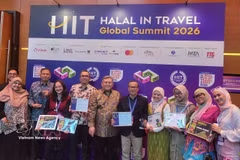
Many travel companies have been granted halal certifications. (Photo: VNA)

Indonesia eyes larger share of global Muslim tourism market by 2030

Indonesia boasts strong advantages in developing the sector as the country is home to 11.3% of the world's Muslim population, 17% of Asia's, and 86% of ASEAN's. Nineteen provinces have Muslim populations exceeding 90%, providing a solid foundation for tailored tourism products.

Electric vehicles produced by Chinese automaker BYD. (Photo: Xinhua/VNA)

Thailand attracts over 4.1 billion USD in EV investment

In 2025, electrified vehicles accounted for more than 44% of new vehicle registrations in Thailand, up sharply from 3% five years earlier. Hybrid vehicles represented 21.8% of new registrations, followed by BEVs at 19.6% and PHEVs at 2.9%.

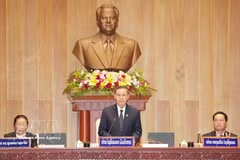
President of the Lao National Assembly Xaysomphone Phomvihane delivers the opening remarks at the first extraordinary session on July 6, 2026. (Photo: VNA)

Laos' 10th National Assembly opens first extraordinary session

The 10th National Assembly of Laos officially opened its first extraordinary session on July 6 in Vientiane, focusing on several key national issues, including the Government's report on the implementation of the national socio-economic development plan, the state budget and monetary policy during the first half of 2026, as well as priorities for the remainder of the year.

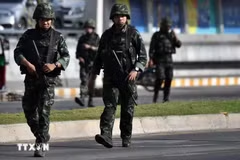
Thailand steps up security in 21 border provinces

Thailand steps up security in 21 border provinces

The Border Security Coordination Centre, chaired by Commander-in-Chief of the Royal Thai Armed Forces Gen. Ukrit Boontanon, has agreed on measures to tackle three pressing security threats along the country's borders: call centre scam syndicates, online gambling, and human trafficking and drug-related crimes.

Singapore, Indonesia work on carbon credits, cross-border trade

Singapore, Indonesia work on carbon credits, cross-border trade

The two countries will collaborate on carbon credits under a memorandum of understanding (MOU) signed on July 6 at the annual Singapore – Indonesia Leaders’ Retreat held in Jakarta, where Singaporean Prime Minister Lawrence Wong met Indonesian President Prabowo Subianto.

FAO helps Laos push chilli exports

FAO helps Laos push chilli exports

Through the FAO-supported initiative, Laos aims to develop a modern chilli pepper industry that complies with international standards, expands exports and raises farmers' incomes.

Malaysia, Singapore to introduce digital immigration system

Malaysia, Singapore to introduce digital immigration system

Malaysian Prime Minister Anwar Ibrahim said the initiative will be launched jointly with his Singaporean counterpart, Lawrence Wong, once all technical preparations and infrastructure have been completed. The new system will feature more advanced movement procedures to facilitate travel between Singapore and Johor.

​

India pushes for upgrade of ASEAN-India trade pact

The upgrade of the ASEAN-India Trade in Goods Agreement requires consensus among all ASEAN members. New Delhi is maintaining regular dialogue with regional partners to advance the negotiations while continuing to strengthen bilateral ties with individual ASEAN countries.

Thailand, Kazakhstan upgrade ties to strategic partnership

Thailand, Kazakhstan upgrade ties to strategic partnership

Thai Deputy Prime Minister and Foreign Minister Sihasak Phuangketkeow said Kazakhstan serves as a gateway to Central Asia while Thailand plays a similar role in ASEAN, creating new opportunities for trade and regional supply chains.

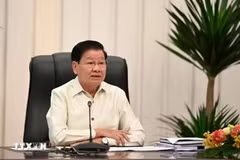
Party General Secretary and President of Laos Thongloun Sisoulith (Photo: VNA)

Laos intensifies anti-corruption campaign

Party General Secretary and President of Laos Thongloun Sisoulith said inspection work should go beyond recognising good practices to uncovering shortcomings, misconduct and law violations, while fully assessing the losses caused to the State, organisations, individuals and the legitimate interests of citizens.