Thailand, Kazakhstan upgrade ties to strategic partnership

Thai Deputy Prime Minister and Foreign Minister Sihasak Phuangketkeow said Kazakhstan serves as a gateway to Central Asia while Thailand plays a similar role in ASEAN, creating new opportunities for trade and regional supply chains.

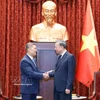
Hanoi (NNT/VNA) – Thai Deputy Prime Minister and Foreign Minister Sihasak Phuangketkeow recently met with Kazakh President Kassym-Jomart Tokayev during an official visit to Kazakhstan, where the two countries agreed to elevate bilateral ties to a strategic partnership.

The talks covered economic development, trade, investment, security, and other areas of long-term cooperation.

Sihasak said Kazakhstan serves as a gateway to Central Asia while Thailand plays a similar role in ASEAN, creating new opportunities for trade and regional supply chains.

He also pointed to Kazakhstan's location along the Trans-Caspian International Transport Corridor, saying it could help Thailand expand exports into Central Asia, Europe, and other nearby markets. Kazakhstan's population of about 20 million, combined with relatively high purchasing power, also offers opportunities for Thai exporters.

Thai businesses are showing growing interest in Kazakhstan, especially in the food industry, where the country could serve as a manufacturing and distribution hub for Central Asia, Russia, and Europe. Thailand's hospitality, spa, and wellness sectors are also receiving interest from Kazakhstan's expanding middle- and upper-income market.

The two sides also discussed cooperation in energy and mineral resources, including Thailand's interest in importing rare earth minerals and other materials used in electric vehicle and battery production.

Sihasak said closer economic relations with Kazakhstan would help diversify Thailand's export markets, reduce reliance on traditional trading partners, and create new opportunities for Thai businesses./.
VNA

See more

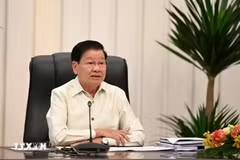
Party General Secretary and President of Laos Thongloun Sisoulith (Photo: VNA)

Laos intensifies anti-corruption campaign

Party General Secretary and President of Laos Thongloun Sisoulith said inspection work should go beyond recognising good practices to uncovering shortcomings, misconduct and law violations, while fully assessing the losses caused to the State, organisations, individuals and the legitimate interests of citizens.

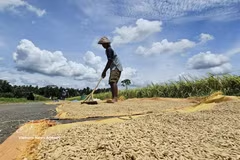
An Indonesian farmer is sun-drying paddy. (Photo: VNA)

Indonesia aims to create up to 3.5 million jobs in 2027

The employment target is aligned with the Indonesian government's goals of achieving economic growth of 5.8–6.5%, increasing the rate of formal employment to 40.81%, and lowering the unemployment rate to 4.3–4.87% in 2027.

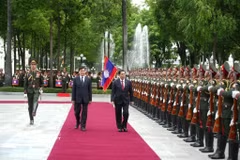
Lao President Thongloun Sisoulith (left) and Myanmar President Min Aung Hlaing inspect the guard of honour of the Lao People's Army at the welcome ceremony for the latter in Vientiane on July 3, 2026. (Photo: VNA)

Laos, Myanmar pledge to deepen bilateral cooperation

The Lao and Myanmar Presidents expressed satisfaction with the steady development of the traditional friendship and cooperation between their countries, highlighting strong political ties, high-level mutual trust, effective mutual support, and frequent mutual visits by high-ranking leaders.

(Photo: skytraxratings.com)

Thailand tightens airport anti-drug measures after smuggling case

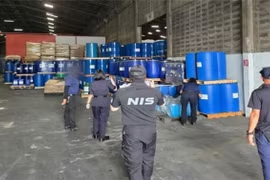
Deputy Minister of Transport Phattrapong Phattraprasit said he had instructed Air Chief Marshal Manat Chavanaprayoon, Director-General of the Civil Aviation Authority of Thailand (CAAT), to urgently coordinate with relevant agencies to strengthen controls against drug smuggling on international flights.

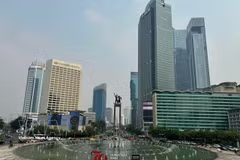
Bundaran HI roundabout, a landmark in central Jakarta, is highlighted by the iconic Selamat Datang Monument. (Photo: VNA)

Indonesia moves closer to CPTPP membership

CPTPP member states agreed to launch the discussion process for Indonesia, the Philippines and the United Arab Emirates (UAE) during the agreement's 10th commission meeting, held virtually on June 26.

Thailand pilots low-carbon rice farming model

Thailand pilots low-carbon rice farming model

The initiative aims to establish an environmentally friendly rice production system that lowers production costs while increasing farmers’ incomes through the sale of high-quality rice and the generation of carbon credits.

Malaysia seeks sovereign cloud to safeguard national data

Malaysia seeks sovereign cloud to safeguard national data

Malaysia will establish secure, firewall-protected storage systems for sensitive national security information and citizens' personal data to protect national interest as the US' Cloud Act allows companies established in the US to penetrate and get all the data from countries where they invest

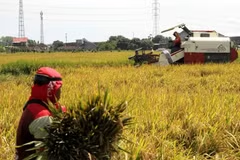
Farmers harvest rice in a paddy field in Central Java, Indonesia. (Photo: Xinhua/VNA)

Indonesia eyes global markets for transmigration products

Alongside expanding export markets, Indonesia is focusing on developing processing industries and increasing the added value of agricultural products from transmigration areas rather than exporting raw materials. The strategy is expected to improve local incomes and support sustainable economic development.

(Photo: thailandpolicylab.com)

Thailand moves to boost digital government

According to the Department of Business Development (DBD) under the Ministry of Commerce, all registrations for newly established partnerships and companies must now be completed through the DBD Biz Regist online platform.

(Illustrative photo: VNA)

Data centre power demand in Peninsular Malaysia predicted to reach 31% by 2035

The rapid growth of artificial intelligence (AI) and data centre industries will also drive a sharp increase in peak electricity demand, an official noted, adding that peak demand in Peninsular Malaysia is projected to grow at a compound annual growth rate of 5.1% between 2026 and 2035, rising from 21.3 GW in 2026 to 33.5 GW by 2035.

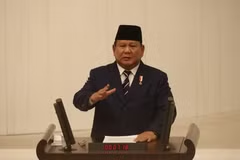
Indonesian President Prabowo Subianto (Photo: Xinhua/VNA)

Indonesia increases funding for research, innovation

The Indonesian government is seeking to shift toward a more integrated research model, linking science and technology programmes directly with national development priorities, including food and energy self-sufficiency, industrialisation and downstream development.