Malaysia to convert coal-fired power plants into renewable energy hubs

Malaysia remains committed to building no new coal-fired power plants, toward phasing out coal-fired electricity generation by 2044 and increasing the share of renewable energy to 70% of the country's installed power generation capacity by 2050.

Kuala Lumpur (VNA) – Malaysia plans to repurpose sites of retiring coal-fired power plants into renewable energy (RE) hubs and battery energy storage facilities to support its power sector's emissions reduction roadmap.

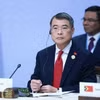
Malaysia's Deputy Prime Minister Datuk Seri Fadillah Yusof said on July 2 that the country's existing coal-fired power plants represent significant national infrastructure, including transmission connections, industrial facilities and strategically located land.

Addressing the closing session of an in-depth discussion titled "Malaysia's Energy Future: Power Sector Decarbonisation Deep Dive", organised by the World Economic Forum, Fadillah emphasised that these assets should not be left idle when coal-fired power plants cease operations, but instead should be viewed as opportunities to create new economic value.

According to the official, several sites have strong potential to be transformed into renewable energy hubs, battery energy storage facilities and other clean energy projects, enabling them to continue contributing to local economic development while supporting the country's energy transition goals. He said the retirement of coal-fired power plants would create opportunities for new industries, attract investment and prepare the workforce for the future economy.

He added that Malaysia remains committed to building no new coal-fired power plants, toward phasing out coal-fired electricity generation by 2044 and increasing the share of renewable energy to 70% of the country's installed power generation capacity by 2050.

The Deputy Prime Minister stressed that renewable energy development must precede the phase-out of coal to avoid replacing dependence on coal with greater reliance on imported liquefied natural gas (LNG). Otherwise, Malaysia could face greater exposure to fuel price volatility and external geopolitical uncertainties.

To support the transition, the Ministry of Energy Transition and Water Transformation continues to prioritise the development of large-scale solar power projects, renewable energy supply mechanisms for businesses, battery energy storage systems and smart grid modernisation.

Regarding regional cooperation, Fadillah reaffirmed Malaysia's commitment to advancing the ASEAN Power Grid initiative and expanding cross-border electricity trade to strengthen regional energy security and facilitate greater integration of renewable energy./.


VNA

See more

Indonesian President Prabowo Subianto (Photo: Xinhua/VNA)

Indonesia increases funding for research, innovation

The Indonesian government is seeking to shift toward a more integrated research model, linking science and technology programmes directly with national development priorities, including food and energy self-sufficiency, industrialisation and downstream development.

The screenshot of the article on the French online magazine Journal des Français à l'étranger. (Photo: VNA)

French journal dubs Da Nang the "Miami of Vietnam"

With its strategic location, affordable living costs, strong digital infrastructure and high quality of life, Da Nang is steadily attracting remote workers from around the world and is emerging as one of Asia’s most promising destinations for the global digital nomad community.

Indonesia launches key salt project to boost local economy

Indonesia launches key salt project to boost local economy

Indonesia's Ministry of Marine Affairs and Fisheries is building a community salt production centre in Pamekasan district, East Java, as part of a strategy to strengthen local economies, increase national output and reduce reliance on imported salt.

Malaysia's household debt rises to about 423 billion USD

Malaysia's household debt rises to about 423 billion USD

According to the Malaysian government's assessment, debt growth has remained broadly in step with economic expansion and income gains, easing concerns that households may be becoming increasingly overstretched amid uncertainty in the global economy.

Illustrative photo (Photo: who.int)

Thailand considers social media ban for children under 16

ThaiHealth warned that beyond developmental concerns, children and adolescents face a range of online threats, including cyberbullying, sexual exploitation, online gambling and exposure to advertisements promoting harmful behaviours such as e-cigarette use.

A farmer harvest rice in a field in Ayutthaya province, Thailand (Photo: AFP/VNA)

Thailand steps up water storage amid El Niño concerns

Thai Minister of Agriculture and Cooperatives Suriya Jungrungreangkit said on June 30 that the Royal Irrigation Department (RID) has been instructed to monitor weather conditions, rainfall, and water resources closely, and to develop proactive water management measures to ensure adequate supplies for domestic use, agriculture, industry, and ecosystem conservation.

Thai Prime Minister Anutin Charnvirakul speaks before the Parliament in Bangkok. (Photo: Xinhua/VNA)

Thailand accelerates energy transition

Ministries and agencies of Thailand have been asked to urgently develop and submit projects using funds from the 400-billion-THB (about 10.9 billion USD) emergency decree to promote the national energy transition.