Philippines lifted to upper-middle income status by WB

The WB's latest country income classifications, released on July 1, moved the Philippines from lower-middle-income to upper-middle-income status based on 2025 gross national income per capita estimates.

Manila (VNA) – The Philippines is now classified by the World Bank as an upper-middle-income economy, a milestone that reflects broad economic growth but does not mean most Filipinos are suddenly middle class.

The WB's latest country income classifications, released on July 1, moved the Philippines from lower-middle-income to upper-middle-income status based on 2025 gross national income per capita estimates.

The country's gross national income (GNI) per capita reached 4,850 USD in 2025, above the 4,636 USD threshold for upper-middle-income economies.

"The Philippines achieved its reclassification through broad-based expansion", the WB said in a post. "GDP grew at an average of 5.8% per year over five years, reflecting gains across all major industries, not a single sector boom, but an economy-wide shift".

The updated classifications will remain as a global reference until the end of June 2027./.​

VNA

See more

Malaysia's household debt rises to about 423 billion USD

Malaysia's household debt rises to about 423 billion USD

According to the Malaysian government's assessment, debt growth has remained broadly in step with economic expansion and income gains, easing concerns that households may be becoming increasingly overstretched amid uncertainty in the global economy.

Illustrative photo (Photo: who.int)

Thailand considers social media ban for children under 16

ThaiHealth warned that beyond developmental concerns, children and adolescents face a range of online threats, including cyberbullying, sexual exploitation, online gambling and exposure to advertisements promoting harmful behaviours such as e-cigarette use.

A farmer harvest rice in a field in Ayutthaya province, Thailand (Photo: AFP/VNA)

Thailand steps up water storage amid El Niño concerns

Thai Minister of Agriculture and Cooperatives Suriya Jungrungreangkit said on June 30 that the Royal Irrigation Department (RID) has been instructed to monitor weather conditions, rainfall, and water resources closely, and to develop proactive water management measures to ensure adequate supplies for domestic use, agriculture, industry, and ecosystem conservation.

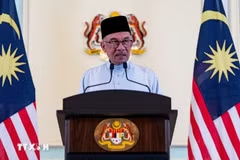
Thai Prime Minister Anutin Charnvirakul speaks before the Parliament in Bangkok. (Photo: Xinhua/VNA)

Thailand accelerates energy transition

Ministries and agencies of Thailand have been asked to urgently develop and submit projects using funds from the 400-billion-THB (about 10.9 billion USD) emergency decree to promote the national energy transition.

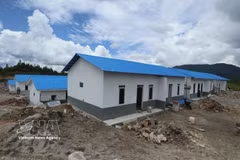
The Indonesian government invests in the construction of resettlement areas following the devastating floods in Sumatra. (Photo: VNA)

Indonesia diversifies funding tools for climate action

Acting Director General of Financial Sector Stability and Development at Indonesia's Ministry of Finance Herman Saheruddin said the country is building a comprehensive climate finance ecosystem involving both the public and private sectors while expanding cooperation with international financial institutions to support its green transition.

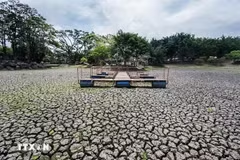
A super El Niño could bring higher temperatures and significantly reduce water storage in reservoirs. (Illustrative photo: VNA)

Thailand ramps up measures against potential super El Niño

A super El Niño could bring higher temperatures and significantly reduce water storage in reservoirs. In response, ONWR called for closer real-time monitoring of water resources, continued implementation of the 2026 rainy-season water management plan, and stronger integrated water resource management involving relevant agencies and river basin committees.

Fruit is displayed for sale at a market in Bangkok, Thailand (Photo: XINHUA/VNA)

Thailand faces four economic challenges

The Thai government needs to simultaneously address immediate issues and implement long-term structural reforms, while acknowledging that many long-standing problems cannot be resolved in the short term, said Thai Deputy Prime Minister and Commerce Minister Suphajee Suthumpun.

Malaysia unveils action plan to become regional AI leader

Malaysia unveils action plan to become regional AI leader

The Malaysia Digital 2030 (MD2030) strategy is built around seven strategic pillars, namely government, economy, infrastructure, talent, society, trust and security, and innovation, with each led by the relevant ministry under a whole-of-government approach.