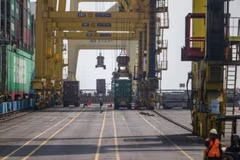
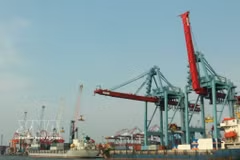
Hanoi (VNA) - The Philippines' Department of Energy (DOE) has said its proposed Philippine Strategic Petroleum Reserve (PSPR) project is aimed not only at strengthening national energy security but also at positioning the country as a regional oil storage hub, attracting global energy companies to use the Philippines as a fuel storage and transshipment centre.
DOE Secretary Sharon Garin was quoted as saying during the Senate Committee on Energy hearing on July 2 that the reserve will strengthen national security, improve supply confidence during global disruptions, and attract foreign firms willing to build or use storage facilities in the country.
Garin said the government is in talks with several parties, including the Maharlika Investment Corp. (MIC), Philippine National Oil Co. (PNOC), Japanese entities, Middle Eastern firms, and other foreign companies interested in the project.
She said the country needs its own proper tanks, noting that the government may also develop additional facilities that can be leased to oil companies or built through business arrangements with private or foreign partners.
Garin told the committee that if the initial target is one million barrels, construction of the storage facility could take about one year, with the timetable now being studied for possible completion by the last quarter of 2027 or the first quarter of 2028.
Senator Erwin Tulfo, chairperson of the committee, said the reserve is crucial because the Philippines remains vulnerable to conflicts in the Middle East and other disruptions that may affect fuel supply and prices.
Garin said the Philippines’ location makes it attractive to foreign oil players that want to diversify storage points in the region.
She said the reserve project could allow companies to store oil in the Philippines, pay rent for storage facilities, and possibly even lead to downstream investments, such as refinery projects.
Garin said the Philippine Government could focus on building or making available facilities while allowing private firms to store part of their supply in the country, provided that fuel would be retained locally during emergencies.
Meanwhile, Philippine Senate President Sherwin Gatchalian said the concept of a strategic petroleum reserve is not new, but the government must now produce a clear feasibility and financial study to determine the project’s cost, benefits, and strategic value./.
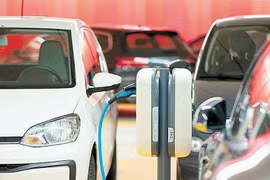
Philippines moves closer to launching EV incentive programme
Secretary of Finance Frederick Go said on May 13 the EV Incentive Strategy (EVIS) may be released soon. The EVIS has already been presented to President Marcos, but the Board of Investments (BOI) is still working with other agencies in the Fiscal Incentives Review Board (FIRB) on the details of the programme.