Philippines calls for enhanced cooperation to ensure regional food security

Speaking at the 38th session of the UN Food and Agriculture Organization (FAO) Asia-Pacific Regional Conference held in Bandar Seri Begawan, Brunei, on April 23–24, the official said that the global energy shock is putting increasing pressure on the agricultural sector in the region.

Hanoi (VNA) – Philippine Agriculture Secretary Francisco Tiu Laurel Jr. has called for enhanced regional cooperation to ensure food security in the Asia-Pacific region amid ongoing Middle East tensions impacting the global economy.

Speaking at the 38th session of the UN Food and Agriculture Organisation (FAO) Asia-Pacific Regional Conference held in Bandar Seri Begawan, Brunei, on April 23–24, the official said that the global energy shock is putting increasing pressure on the agricultural sector in the region. According to him, geopolitical tensions in the Middle East have disrupted supplies of oil, gas, and fertilisers, leading to higher prices and posing risks to global food security.

In the Philippines, rising fuel and fertiliser prices are directly affecting agricultural production, especially ahead of the upcoming rainy-season planting. He noted that increasing production and transportation costs would quickly translate into higher retail prices for agricultural products, putting pressure on consumers.

Besides the energy shock, the Philippine Department of Agriculture also warned of climate-related risks, including the potential for a strong El Niño phenomenon. Furthermore, factors such as extreme weather, livestock diseases, and supply chain disruptions continue to impact agricultural production and supply, particularly in the livestock sector.

Secretary Tiu Laurel called for stronger international coordination, highlighting the World Trade Organisation (WTO) as a crucial forum for promoting dialogue amid volatile global markets.

To mitigate the impact, the Philippine government has implemented a series of response measures, including fuel subsidies for farmers and fishermen, expanded logistics support, a toll-free road transport programme for agricultural products, and the use of a rapid response fund to provide biofertilisers to farmers.

In the long term, the country is stepping up investment in cold storage systems, rice processing facilities, and post-harvest infrastructure to enhance the resilience of its agricultural sector to external shocks./.

VNA

See more

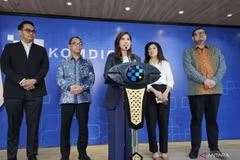
Minister of Communication and Digital Affairs Meutya Hafid speaks in a press conference in Jakarta on April 28. (Photo: ANTARA)

TikTok deactivates millions of child accounts in Indonesia

The short-form video platform TikTok has disabled approximately 1.7 million accounts belonging to users under the age of 16 in Indonesia, following the enforcement of a new online child protection regulation that took effect on March 28.

EU expects FTA to increase investments into Philippines

EU expects FTA to increase investments into Philippines

Justyna Lasik, head of economic and trade section of the EU Delegation to the Philippines told reporters on the sidelines of the launch of the Geographical Indications (GI) logo, that the EU considers the FTA as a tool to promote investments and attract European investors who might not be that familiar with the Philippines.

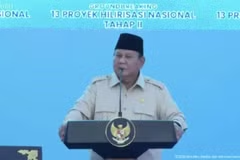
Indonesia begins construction on 13 mega-projects to achieve energy self-reliance

Indonesia begins construction on 13 mega-projects to achieve energy self-reliance

Indonesia's energy sector is witnessing a series of landmark projects. Notably, new gasoline refining facilities are being built at the Dumai and Cilacap complexes under the state oil and gas group Pertamina. Once operational in 2030, these facilities are expected to cut gasoline imports by up to 2 million kilolitres, saving the state budget of 1.25 billion USD annually.

Malaysian Minister of Economy Akmal Nasrullah says the government sets up a high-level biofuel committee to strengthen national energy security. (Illustrative photo: theedgemalaysia.com)

Malaysia accelerates biofuel programme

Malaysia has historically relied on a mix of conventional and alternative energy strategies to manage supply security, including coal, natural gas, hydropower and renewable energy development. Coal and gas currently remain the dominant sources in the national electricity generation mix.

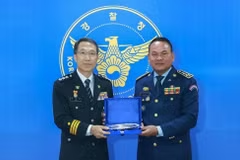
RoK Acting National Police Agency chief Yoo Jae-seong and his Cambodian counterpart, Sar Thet, pose for a photo as they meet in Seoul in this photo provided by Yoo's office on April 29, 2026. (Photo: Yonhap)

RoK, Cambodia expand joint investigations

Police of the Republic of Korea (RoK) and Cambodia on April 29 agreed to broaden the scope of their joint investigations to include drug-related crimes and online gambling.

Malaysia tightens operational spending amid global uncertainties

Malaysia tightens operational spending amid global uncertainties

Speaking at a press conference on April 29, Minister of Communications Fahmi Fadzil said ministries had received notices from the Ministry of Finance (MOF) regarding adjustments to operational spending. The move aligns with the Malaysian Government’s efforts to streamline programmes and activities as it grapples with global economic challenges stemming from Middle East tensions.

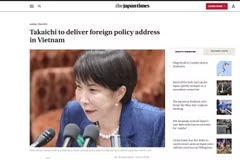
A screenshot of an article on Prime Minister Takaichi Sanae’s upcoming May 1-3 visit to Vietnam published by The Japan Times.

Japanese media highlight importance of economic security cooperation with Vietnam

Japanese media viewed Prime Minister Takaichi Sanae’s visit as a positive and strategic step, not only for deepening bilateral relations but also for reinforcing Japan’s role in shaping a rules-based regional order, in which Vietnam is seen as a central partner in building a sustainable and flexible economic-security cooperation network amid today’s global uncertainties.

Thai Minister of Tourism and Sports Surasak Panjaroenworakul (Photo: bangkokpost.com)

Thailand considers plan to end 60-day visa-free stay

According to Minister of Tourism and Sports Surasak Panjaroenworakul, the policy, currently applied to citizens from 93 countries and territories, may be scrapped following a review of its effectiveness.