Singapore develops satellites, humanoid robots for domestic security

The Home Team Science and Technology Agency (HTX) is collaborating with the new National Space Agency of Singapore (NSAS) to research the application of space technology in strengthening public safety.

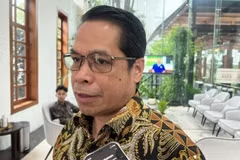
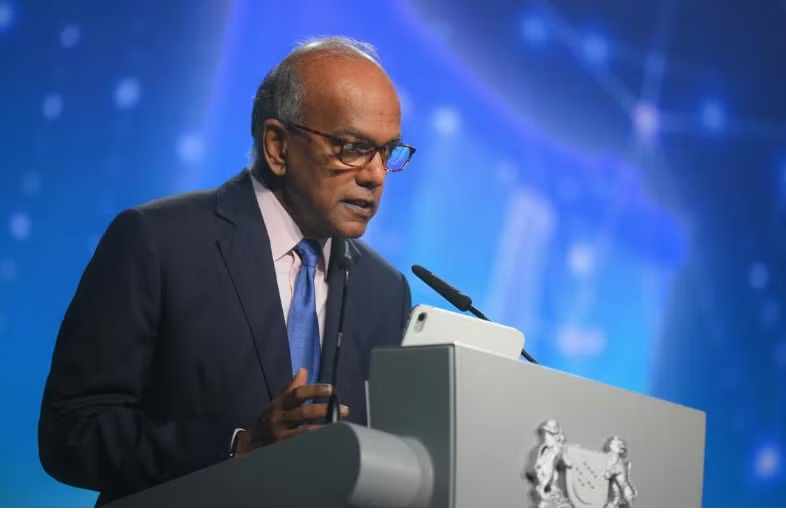
Singapore's Coordinating Minister for National Security and Home Affairs Minister K. Shanmugam speaks at the Milipol TechX Summit on April 28 (Photo: The Straits Times)

Singapore (VNA) – Singapore will develop its first satellite for the Home Team, scheduled for launch in 2029, to enhance its capacity to respond to emergencies.

The satellite, named Xplorer, weighing about 100kg, will operate in near-equatorial orbit and be equipped with sensors to detect toxic gases such as ammonia, thereby assisting the Singapore Civil Defence Force in responding more quickly to dangerous incidents, Coordinating Minister for National Security K Shanmugam, who is also Home Affairs Minister, said on April 28.

The Home Team Science and Technology Agency (HTX) is collaborating with the new National Space Agency of Singapore (NSAS) to research the application of space technology in strengthening public safety. Simultaneously, it is also working with corporations such as Nvidia and French company Mistral AI to develop artificial intelligence (AI) systems to serve this force.

Within the framework of the Milipol TechX Summit (MTX) 2026, Shanmugam stated that HTX will launch a humanoid robotics centre in September to train robots for high-risk tasks such as handling hazardous materials and firefighting.

​According to the official, the geopolitical landscape is profoundly changing the global technology ecosystem as supply chains are being restructured and technology is increasingly being "weaponised", creating new attack risks, especially in the field of cybersecurity. He emphasised that advanced AI models can shorten the time from vulnerability detection to exploitation from several months to just a few hours, leaving defence forces with almost no time to react. Previously, the Cyber Security Agency of Singapore issued a warning about the risks from next-generation AI models.

​In response, HTX, in collaboration with partners such as ST Engineering, Google, Nvidia, and Nutanix is developing Singapore's first sovereign, NGINE, a GPU-powered AI infrastructure. HTX is also expanding the Phoenix big language model, with Phoenix Small already deployed and Phoenix Medium expected to launch with image and document analysis capabilities. In addition, Singapore is strengthening security testing through activities such as the DEF CON Singapore, a hacking conference, held concurrently with MTX, to detect vulnerabilities early and reinforce systems before real-world operation./.

VNA

See more

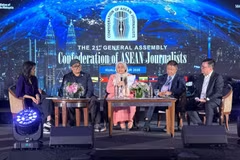
Speakers discuss at the 21st General Assembly of the Confederation of ASEAN Journalists (CAJ-21) in Kuala Lumpur. (Photo: VNA)

ASEAN journalists urged to blend AI power with human values

The Vietnamese delegation, led by Editor-in-Chief of Nhan dan (People) newspaper and President of the Vietnam Journalists Association Le Quoc Minh, actively contributed to discussions and received positive feedback from participants.

Thailand intensifies crackdown on nominee businesses

Thailand intensifies crackdown on nominee businesses

Since January 1, 2026, risk groups have been required to submit additional financial evidence before registration, resulting in a 60% reduction in nominee-risk companies in Q1 2026 to 1,373 companies from 3,511 in the same period last year.

Indonesia boosts special economic zones with skilled labour push

Indonesia boosts special economic zones with skilled labour push

Coordinating Minister for Economic Affairs Airlangga Hartarto said the government has allocated funding for vocational training programmes tailored to the demand of enterprises operating in SEZs and national strategic projects. He stressed that synchronising labour supply and demand is essential to rapidly building a job-ready workforce.

Malaysian Prime Minister Datuk Seri Anwar Ibrahim at at the 80th anniversary celebration of the Road Transport Department on April 25, 2026. (Photo: theedgemalaysia.com)

Malaysia considers cutting road tax for diesel vehicles

Prime Minister Datuk Seri Anwar Ibrahim said he has asked the Transport Ministry to identify a suitable mechanism to implement the reduction, taking into account the impact of higher diesel prices on users, particularly sectors that still rely on diesel vehicles.

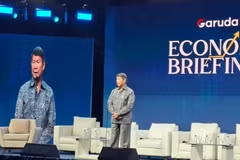
Indonesian Presidential Special Envoy for Energy and Environment Hashim Djojohadikusumo at the Economic Briefing 2026 event held in Jakarta on April 23, 2026. (Photo: ANTARA/Suharsana Aji Sasra J C)

Indonesia diversifies oil supply sources

According to Minister of Energy and Mineral Resources (ESDM) Bahlil Lahadalia, it consumes around 1.6 million barrels of fuel per day, while domestic production stands at only about 600,000 barrels daily. Around 20–25% of its crude oil imports come from the Middle East and pass through the Strait of Hormuz.

Thailand plans major industrial overhaul fund

Thailand plans major industrial overhaul fund

Under the proposed model, the fund will draw in private-sector co-investment. Talks are set to be held this week with the World Bank as the first institution to be approached, as it is an international financial institution that provides financing and technical assistance to developing countries.

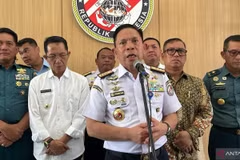
Bakamla Head Rear Admiral Irvansyah speaks with the press (Photo: Antara)

Indonesia ramps up sea patrols to maintain maritime security

In addition to independent patrols, which are conducted throughout the year, Bakamla is conducting collaborative patrols with domestic agencies such as the Indonesian Navy, the Maritime and Shipping Surveillance Unit (KPLP), the Indonesian National Police (Polri), as well as Customs and Excise, and Immigration.