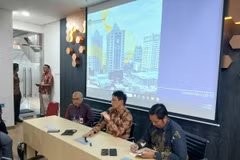
Hanoi (VNA) – The Philippines will place strong emphasis on translating climate commitments into concrete actions at the local level as it hosts ASEAN Climate Week (ACW) 2026 from April 27 to May 1.
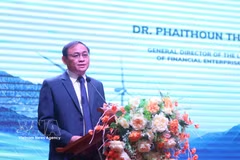
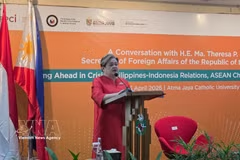
Speaking at the opening ceremony in Taguig on April 27, Secretary of the Philippine Department of Environment and Natural Resources (DENR) Juan Miguel Cuna said the Association of Southeast Asian Nations (ASEAN) is entering a crucial phase where climate strategies must be implemented at the community level rather than remaining within policy frameworks. The urgent task now is to turn commitments into concrete policies, programmes, and investment-ready projects that deliver measurable benefits to people.
According to Cuna, the regional agenda should shift towards supporting local government units in implementing adaptation and resilience programmes, especially in vulnerable and disaster-prone areas.
Meanwhile, DENR Undersecretary Jonas Leones noted that specific projects and pilot programmes are expected to be launched or scaled up following the ASEAN Climate Week. He cited an initiative in Iloilo as an example, which integrates land titling, climate-resilient housing, urban greening, and livelihood support through seedling distribution.
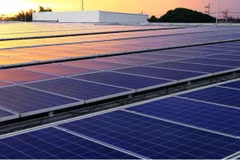
The programme also introduces climate-resilient housing models featuring energy-efficient and solar-ready designs, along with solutions such as developing linear parks along rivers to reduce flood risks and improve the environment.
Cuna added that disaster prevention systems need to be strengthened amid rising climate risks, particularly under the impact of El Niño. Water conservation should be prioritised, while vigilance is required to address the increased risk of forest and landfill fires.
He also noted that geohazard mapping is being used in the Philippines to identify flood- and landslide-prone communities, guide land-use planning, and support evacuation and disaster response efforts in coordination with local authorities.
At the grassroots level, projects supported by development partners such as the United Nations Development Programme (UNDP) are being implemented, including small grants for local and indigenous communities to manage coastal, marine, and forest ecosystems, thereby integrating biodiversity conservation with climate change adaptation./.