Indonesia’s economy remains resilient, recession risk below 5%

Indonesia's inflation has been effectively contained at 3.48%, while consumer confidence remains high at 122.9 points. Domestic consumption continues to serve as a key pillar of the economy, contributing around 54% to gross domestic product (GDP).

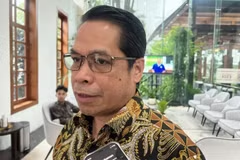
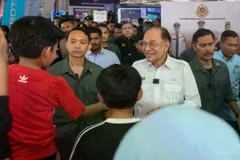
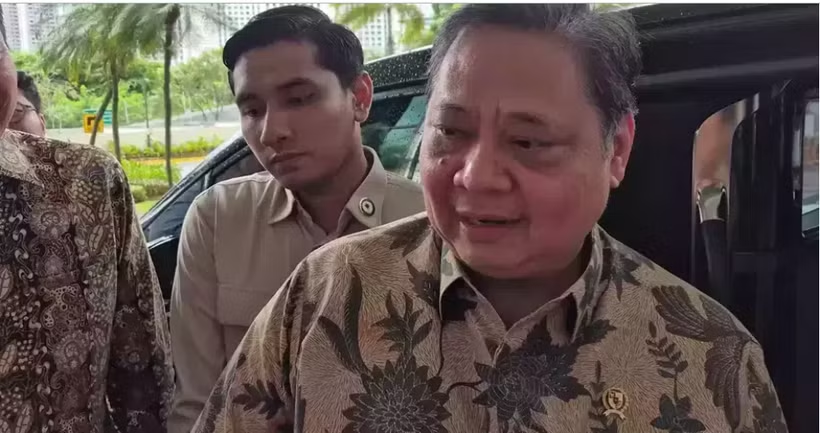
Indonesian Coordinating Minister for Economic Affairs Airlangga Hartarto speaks to reporter in Jakarta. (Photo: B-Universe)

Jakarta (VNA) – Indonesia’s economy continues to demonstrate strong resilience, with recession risk kept below 5% thanks to solid macroeconomic fundamentals, Indonesian Coordinating Minister for Economic Affairs Airlangga Hartarto said on April 27.

Airlangga noted that key economic indicators remain positive, helping maintain overall stability in Southeast Asia’s largest economy. Indonesia recorded growth of 5.11% in 2025, and the government has set a target of 5.4% for 2026. Growth in the first quarter of 2026 is estimated to reach at least 5.5%.

Inflation has been effectively contained at 3.48%, while consumer confidence remains high at 122.9 points. Domestic consumption continues to serve as a key pillar of the economy, contributing around 54% to gross domestic product (GDP).

From an external perspective, Indonesia’s trade performance has remained robust, with the country recording a trade surplus for 70 consecutive months, totalling 148.2 billion USD. External debt is maintained at a safe level of 29.9% of GDP.

According to Airlangga, Indonesia’s financing structure is also resilient, with government bonds largely held by domestic investors, accounting for 87.4%, compared to 12.6% held by foreign investors. This helps reduce exposure to global capital market fluctuations.

International financial institutions have maintained an optimistic outlook on Indonesia. The International Monetary Fund has described the country as one of Asia’s “bright spots”, while the Asian Development Bank forecasts economic growth of around 5.2% in 2026.

The Indonesian economy is also considered less vulnerable to global energy shocks caused by geopolitical tensions, particularly in the Middle East, due to its relatively low dependence on external energy sources./.
VNA

See more

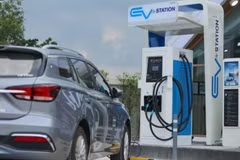
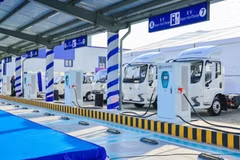
Singapore’s Green Plan 2030 means converting all public and private transport to electric vehicles so the government is working with the private sector to prompt infrastructure investment in fast-charging points such as these. (Photo: Handout)

EV growth puts pressure on Singapore charging network

Electric vehicles (EVs) made up nearly 60% of new car registrations in the first quarter of 2026, overtaking combustion engine and hybrid models for the first time, and a jump from 45% in 2025 and 3.8% in 2021.

Indonesian President Prabowo Subianto presents the Macroeconomic Framework and Fiscal Policy Points during a plenary session of the House of Representatives. (Photo: VNA)

Indonesia pushes reforms, targeting 6.5% economic growth in 2027

Indonesia’s key strategy in the coming period will focus on leveraging its natural resource advantages, promoting downstream processing industries and restructuring the export system to prevent the outflow of national wealth abroad, President Prabowo stressed.

Thailand strives to solve labour shortages

Thailand strives to solve labour shortages

The JSCCIB stated that easing legal barriers and renewing work permits for migrant workers from neighbouring countries are crucial to maintaining competitiveness, economic growth and exports.

Singapore evaluates potential deployment of nuclear energy

Singapore evaluates potential deployment of nuclear energy

Starting in 2027, with support from international experts, Singapore will conduct a formal assessment aimed at informing any future decision on advanced nuclear technologies. The review will form Phase 1 of the Integrated Nuclear Infrastructure Review (INIR) mission.

ASEAN, EU step up cooperation to promote multilateralism

ASEAN, EU step up cooperation to promote multilateralism

Ambassadors from the Association of Southeast Asian Nations (ASEAN) have reaffirmed their commitment to close coordination with the European Union (EU) in safeguarding the multilateral system and strengthening cooperation in digital transformation, sustainable development, cybersecurity, science-technology, and innovation, thereby contributing to peace, stability and development in the region and beyond.

Thongly Sisoulith, Secretary of the Central Committee of the Lao People's Revolutionary Youth Union, speaks to Vietnam News Agency's correspondents in Vientiane (Photo: VNA)

Young Lao leaders hail Vietnam’s development achievements

Vietnam’s breakthrough economic targets and achievements in international integration offer valuable practical lessons for Laos, young leaders of Laos said on the sidelines of a conference organised earlier this month by the Vietnamese Embassy in Laos.

Philippines, US boost economic cooperation, develop Luzon economic corridor

Philippines, US boost economic cooperation, develop Luzon economic corridor

Philippine President Ferdinand R. Marcos Jr. met with US Undersecretary of State for Economic Growth, Energy, and the Environment Jacob Helberg in Malacañang Palace on May 19 to discuss expanding bilateral economic cooperation. The meeting reaffirmed both countries’ commitment to strengthening economic and trade ties amid growing cooperation in strategic industries and emerging technologies.

Malaysian Foreign Minister Mohamad Hasan (Photo: Bernama)

Malaysia, Myanmar move towards diplomatic reset

Malaysia and Myanmar are moving to restore diplomatic relations following the inauguration of Myanmar President Min Aung Hlaing on April 10, Malaysia’s national news agency Bernama reported on May 20.

Workers harvest palm oil fruit in Pelalawan, Riau province, Indonesia. (Photo: AFP/VNA)

Indonesia tightens controls on coal, palm oil exports

Indonesian President Prabowo Subianto on May 20 announced new controls on the export of several strategic resources, including crude palm oil, coal, and iron-containing alloys, in a bid to boost state revenues and curb foreign exchange losses amid economic pressures stemming from conflict in the Middle East and global financial volatility.

OpenAI opens first applied AI lab in Singapore

OpenAI opens first applied AI lab in Singapore

At the heart of the partnership is the OpenAI Singapore Applied AI Lab, a first outside the US. The lab will support work aligned with Singapore’s AI missions and national priorities, particularly in the areas of public services, finance, healthcare and digital infrastructure.

Screenshot of the article titled “President Ho Chi Minh – A National Hero of Vietnam” on Cambodian Express News (Photo: VNA)

Cambodian newspaper praises President Ho Chi Minh as National Hero of Vietnam

The article provided an in-depth introduction to the life, career and revolutionary journey of National Hero, President Ho Chi Minh. It also highlights the achievements and legacy he left to the Vietnamese nation and people, as well as his contributions to fostering friendship, cooperation and prosperity among peoples in the region and around the world.

President Ho Chi Minh visits and inspects a southern military unit regrouped in the North during a training exercise before returning to the southern battlefield in June 1957. (Photo: VNA)

Italian Communist Party honours Ho Chi Minh’s lasting legacy

The Italian Communist Party on May 19 published an article paying tribute to President Ho Chi Minh on the occasion of his birth anniversary, describing him as a pivotal leader of Vietnam’s liberation struggle and a global symbol of anti-colonial resistance and anti-imperialist movements.