Vietnamese trade offices push rapid adaptation for H2 export growth

As import markets transform, attendees agreed that trade promotion itself must become more specialised, focused on the demands of each market and sector rather than sticking to traditional promotional events.

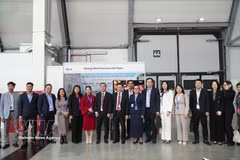
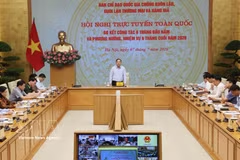
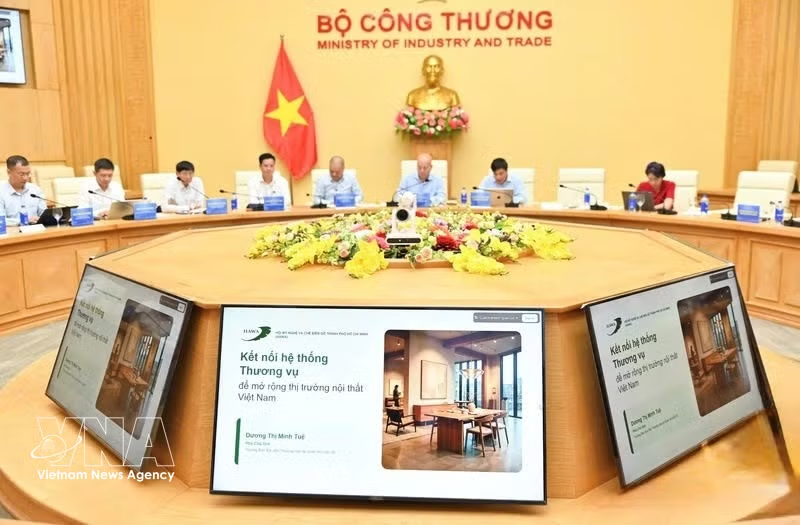
An overview of the hybrid trade promotion conference. (Photo: VNA)

Hanoi (VNA) – Vietnamese trade representatives around the world issued warnings and practical advice at a hybrid trade promotion conference in Hanoi on July 7, urging firms to move fast to keep export momentum alive.

​Vietnamese Trade Counsellor in the US Do Ngoc Hung said exports to the US rose in the first half of the year across many product lines, but the rest of 2026 looks much tougher as tariff policies and trade defence actions ramp up.

​The US is not just seeing weaker import demand, but also widening probes into labour practices, environmental rules, intellectual property, product origin and supply chains. To defend their share in Vietnam's biggest export market, companies need rock-solid documentation to prove where goods come from, stronger traceability and a real commitment to sustainability standards, he added.

​Across the Atlantic, Europe is rapidly piling on new technical barriers. Vietnamese Trade Counsellor in the Netherlands Vo Thi Ngoc Diep said the tariff breaks under the EU-Vietnam Free Trade Agreement (EVFTA) are no longer the main prize. Today's biggest test is a series of new environmental and sustainability regulations.

​The EU is expanding its Carbon Border Adjustment Mechanism (CBAM), enforcing the EU Deforestation Regulation (EUDR), tightening limits on pesticide residues, requiring proof of traceability, social responsibility and Environmental, Social, and Governance (ESG) compliance. At the same time, trade defence measures are impacting certain product groups more often.

​According to the Vietnamese Trade Office in the Netherlands, Europe has fundamentally shifted from checking the quality of a final product to watching over the entire supply chain, from raw materials and carbon emissions to labour conditions and environmental responsibility. That is a long-term trend, and Vietnamese companies will have to make systematic investments just to stay competitive.

​In the Middle East, shipping through the Red Sea and the Strait of Hormuz is returning to normal after disruptions. But the market is layering on new import rules, said Truong Xuan Trung, who is in charge of the Vietnamese Trade Office in the United Arab Emirates (UAE).

The UAE is tightening its Halal certification process, using artificial intelligence to inspect goods and run post-clearance checks, and requiring many products to come in biodegradable or recycled packaging to reach retail shelves.

​As import markets transform, attendees agreed that trade promotion itself must become more specialised, focused on the demands of each market and sector rather than sticking to traditional promotional events.

​For the US, Hung pushed for business matchmaking at the Vietnam International Sourcing 2026, which is expected to draw retail heavyweights like Walmart, Amazon and Costco. He called for a supplier database that lets trade offices connect firms with partners before foreign delegations even arrive, stronger verification to cut transaction risks, and early warning systems for high-risk sectors like apparel, footwear, wooden furniture, electronics, aluminum, machinery and processed farm products.

​For the Netherlands, Diep wants trade missions zeroed in on economic, logistics and technology hubs like Rotterdam and Amsterdam, tied closely to major specialised trade fairs so Vietnamese firms can plug straight into international buyer networks.

​For the UAE, the immediate priority is squeezing every advantage out of the Vietnam-UAE Comprehensive Economic Partnership Agreement (CEPA). Trung urged companies to secure Halal certification, tighten traceability, meet eco-friendly packaging rules, and set up bonded warehouses, distribution centres or retail operations in the UAE's free zones. These moves will open up re-export opportunities to the wider Gulf Cooperation Council.

​The Vietnam Trade Office in the UAE has already persuaded two big retail groups to attend the Vietnam International Sourcing 2026. Another retailer is moving ahead with plans to open a representative office in Ho Chi Minh City, a step that could carve out new direct distribution channels for Vietnamese goods./.
VNA

See more

Standing Deputy Prime Minister Pham Gia Tuc chairs a meeting with representatives of US business associations and companies operating in Vietnam on July 17, 2026. (Photo: baochinhphu.vn)

Standing Deputy PM meets with US business community

Chairing a meeting with representatives of US business associations and companies operating in Vietnam, Tuc praised the US business community for its substantive contributions to Vietnam's socio-economic development as well as the two countries’ relations.

Workers assembles electronic components on the production line at the Bao Sen Co., Ltd. in Bac Ninh province. (Photo: VNA)

Vietnam's economy needs to shift from quantity to quality: ADB experts

Shantanu Chakraborty, ADB Country Director for Vietnam, noted that while achieving strong growth in a single year is encouraging, maintaining both the pace and quality of growth over many years will be essential if Vietnam is to achieve its goal of becoming a high-income country by 2045.

The Long Son Petrochemical Complex, an investment project of Thailand's SCG Group, is located in Long Son commune, Ho Chi Minh City. (Photo: VNA)

Vietnam reshapes FDI strategy with focus on technology, innovation

Politburo Resolution No. 10-NQ/TW, issued on June 8, 2026, recognises the foreign-invested sector as an important component of the national economy, signalling a major shift in the country's investment attraction strategy. Rather than prioritising labour-intensive projects, Vietnam is now seeking high-quality investments capable of driving technological progress, innovation, sustainable development and stronger participation in global value chains.

International tourists love shopping for souvenirs at Hanoi's Old Quarter night market (Photo: VNA)

Hanoi aims to raise tourists' night-time spending to 30%

Hanoi will establish and operate flagship night-time economy zones supported by preferential policies, including heritage and cultural districts in Hoan Kiem, Cua Nam, Ba Dinh, Son Tay and Soc Son; modern entertainment hubs in Tay Ho-West Lake West, My Dinh and Dong Anh; creative economy zones linked to cultural industries such as theatres, cinemas and museums; and cultural tourism and resort destinations in suburban craft villages including Bat Trang, Ba Vi and Huong Son.

Vietnamese Ambassador to Laos Nguyen Minh Tam and Lao Deputy Minister of Industry and Commerce Phouthavanh Nanthavong visit the Vietnamese pavilion at VIETLAO EXPO 2026 (Photo: VNA)

VIETLAO EXPO 2026 helps boost Vietnam-Laos strategic cohesion

The Vietnam-Laos Trade Fair 2026 (VIETLAO EXPO 2026) opened on July 16 in Vientiane, serving as a key platform for businesses from both countries to showcase products, seek partnerships, transfer technologies and expand investment cooperation.

The Vietnam-EFTA FTA is one of the longest-negotiated trade agreements in Vietnam's history. (Illustrative Photo: VNA)

Vietnam-EFTA deal set to further boost bilateral trade growth

The Vietnam-EFTA FTA is one of the longest-negotiated trade agreements in Vietnam's history, reflecting its broad scope of commitments covering trade in goods and services, investment, intellectual property, government procurement, environmental protection, sustainable development, small and medium-sized enterprises (SMEs), and other areas of cooperation.

Passengers and visitors check in at Terminal 1 of Noi Bai International Airport. (Photo: VNA)

Hanoi-Ho Chi Minh City route among world’s busiest

According to IATA’s ranking of global air passenger markets, the US remained the world’s largest market in 2025, with 890.1 million passengers, up 1.6% from 2024. China, the world’s second-largest market, recorded stronger growth of 4.8%, reaching 776.1 million passengers. China is widely forecast to overtake the US and become the world’s largest air passenger market in the 2030s.

An overview of the working session between the Kazakh delegation and the Can Tho City People's Committee on July 16. (Photo: VNA)

Kazakhstan explores agricultural by-product recycling project in Can Tho city

The proposed project would use rice husks as its primary feedstock, with an estimated one million tonnes processed annually using advanced technology developed in Kazakhstan. At present, the top priority is to secure a stable supply of raw materials from rice-producing provinces across the Mekong Delta.

Consumers buy fruit at a supermarket in Vietnam. (Photo: VNA)

US highlights potential in Vietnam’s fruit market

The US was Vietnam's second-largest supplier of agricultural products, with export turnover reaching 4.7 billion USD in 2025, a remarkable increase from less than 3.5 billion USD in 2024, Fruitnet said, citing a new report by the US Department of Agriculture (USDA).

Vietnamese Ambassador to Thailand Pham Viet Hung (thitd, left) attends the opening ceremony of Grand Halal Bangkok 2026 (Photo: VNA)

Vietnamese firms seek global Halal opportunities at Bangkok exhibition

Ambassador Pham Viet Hung described Grand Halal Bangkok 2026 as an important opportunity for Vietnamese businesses to connect not only with Thailand's Halal industry but also with Halal food producers worldwide, while learning from experience of Thailand and international partners.

Marnufacturing garments for export at Hung Yen Jute and Garment Joint Stock Company. (Photo: VNA)

GDP expands 8.18%, with new growth drivers taking shape

According to the National Statistics Office under the Ministry of Finance, GDP expanded by 8.39% in the second quarter, up from 8.14% a year earlier. Growth for the first six months reached 8.18%, exceeding the 7.63% recorded in the same period of 2025. The performance reflected broad-based contributions from both the supply and demand sides of the economy.