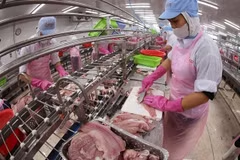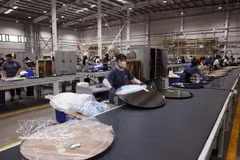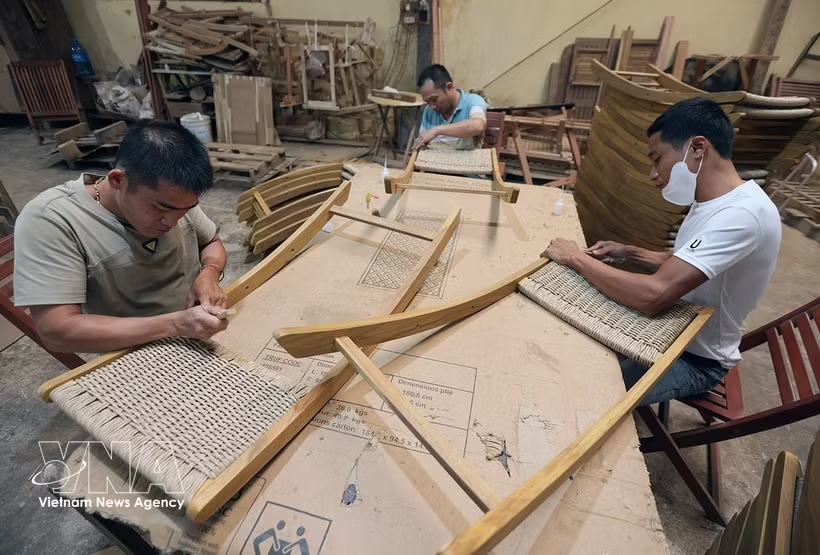
Hanoi (VNA) – Vietnam's wood industry is seeking to maintain export momentum and reach its 19 billion USD target this year by diversifying markets and building more transparent, legal and sustainable supply chains.
Despite headwinds from Middle East tensions that have pushed up freight and logistics costs, exports of wood and wood products were estimated at 1.53 billion USD in June, lifting first-half export turnover to 8.54 billion USD, up 4.4% from a year earlier, according to the Ministry of Agriculture and Environment (MAE).
The US remained the dominant destination, accounting for nearly half of Vietnam's wood-export revenue, while China represented 15% and Japan 12.9%. Export performance, however, showed a mixed picture: shipments to the US fell 8% in the first five months of the year, whereas exports to China jumped 49% and those to Japan rose 5.1%. The Netherlands posted the fastest growth among major markets, while the Republic of Korea recorded the sharpest decline.
Vietnam ranks among the world's top five furniture exporters and ships products to almost 170 countries and territories. Even so, the country holds only about 7% of global furniture import demand, leaving significant room for expansion.
Industry officials say the sector's greatest risk lies in its dependence on the US market, which absorbs roughly half of total export turnover, exposing businesses to shifts in trade policy, tariffs and trade-remedy measures. Expanding sales to the EU, Japan, China, India and the Middle East has therefore become increasingly urgent.
Exporters say order books remain relatively healthy, with many contracts extending through the second quarter and some into the third as global consumption gradually recovers. The bigger challenge now is meeting stricter requirements on legal timber sourcing, anti-deforestation compliance, traceability and carbon-emission reduction.
Nguyen Van Dien, Deputy Director General of the MAE's Forestry and Forest Protection Department, said Vietnam has strengthened its position in international markets by developing legal raw-material sources, expanding sustainably certified forests and gradually forming a legal timber supply chain. However, he acknowledged that the current system is only an initial step toward satisfying increasingly demanding market requirements.
The pilot programme for production forest area codes currently covers about 25,500 hectares in five northern provinces, a small fraction of the country's nearly 4.9 million hectares of planted forests. Around 868,000 hectares have received sustainable forest-management certification, but the area remains insufficient to meet export demand.
Dien said the industry must expand certified forests, ensure the legality of timber supplies, accelerate digital traceability and proactively comply with regulations such as the EU Deforestation Regulation (EUDR), the US Lacey Act and emerging carbon standards. Doing so, he added, is not only essential for market access but also an opportunity to improve the industry's competitiveness.
Phung Quoc Man, Chairman of the Handicraft and Wood Industry Association of Ho Chi Minh City (HAWA), said ASEAN's wood sector can develop sustainably only through regional cooperation in building transparent, responsible supply chains that meet international standards.
To support businesses, the MAE is working with the Ministry of Finance to resolve value-added tax refund issues for semi-processed wood products under Government Decree No. 181/2025/ND-CP and is finalising guidance on implementing the EUDR for wood and agro-forestry products. Authorities also plan to launch the National Plan on Production Forest Area Codes for 2026–2030, expand pilot programmes to 15–20 key provinces and integrate the system into the national forest database to satisfy traceability requirements in importing markets.
As global trade moves increasingly toward green and sustainable standards, industry leaders say that market diversification, legal timber supply chains and compliance with international rules will be crucial for Vietnam to maintain export growth and increase its share of the global furniture import market, estimated at around 230 billion USD a year./.
See more
Vietnam seeks stronger export growth in H2
Despite the encouraging performance, Vietnam's exports remain heavily dependent on a limited number of major markets and product groups, while the domestic value added of many export products remains relatively low because of their reliance on imported raw materials and components.
Ho Chi Minh City: Industrial, export processing zones attract over 2.6 bln USD in H1
Speaking at the at the city's regular socio-economic press briefing on July 9, Deputy Head of the Ho Chi Minh City Export Processing and Industrial Zones Authority (HEPZA) Tran Viet Ha said that foreign direct investment (FDI) accounted for nearly 1.6 billion USD of the total, including 65 newly licensed projects worth more than 867 million USD and 83 existing projects that added over 707 million USD in registered capital.
Reference exchange rate inches up on July 10
With the current trading band of +/- 5%, the ceiling rate applicable for commercial banks during the day is 26,475 VND/USD, and the floor rate 23,953 VND/USD.
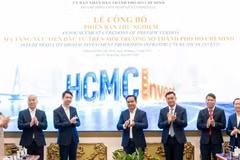
Ho Chi Minh City launches pilot digital investment promotion infrastructure
The initiative marks a shift from traditional investment promotion toward a digital ecosystem that standardises information and provides transparent connections with investors worldwide.
Labour shortage emerges as constraint amid export order recovery
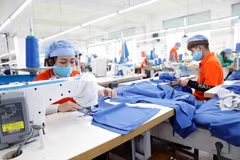
Textile and seafood exporters are struggling to retain enough workers to meet recovering export demand, underscoring a shift in constraints from demand to workforce capacity.
Vietnam Airlines to add more flights to Northeast Asia amid rising travel demand
National flag carrier Vietnam Airlines will increase frequencies on several routes to Japan, the Republic of Korea (RoK) and Taiwan (China) to meet rising demand for tourism, business and family visits between Vietnam and Northeast Asia.
Vietnam, Israel strengthen connectivity in high-tech agriculture
Israeli businesses and experts introduced a wide range of technologies and solutions for sustainable agricultural development, including smart irrigation systems, greenhouse technologies, crop varieties, microbial technologies, post-harvest solutions, aquaculture technologies, and digital transformation in agriculture.
Fuel prices continue to fall on latest adjustment
The maximum retail price of E5RON92 was set at 19,191 VND (0.73 USD) per litre, down 539 VND from the previous ceiling and 812 VND lower than E10RON95-III. The latter was capped at 20,003 VND per litre, a decrease of 412 VND.
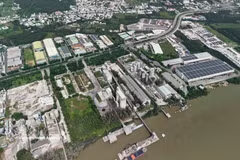
Long An port becomes first Vietnamese company to win Asia-Pacific smart green port award
The recognition marks a significant milestone for Vietnam’s maritime industry as it advances the development of smart, green ports and sustainable logistics.
UOB revises up Vietnam's 2026 GDP growth forecast to 8.5%
Singapore-based United Overseas Bank (UOB) has sharply raised its forecast for Vietnam's 2026 GDP growth to 8.5%, more than reversing the previous downgrade to 7%, citing stronger-than-expected first-half economic performance driven by manufacturing, investment and foreign direct investment (FDI).
PM requests full disbursement of national target programme funds in 2026
PM Le Minh Hung said the fulfilment of the capital disbursement target should become a key criterion in evaluating the performance of ministries, sectors and local authorities.
Da Nang eyes role as gateway for global capital
Da Nang is pursuing a next-generation IFC focused on innovation, fintech and sustainable finance, concentrating on high-value segments rather than a traditional fully integrated financial-centre model.
Beyond FDI, Vietnam leverages foreign resources to build up domestic capacity
Instead of concentrating mainly on attracting foreign capital, Resolution No. 10-NQ/TW emphasises building a foreign-invested sector that is closely integrated with the domestic sector to create new growth drivers for the country.
ADB keeps Vietnam as Southeast Asia’s fastest-growing economy
Vietnam is projected to remain the fastest-growing economy in Southeast Asia, with the Asian Development Bank (ADB) maintaining its growth forecasts of 7.2% for 2026 and 7.0% for 2027 in its Asian Development Outlook (ADO) July 2026 released on July 8.
Vietnam boosts collective economy, elevates OCOP products in digital age
Vietnam currently has about 17,400 OCOP products rated three stars or above. The figure is set to increase to around 25,000 by 2030, with greater emphasis on improving quality, adding value and enhancing competitiveness rather than simply expanding the number of products.
Ministry pushes social and rental housing, saying apartment prices have stabilised
Vietnam currently has 130,571 rental housing units under construction. A review of national rental housing demand will be completed before the construction ministry assigns specific targets to provincial governments.
Vietnam spends over 121.5 million USD on diamond imports in first half
India remained the largest supplier, with the value reaching 63.2 million USD, representing around 52% of Vietnam's total diamond imports.
Vietnamese firms seek deeper access to UK supply chains
Speaking at the opening ceremony at Staybridge Suites London-Vauxhall in Lambeth, Vietnamese Ambassador to the UK Do Minh Hung said bilateral ties have developed strongly in recent years, culminating in the establishment of a Comprehensive Strategic Partnership during Party General Secretary To Lam’s official visit to the UK in October last year.
Quang Ngai seeks stronger French partnership for green growth
The meetings with AFD and EDF were seen as an important step in deepening ties between Quang Ngai and French partners as the province enters a new phase of development. Through broader international cooperation, Quang Ngai aims to attract more capital, technology, management expertise and training resources to advance green industry, clean energy and sustainable infrastructure, strengthen competitiveness and move toward becoming a major industrial, energy and logistics hub in central Vietnam and the country.
Agriculture sustains growth momentum in H1, strengthening foundation for green development
Deputy Minister of Agriculture and Environment Dang Ngoc Diep said the sector achieved encouraging results thanks to close monitoring of market developments, proactive production management and timely measures to remove institutional and policy bottlenecks.