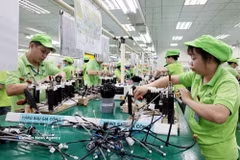
Hanoi (VNS/VNA) – Textile and seafood exporters are struggling to retain enough workers to meet recovering export demand, underscoring a shift in constraints from demand to workforce capacity.
Manufacturers say higher wages are no longer enough to retain workers, while automation has yet to fully replace labour-intensive production.
The Vietnam Textile and Apparel Association (VITAS) recently warned that labour shortages have become a major bottleneck for the industry, adding that competition for labour is intensifying not only within the industry but also from emerging sectors offering more attractive conditions.
“Competition for labour between textile firms and new industries is becoming increasingly fierce,” said VITAS deputy president Truong Van Cam, adding that the industry also faces pressures from growing requirements for green production, traceability, digital transformation and sustainability.
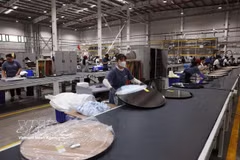
As export demand strengthens, labour shortages are becoming a growing constraint on manufacturers. They are struggling to both recruit new workers and retain existing staff, forcing repeated recruitment and retraining that raise costs and disrupt production.
In a report submitted to the Ministry of Industry and Trade in May, VITAS said some regulations on unemployment insurance and labour contract termination may have unintentionally encouraged job-hopping.
The labour constraints are occurring just as export orders are recovering, creating what firms describe as a paradox: factories have secured demand but lack the workforce to meet delivery schedules.
The problem extends beyond textiles.
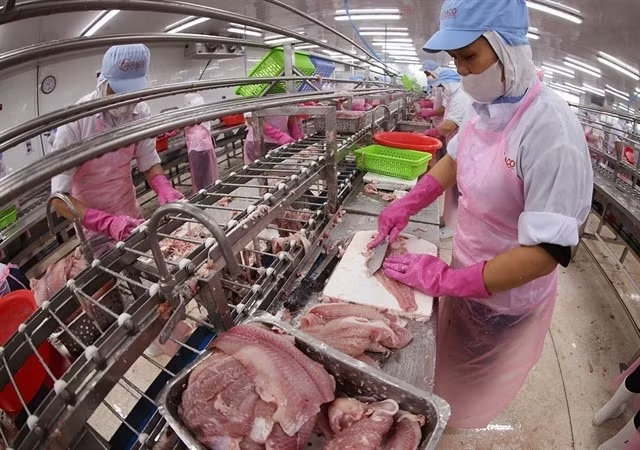
In a June report to the Ministry of Finance, the Vietnam Association of Seafood Exporters and Producers (VASEP) said seafood processors in the Mekong Delta and HCM City are also facing significant labour shortages that are affecting factory operation capacity and delaying deliveries during the peak production season.
VASEP's General Secretary Nguyen Hoai Nam said many local workers have shifted to other industries, taken overseas jobs or left employment to receive unemployment benefits.
He added that many companies have even increased wages by 25-30%, but still struggle to recruit and retain enough workers.
Le Van Quang, director of seafood processor Minh Phu Corporation, said the company's Khanh An factory has been operating for nearly two months at only 30% of its designed capacity due to worker shortages.
The plant currently employs more than 2,000 workers, but requires around 5,000 to operate all production lines.
“The problem is no longer orders, but workers. There are too many managers and not enough skilled workers,” he said.
Automation not yet enough
Amid these labour constraints, manufacturers are accelerating investment in automation and digitalisation, but acknowledge that technology cannot yet fully replace human labour in many production stages.
VITAS President Vu Duc Giang said automation has become more accessible and affordable, allowing companies of different sizes to invest in production.
He added that fully automated spinning mills have reduced staffing needs from several hundred workers to just a few dozen.
However, Giang acknowledged that automation cannot completely solve labour shortages, because many garment manufacturing processes still require manual work.
At Minh Phu, Quang said the company has tested robots for shrimp processing, but the machines have not yet matched human dexterity in delicate processing tasks.
"Robots still cannot perform as well as humans," he said.
Despite growing investment in automation, companies say technology is unlikely to eliminate labour shortages any time soon, as many production processes continue to require manual skills. While robots can help ease staffing pressures and improve productivity, they are not yet capable of replacing workers across the production line.
Long-term workforce strategy
With higher wages proving insufficient to retain workers and automation unlikely to fully address labour shortages in the near term, industry groups say policy reforms will be essential.
Both VITAS and VASEP called for a long-term workforce strategy, including greater investment in vocational training, reforms to unemployment insurance rules, improved worker welfare and better labour planning.
VITAS said reforms to unemployment insurance and labour contract regulations are needed to reduce workforce volatility.
The association also urged stronger public investment in vocational training.
VASEP has proposed a national strategy for labour development in processing industries and improved industrial zoning to ease labour constraints.
Aside from labour shortages, Vietnam is also facing a widening skills gap that could limit its ability to move up the global manufacturing value chain.
"The growth model based on abundant, low-cost labour has reached its limits," economist Pham Quang Huy An said. "Future growth will have to be driven by skills, technology and productivity."
Nguyen Thi Lan, vice rector of a vocational college in Ho Chi Minh City, said training programmes should be designed around labour market demand, which would require greater participation of businesses in curriculum development, skills assessment and practical training so graduates can enter the workforce immediately.
Experts called for stronger incentives to encourage companies to invest in workforce development, while improving labour market forecasting to better match training with future demand.
For manufacturers competing for investment and export orders, experts say improving workforce quality has become as important as expanding production capacity, as global buyers increasingly demand both higher productivity and more sophisticated manufacturing capabilities./.