Gia Lai (VNA) – With a strategy focused on integrated development, Gia Lai province is steadily promoting green production, strengthening supply chains, enhancing value creation and increasing its appeal to both domestic and foreign investors.
Green growth, digital transformation and innovation are no longer mere slogans but have become central to the development thinking of modern localities. ESG (environmental, social and governance standards) is increasingly viewed as a key passport for businesses and provinces seeking sustainable growth and higher-quality development.
A foundation for sustainable growth
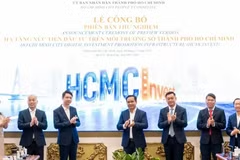
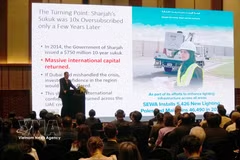
Vice Chairman of the provincial People's Committee Nguyen Huu Que said ESG is no longer a communications message or a cost burden, but an essential requirement for accessing global capital. Gia Lai has chosen ESG as a pillar for building new competitive advantages and achieving sustainable development.
As the Government rolls out the national programme on promoting sustainable business practices for 2026–2030, which aims to support 25,000 enterprises, household businesses and cooperatives in adopting circular economy models, the push for greener operations is becoming increasingly urgent. International regulations such as the EU's Carbon Border Adjustment Mechanism (CBAM), along with growing supply-chain transparency requirements from multinational corporations, are also compelling businesses to meet ESG standards in order to export, attract investment and secure long-term growth.
Chairman of the provincial People's Committee Pham Anh Tuan said Gia Lai is proactively building green value chains, developing eco-industrial parks and promoting high-tech agriculture, deep processing and smart logistics to support sustainable development and deeper integration into global supply chains.
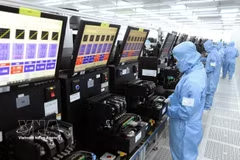
The province sees the 2026–2030 period as a “golden phase” for accelerating digital transformation, innovation, private-sector development and the green transition, with the ambition of becoming a new hub for processing industries, renewable energy, services, semiconductors and artificial intelligence in the central and Central Highlands region.
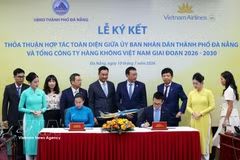
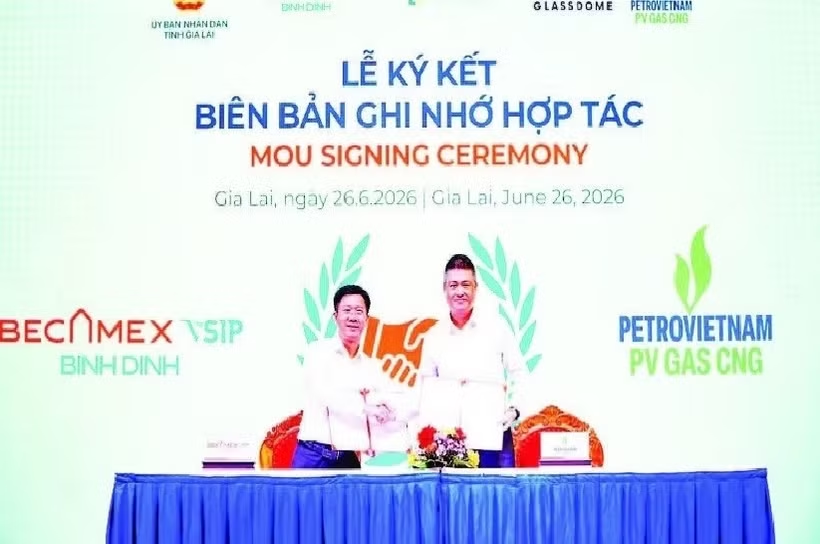
Recently, Becamex Binh Dinh signed a cooperation agreement with CNG Vietnam JSC to pioneer comprehensive clean-energy solutions at Becamex VSIP Binh Dinh, helping enterprises and industrial parks gradually meet ESG standards.
While ESG implementation may initially create pressure in terms of costs, technology and data management, it offers significant long-term benefits through lower operating costs, improved product quality and easier access to green finance.
Responsible investment and long-term value creation
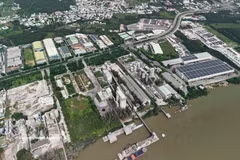
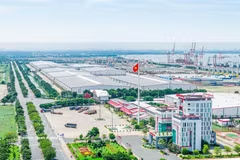
Gia Lai now has an expanded development space covering more than 21,500 sq.km and a population of about 3.5 million. With diverse ecosystems stretching from the highlands to the coast, more than 600,000 ha of forest, extensive agricultural land and a network of seaports, airports, border gates and industrial parks, the province has strong foundations for developing a green and circular economy, renewable energy, processing industries and logistics.
The participation of infrastructure developers such as Becamex Binh Dinh, which has experience in building modern, integrated, green and smart industrial parks, is expected to translate ESG commitments into concrete projects. Its partnership with CNG Vietnam is also expected to turn Becamex VSIP Binh Dinh into a hub for comprehensive clean-energy solutions, helping industrial parks reduce emissions while optimising costs for partners.
Nguyen Van Lang, General Director of Becamex Binh Dinh JSC, said the company is committed to building green infrastructure from the outset, including water and waste treatment systems, energy infrastructure and the digitalisation of environmental data to create a shared ESG platform. The platform will support businesses in technology adoption, governance and access to capital and markets.
He added that economic development must go hand in hand with improving living standards, ensuring social welfare, training human resources and creating a high-quality living environment for workers, experts and investors.
Gia Lai is also continuing to build a facilitating and service-oriented administration by streamlining procedures, enhancing transparency and maintaining regular dialogue with businesses and residents to address problems at their roots. Tuan said the province will implement a roadmap to shut down facilities that deliberately waste resources or cause environmental pollution, with the aim of prioritising businesses that make genuine contributions to green growth and sustainable development.
These commitments are being translated into action through cooperation with research institutes, international organisations, financing partners and pioneering companies such as Houselink, Glassdome, CNG Vietnam and Syre Impact AB. At the same time, the province is prioritising policies on land access, science and technology development and support for projects involving recycling and new materials.
According to Tuan, these measures will help businesses strengthen their ESG capabilities and give Gia Lai a solid advantage in attracting selective investment, developing clean energy, creating sustainable jobs and promoting local socio-economic development.
The province is committed to accompanying investors, protecting their legitimate interests, sharing risks and fostering a transparent, favourable and fairly competitive business environment for the benefit of the community, environmental protection and sustainable development, he said./.