Vietnam to pursue energy transition on suitable roadmap for sustainable growth: Deputy PM

According to the Deputy PM, the transition must simultaneously meet three key requirements: ensuring sufficient energy for economic growth, reducing emissions in line with Vietnam's international commitments, and guaranteeing a just transition for workers, businesses and localities.

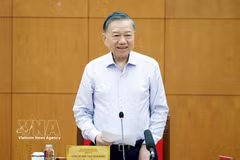
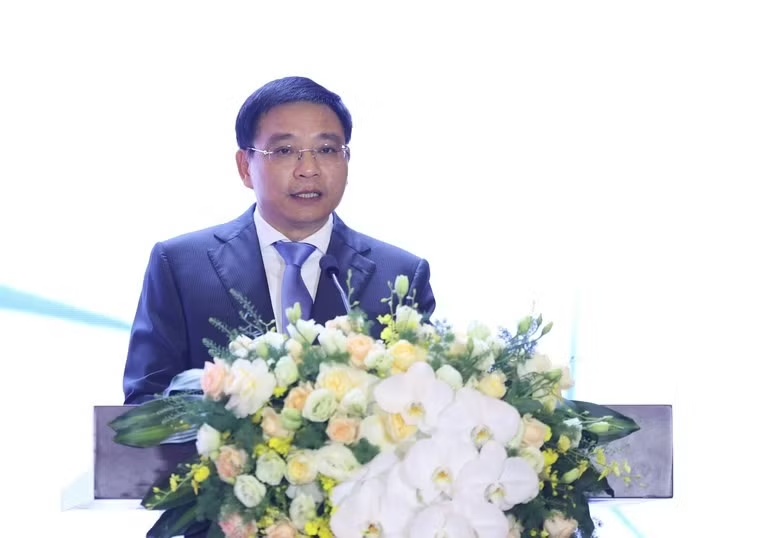
Deputy Prime Minister Nguyen Van Thang speaks at the World Energy and Environment Forum – Vietnam 2026 in Hanoi on July 8. (Photo: chinhphu.vn)

Hanoi (VNA) – Vietnam will pursue its energy transition through an appropriate roadmap that ensures efficiency, sustainability and energy security, Deputy Prime Minister Nguyen Van Thang said at the World Energy and Environment Forum – Vietnam 2026 in Hanoi on July 8.

Addressing the forum, themed "Vietnam's Pathway to Net Zero", the Deputy PM, who also chairs the National Council for Sustainable Development, said the country has entered a new stage of development when ensuring energy security, accelerating green transition and enhancing national competitiveness have become more urgent than ever.

He said the forum is an opportunity to translate commitments into concrete actions and strategies into practical projects while mobilising the participation of the whole society, particularly the business community.

Thang noted that climate change remains one of the world's greatest challenges, strongly affecting every aspect of socio-economic development. As a fast-growing and highly open economy with rising energy demand, Vietnam is among the countries most vulnerable to its impacts.

He reaffirmed the Party and State's commitment to pursuing fast growth alongside sustainable development, ensuring that economic expansion goes hand in hand with social progress, environmental protection and innovation.

Representatives from ministries and central agencies shared policy orientations for implementing Vietnam's commitment to achieving net-zero emissions by 2050.

Speakers agreed that energy security and green transition are complementary goals that should be advanced simultaneously through a modern and diversified energy system, efficient resource use, innovation, science – technology, and stronger private-sector engagement.

At the 26th United Nations Climate Change Conference (COP26), Vietnam pledged to achieve net-zero emissions by 2050. The commitment has since been incorporated into key national policies and strategies on energy security and energy development.

To advance energy transition, Thang said the Government will continue improving policies and mechanisms to build a comprehensive energy system, diversify energy sources, expand renewable energy and promote energy efficiency.

He stressed that Vietnam will continue investing in power transmission networks, energy storage, power system dispatch and a competitive electricity market while encouraging greater private-sector participation.

The transition will not involve the abrupt elimination of traditional energy sources. Instead, they will be used more efficiently through the application of advanced technologies to strictly control emissions and gradually reduce their share in the energy mix according to an appropriate roadmap, Thang said.

According to the Deputy PM, the transition must simultaneously meet three key requirements: ensuring sufficient energy for economic growth, reducing emissions in line with Vietnam's international commitments, and guaranteeing a just transition for workers, businesses and localities.

He reaffirmed Vietnam's principle of not sacrificing the environment for economic growth, saying the Government will strengthen environmental protection, tackle pollution more effectively and restore natural ecosystems. It will also accelerate the development of a circular economy and promote greener production and consumption to build a low-carbon economy.

Thang highlighted green finance and the domestic carbon market as key pillars of the country's climate strategy. He said Vietnam will continue refining its legal framework, expand green capital markets through green bonds and green credit, integrate environmental criteria into public budget management, and strengthen cooperation with international financial institutions to mobilise concessional financing and advanced technologies.

He also called on businesses to take the lead in developing emissions reduction roadmaps, integrating environmental, social and governance (ESG) standards into their long-term strategies, and investing in clean technologies. Localities, particularly those with strong renewable energy potential, should improve planning, better the investment environment, and streamline administrative procedures to create the best possible conditions for green investment projects.

The Government, he affirmed, will continue working closely with businesses and local authorities to remove obstacles and support Vietnam's journey towards its net-zero target./.

VNA

See more

The Ministry of Industry and Trade has reported initial signs that the fuel is helping reduce emissions and protect the environment. (Photo: VNA)

E10 biofuel shows initial environmental benefits: Ministry

An official said the initial results indicate the nationwide rollout has begun to achieve its intended objectives, but more comprehensive monitoring over a longer period, with a wider observation network and more frequent measurement, is needed for a precise and objective assessment.

Forest development in Phan Son commune, Lam Dong province. (Photo: nhandan.vn)

Vietnam lays groundwork for transparent carbon market

Experts say the launch of the trading platform is only the first step. The long-term success of the market will depend on a transparent system backed by robust measurement, reporting and verification (MRV) standards to ensure every transaction reflects genuine emissions reductions.

A rubber plantation are in Dong Nai province. Vietnam has more than 900,000 ha of rubber plantations, with over 60% operated by smallholders. (Photo: VNA)

Rubber traceability accelerated as EU deforestation regulation deadline nears

Speaking at a conference held recently in Ho Chi Minh City to gather feedback on draft EUDR compliance guidelines for the rubber sector, Nguyen Quoc Manh, Deputy Director of the Plant Production and Protection Department under the Ministry of Agriculture and Environment, said that Vietnam had spent the past three years preparing for the regulation through awareness campaigns, training programmes and coordination with ministries, local authorities and businesses.

A view of the Can Gio mangrove forest, a crucial "carbon sink" ecosystem that contributes to generating carbon credits for operating Vietnam's carbon market. (Photo: VNA)

Vietnam earns 56.5 million USD from forest carbon credit sales to World Bank

Speaking at a conference in Hanoi on July 2 to introduce Decree No. 180 on forest carbon sequestration and storage services, Luong said the latest transaction brought the country's total revenue from the transfer to 56.5 million USD, covering 11.3 million tonnes of CO2 emission reductions at a price of 5 USD per tonne.

Dray Sap Waterfall is located within the UNESCO Dak Nong Global Geopark in Nam Da commune, Lam Dong province. (Photo: VNA)

UNESCO review spurs conservation drive at Dak Nong Global Geopark

The provincial Department of Culture, Sports and Tourism, in collaboration with the Vietnam UNESCO Global Geoparks Network and relevant agencies, surveyed 41 geological, cultural and tourism sites across the geopark, identifying a number of issues requiring urgent attention to safeguard the site's outstanding values.

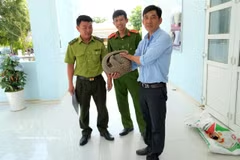
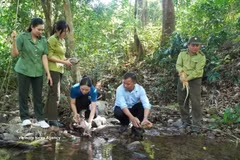
The release site is carefully selected to provide suitable ecological conditions and improve the pangolin's chances of survival in the wild. (Photo: VNA)

Tay Ninh releases rare pangolin back to nature

Following health checks, care and monitoring, the pangolin was confirmed be in good condition and fit for release. The release site was carefully selected to provide suitable ecological conditions and improve the animal's chances of survival in the wild.

Sarus cranes cranes are being cared for at Nakhon Ratchasima Zoo in Nakhon Ratchasima province, Thailand. (Photo: VNA)

Six sarus cranes from Thailand arrive in Dong Thap

Of the six cranes, two are males and four females, with individual weights ranging from 5.3kg to 6.7kg. The birds were raised at Nakhon Ratchasima Zoo in Thailand and transported to Vietnam by air.

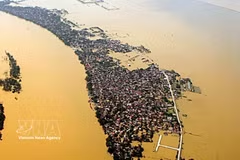
An area in Ha Tinh province under water following Storm Megi in October 2010 (Photo: VNA)

Conference delivers hydro-meteorological outlook for 2026

Deputy Minister of Agriculture and Environment Le Cong Thanh, in his speech, said climate change is making weather more severe and unpredictable, with a powerful El Nino set to hit Vietnam in the second half of 2026 and early 2027. Against such backdrop, enhancing forecasting and early warning capacity, while effectively translating scientific information into management decisions and timely response actions, has become urgent, he said.

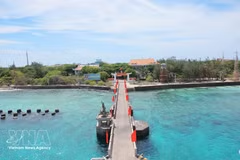
Truong Sa Lon (Big Spratly) of Vietnam (Photo: VNA)

Blue sea, strong economy: Vietnam’s vision for sustainable development

The robust growth of the marine economy has created significant opportunities for Vietnam while at the same time posing major challenges to marine environment protection. From coastal aquaculture areas and renowned tourist bays to marine protected areas rich in biodiversity, traces of plastic waste, land-based pollution and unsustainable exploitation remain visible every day.