E10 biofuel shows initial environmental benefits: Ministry

An official said the initial results indicate the nationwide rollout has begun to achieve its intended objectives, but more comprehensive monitoring over a longer period, with a wider observation network and more frequent measurement, is needed for a precise and objective assessment.

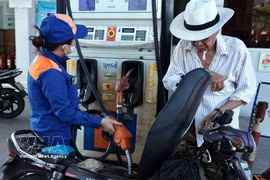
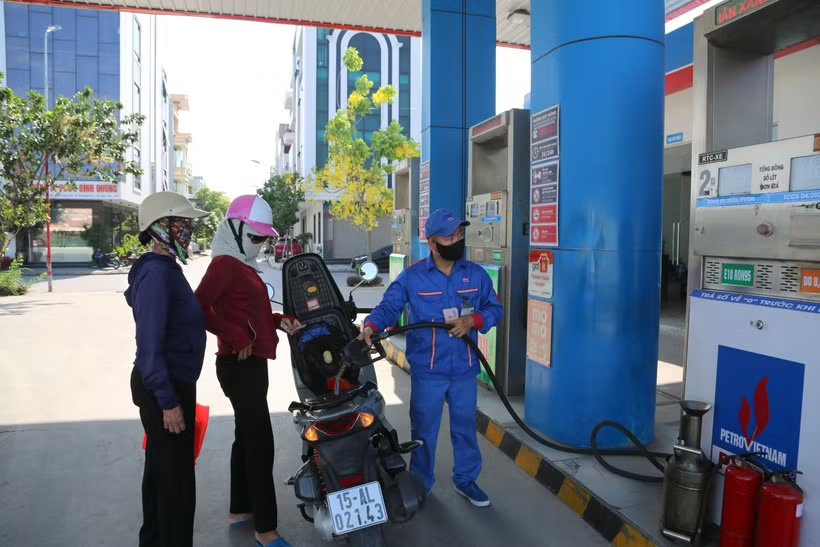
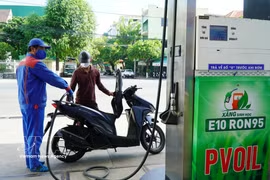
The Ministry of Industry and Trade has reported initial signs that the fuel is helping reduce emissions and protect the environment. (Photo: VNA)

​Hanoi (VNA) – One month since Vietnam launched nationwide sales of E10 biofuel, the Ministry of Industry and Trade (MoIT) has reported initial signs that the fuel is helping reduce emissions and protect the environment, but longer-term monitoring and a broader environmental observation network are needed to make full assessments on the benefits of switching to biofuel.

​​Speaking at the ministry's second-quarter press conference on July 7, Dao Duy Anh, Deputy Director of the Agency for Innovation, Green Transition and Industrial Promotion, said reducing emissions and protecting the environment are among the key objectives of replacing conventional petrol with E10.

Anh cited scientific calculations as showing that reducing each litre of fossil fuel can cut carbon dioxide emissions by about 2.3kg. Ethanol blending also increases the oxygen content of petrol, enabling more complete combustion, improving fuel efficiency and curbing the release of some pollutants.

​To assess E10's environmental impact, the MoIT requested monitoring data from the Centre for Environmental Monitoring under the Ministry of Agriculture and Environment. Initial data were collected in Hanoi and Ho Chi Minh City, where samples were taken before and after the nationwide rollout of E10 on June 1.

Preliminary results show several environmental indicators have declined although findings differ between the two cities, he noted.

Anh said the results are affected by factors such as traffic density, weather conditions, wind speed and sampling time. While the initial figures are encouraging, they are insufficient to conclude that the improvements are solely attributable to E10.

He stressed that more comprehensive monitoring over a longer period, with a wider observation network and more frequent measurement, is needed for a precise and objective assessment.

The MoIT has asked the Centre for Environmental Monitoring to continue collecting data not only in Hanoi and Ho Chi Minh City but also in other localities. Updated findings will be released once sufficient long-term data are available.

The MoIT has also gathered consumer feedback since the nationwide introduction of E10. Between June 1 and June 29, the Vietnam Competition Commission received 293 reports through its hotline and email. Most concerns related to fuel quality, difficulties locating E10 filling stations during the initial rollout, and worries about possible effects on vehicle performance. Some users also reported sluggish engine performance or engine stalling after refuelling with E10.

The ministry said all complaints have been handled or referred to relevant authorities for review.

After one month, E10 consumption reached about 1 million cubic metres, equivalent to the previous consumption of conventional petrol. According to major fuel wholesalers and distributors, there haven't been verified reports about E10 causing engine damage or adversely affecting vehicle performance.

Anh said the initial results indicate the nationwide rollout has begun to achieve its intended objectives. The ministry will continue monitoring both environmental indicators and consumer feedback to build a more comprehensive scientific database on the impact of E10 and provide accurate information for the public./
VNA

See more

Forest development in Phan Son commune, Lam Dong province. (Photo: nhandan.vn)

Vietnam lays groundwork for transparent carbon market

Experts say the launch of the trading platform is only the first step. The long-term success of the market will depend on a transparent system backed by robust measurement, reporting and verification (MRV) standards to ensure every transaction reflects genuine emissions reductions.

A rubber plantation are in Dong Nai province. Vietnam has more than 900,000 ha of rubber plantations, with over 60% operated by smallholders. (Photo: VNA)

Rubber traceability accelerated as EU deforestation regulation deadline nears

Speaking at a conference held recently in Ho Chi Minh City to gather feedback on draft EUDR compliance guidelines for the rubber sector, Nguyen Quoc Manh, Deputy Director of the Plant Production and Protection Department under the Ministry of Agriculture and Environment, said that Vietnam had spent the past three years preparing for the regulation through awareness campaigns, training programmes and coordination with ministries, local authorities and businesses.

A view of the Can Gio mangrove forest, a crucial "carbon sink" ecosystem that contributes to generating carbon credits for operating Vietnam's carbon market. (Photo: VNA)

Vietnam earns 56.5 million USD from forest carbon credit sales to World Bank

Speaking at a conference in Hanoi on July 2 to introduce Decree No. 180 on forest carbon sequestration and storage services, Luong said the latest transaction brought the country's total revenue from the transfer to 56.5 million USD, covering 11.3 million tonnes of CO2 emission reductions at a price of 5 USD per tonne.

Dray Sap Waterfall is located within the UNESCO Dak Nong Global Geopark in Nam Da commune, Lam Dong province. (Photo: VNA)

UNESCO review spurs conservation drive at Dak Nong Global Geopark

The provincial Department of Culture, Sports and Tourism, in collaboration with the Vietnam UNESCO Global Geoparks Network and relevant agencies, surveyed 41 geological, cultural and tourism sites across the geopark, identifying a number of issues requiring urgent attention to safeguard the site's outstanding values.

The release site is carefully selected to provide suitable ecological conditions and improve the pangolin's chances of survival in the wild. (Photo: VNA)

Tay Ninh releases rare pangolin back to nature

Following health checks, care and monitoring, the pangolin was confirmed be in good condition and fit for release. The release site was carefully selected to provide suitable ecological conditions and improve the animal's chances of survival in the wild.

Sarus cranes cranes are being cared for at Nakhon Ratchasima Zoo in Nakhon Ratchasima province, Thailand. (Photo: VNA)

Six sarus cranes from Thailand arrive in Dong Thap

Of the six cranes, two are males and four females, with individual weights ranging from 5.3kg to 6.7kg. The birds were raised at Nakhon Ratchasima Zoo in Thailand and transported to Vietnam by air.

An area in Ha Tinh province under water following Storm Megi in October 2010 (Photo: VNA)

Conference delivers hydro-meteorological outlook for 2026

Deputy Minister of Agriculture and Environment Le Cong Thanh, in his speech, said climate change is making weather more severe and unpredictable, with a powerful El Nino set to hit Vietnam in the second half of 2026 and early 2027. Against such backdrop, enhancing forecasting and early warning capacity, while effectively translating scientific information into management decisions and timely response actions, has become urgent, he said.

Truong Sa Lon (Big Spratly) of Vietnam (Photo: VNA)

Blue sea, strong economy: Vietnam’s vision for sustainable development

The robust growth of the marine economy has created significant opportunities for Vietnam while at the same time posing major challenges to marine environment protection. From coastal aquaculture areas and renowned tourist bays to marine protected areas rich in biodiversity, traces of plastic waste, land-based pollution and unsustainable exploitation remain visible every day.

Sea dike protection works to deal with the risk of erosion and rising sea levels in Hai Thinh commune, Ninh Binh province. (Photo: VNA)

Law amendments needed to strengthen disaster prevention and response: official

According to the Department of Dyke Management and Natural Disaster Prevention and Control under the Ministry of Agriculture and Environment, natural disasters during the 2020–2025 period caused increasingly serious damage nationwide. On average, natural disasters claimed more than 300 lives each year and caused economic losses exceeding 45 trillion VND (1.7 billion USD), up about 167% compared to the 2015–2019 period.