Rubber traceability accelerated as EU deforestation regulation deadline nears

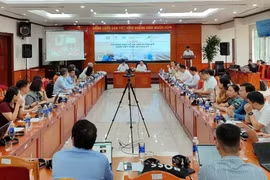
Speaking at a conference held recently in Ho Chi Minh City to gather feedback on draft EUDR compliance guidelines for the rubber sector, Nguyen Quoc Manh, Deputy Director of the Plant Production and Protection Department under the Ministry of Agriculture and Environment, said that Vietnam had spent the past three years preparing for the regulation through awareness campaigns, training programmes and coordination with ministries, local authorities and businesses.

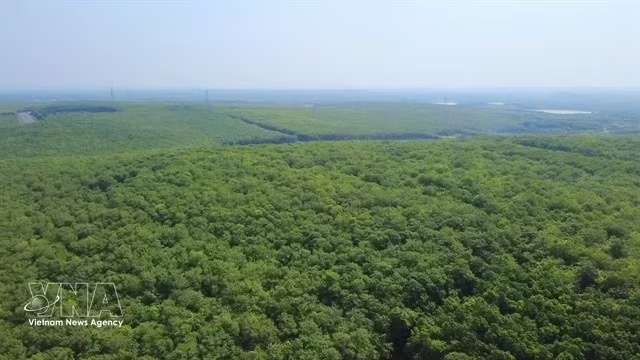
A rubber plantation are in Dong Nai province. Vietnam has more than 900,000 ha of rubber plantations, with over 60% operated by smallholders. (Photo: VNA)


Hanoi (VNS/VNA) - The rubber industry is racing to finalise compliance guidelines, plantation databases and traceability systems before the European Union's anti-deforestation regulation (EUDR) takes effect on January 1, 2027, while enhancing competitiveness towards transparency and sustainable development.

Speaking at a conference held recently in Ho Chi Minh City to gather feedback on draft EUDR compliance guidelines for the rubber sector, Nguyen Quoc Manh, Deputy Director of the Plant Production and Protection Department under the Ministry of Agriculture and Environment, said that Vietnam had spent the past three years preparing for the regulation through awareness campaigns, training programmes and coordination with ministries, local authorities and businesses.

“Preparation time is limited, so finalising the guidance document is critical to ensure consistent implementation," Manh said.

The ministry will continue working with international organisations including GIZ, IDH, FAO and Forest Trends to complete a national action plan on EUDR compliance, expand plantation databases, improve traceability systems and provide training for farmers and exporters during the second half of 2026, he said.

The EUDR requires exports of products, including rubber, coffee, timber, cocoa, palm oil and cattle products, to prove they are not linked to deforestation after December 31, 2020, comply with national laws and include a due diligence statement (DDS) with traceability to production areas.

To meet those requirements, the ministry is building an EUDR compliance framework for the rubber, coffee and timber industries, alongside a national traceability platform and databases covering forest boundaries and plantation areas.

The department said that each plantation will receive a traceability code linked to information including land ownership, geographic coordinates, production records, purchasing companies, processors and exporters.

However, implementation remains challenging because Vietnam has more than 900,000 ha of rubber plantations, with over 60% operated by smallholders, making data collection and traceability more difficult. Incomplete land-use documentation and limited awareness of the new rules among farmers are also among the challenges.

The department said it is pressing for Vietnam to complete its plantation database, issue official compliance guidance and step up private-sector participation in mapping plantation coordinates, verifying land ownership and helping farmers complete the required documentation to meet the implementation timeline.

Diep Xuan Truong, deputy head of VRG's Industry Department, said EUDR compliance could increase rubber selling prices by 150 USD-250 USD per tonne, meaning additional revenue of 80 billion VND (3.1 million USD).

However, extending compliance to smallholder farmers remains difficult because of incomplete legal documents, missing geolocation data and limited awareness of the regulation, he said.

General Secretary of the Vietnam Rubber Association Vo Hoang An said that although the EU is not the largest market for natural rubber, it is an important destination for higher-value processed products such as tyres, gloves and industrial rubber goods, making EUDR compliance strategically important for maintaining market access and improving competitiveness.

The association urged the development of a shared national traceability system together with support for land certification and geolocation for smallholders, as well as financial and technical assistance during implementation.

The association also proposed a two-to-three-year transition period for smallholder producers.

The industry's exports reached about 11.5 billion USD in 2025, including around 772 million USD shipped to the EU./.

VNA
See more

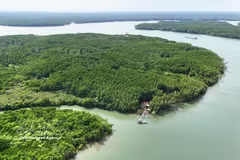
A view of the Can Gio mangrove forest, a crucial "carbon sink" ecosystem that contributes to generating carbon credits for operating Vietnam's carbon market. (Photo: VNA)

Vietnam earns 56.5 million USD from forest carbon credit sales to World Bank

Speaking at a conference in Hanoi on July 2 to introduce Decree No. 180 on forest carbon sequestration and storage services, Luong said the latest transaction brought the country's total revenue from the transfer to 56.5 million USD, covering 11.3 million tonnes of CO2 emission reductions at a price of 5 USD per tonne.

Dray Sap Waterfall is located within the UNESCO Dak Nong Global Geopark in Nam Da commune, Lam Dong province. (Photo: VNA)

UNESCO review spurs conservation drive at Dak Nong Global Geopark

The provincial Department of Culture, Sports and Tourism, in collaboration with the Vietnam UNESCO Global Geoparks Network and relevant agencies, surveyed 41 geological, cultural and tourism sites across the geopark, identifying a number of issues requiring urgent attention to safeguard the site's outstanding values.

The release site is carefully selected to provide suitable ecological conditions and improve the pangolin's chances of survival in the wild. (Photo: VNA)

Tay Ninh releases rare pangolin back to nature

Following health checks, care and monitoring, the pangolin was confirmed be in good condition and fit for release. The release site was carefully selected to provide suitable ecological conditions and improve the animal's chances of survival in the wild.

Sarus cranes cranes are being cared for at Nakhon Ratchasima Zoo in Nakhon Ratchasima province, Thailand. (Photo: VNA)

Six sarus cranes from Thailand arrive in Dong Thap

Of the six cranes, two are males and four females, with individual weights ranging from 5.3kg to 6.7kg. The birds were raised at Nakhon Ratchasima Zoo in Thailand and transported to Vietnam by air.

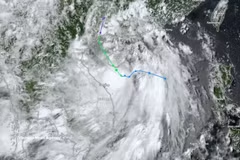
An area in Ha Tinh province under water following Storm Megi in October 2010 (Photo: VNA)

Conference delivers hydro-meteorological outlook for 2026

Deputy Minister of Agriculture and Environment Le Cong Thanh, in his speech, said climate change is making weather more severe and unpredictable, with a powerful El Nino set to hit Vietnam in the second half of 2026 and early 2027. Against such backdrop, enhancing forecasting and early warning capacity, while effectively translating scientific information into management decisions and timely response actions, has become urgent, he said.

Truong Sa Lon (Big Spratly) of Vietnam (Photo: VNA)

Blue sea, strong economy: Vietnam’s vision for sustainable development

The robust growth of the marine economy has created significant opportunities for Vietnam while at the same time posing major challenges to marine environment protection. From coastal aquaculture areas and renowned tourist bays to marine protected areas rich in biodiversity, traces of plastic waste, land-based pollution and unsustainable exploitation remain visible every day.

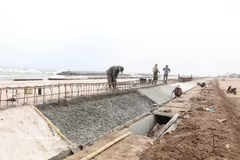
Sea dike protection works to deal with the risk of erosion and rising sea levels in Hai Thinh commune, Ninh Binh province. (Photo: VNA)

Law amendments needed to strengthen disaster prevention and response: official

According to the Department of Dyke Management and Natural Disaster Prevention and Control under the Ministry of Agriculture and Environment, natural disasters during the 2020–2025 period caused increasingly serious damage nationwide. On average, natural disasters claimed more than 300 lives each year and caused economic losses exceeding 45 trillion VND (1.7 billion USD), up about 167% compared to the 2015–2019 period.

Deputy Prime Minister Ho Quoc Dung chairs a meeting in Hanoi on June 17, 2026 to discuss the draft law amending and supplementing a number of articles of the Law on Environmental Protection. (Photo: baochinhphu.vn)

Deputy PM identifies three major environmental issues requiring special attention

The pressing concerns comprise persistent environmental hotspots in industrial parks and industrial clusters; increasingly complex air and water pollution in major cities directly affecting public health; and shortcomings in waste management and wastewater treatment across river basins and rural areas that have yet to meet practical requirements.

Illustrative photo (Photo: VNA)

Vietnam accelerates adoption of sustainable aviation fuel

In Vietnam, airlines, fuel suppliers and energy companies have begun collaborating to deploy SAF on commercial flights, demonstrating that key links in the fuel value chain—from production and supply to operation—are gradually taking shape.