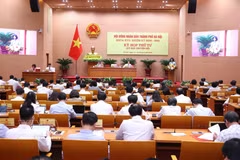
Hanoi (VNA) – The Vietnam Meteorological and Hydrological Administration under the Ministry of Agriculture and Environment, together with the United Nations Development Programme (UNDP) in Vietnam, on June 23 convened a conference to deliver hydro-meteorological outlook for 2026.
The event was funded by the Canadian Government through the project “Vietnam Climate-Smart Coastal Communities” carried out by UNDP.
Deputy Minister of Agriculture and Environment Le Cong Thanh, in his speech, said climate change is making weather more severe and unpredictable, with a powerful El Nino set to hit Vietnam in the second half of 2026 and early 2027. Against such backdrop, enhancing forecasting and early warning capacity, while effectively translating scientific information into management decisions and timely response actions, has become urgent, he said.
He pushed for faster adoption of sci-tech, digital transformation, artificial intelligence, and data sharing to sharpen forecasts and warnings, cut disaster losses, safeguard water and food security, settle down lives, and support sustainable socio-economic development.
The official also called on experts to fully assess El Nino’s impacts, flag risks early, and propose tailored countermeasures for sectors and localities. The conference’s findings, he said, will provide a critical foundation for ministries, agencies, and local authorities to build proactive response scenarios that ensure water and food security as well as socio-economic stability.
Canadian Ambassador to Vietnam Jim Nickel noted that the event underscores the increasingly strong partnership between Canada and Vietnam in bolstering climate resilience.
Connecting Canadian experts with Vietnamese partners is advancing practical, science-based solutions to protect lives and livelihoods. That partnership, he added, reflects a shared commitment to a safer, more resilient future where climate preparedness forms the bedrock of sustainable development.
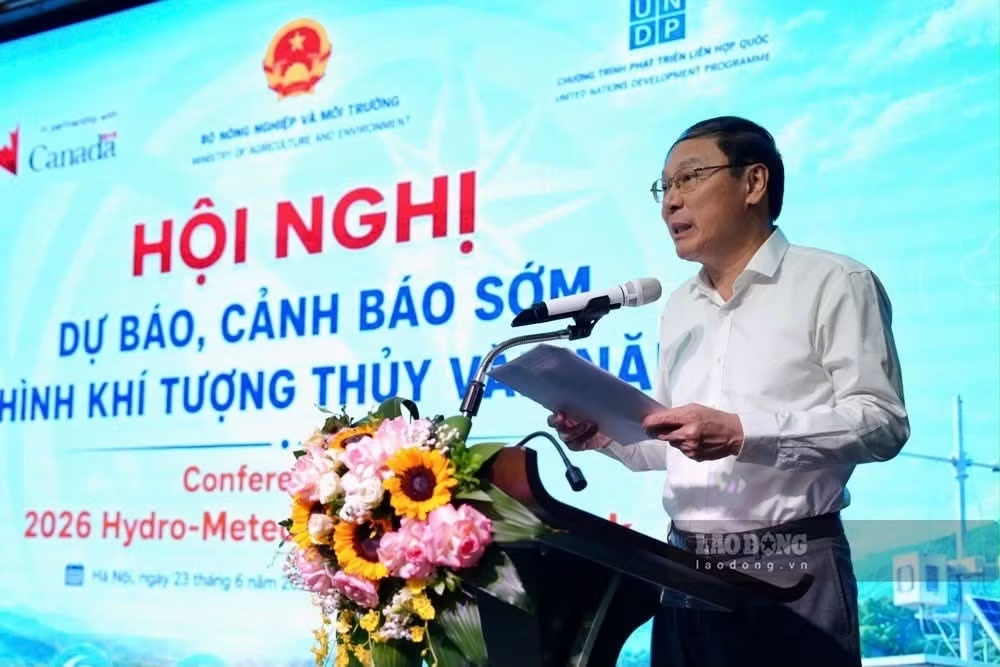
Outlining disaster trends for the latter months of 2026, Hoang Phuc Lam, Vice Director of the National Centre for Hydro-Meteorological Forecasting, said the El Nino–Southern Oscillation will remain in a strong El Niño phase from July through December. The probability of a very strong event climbs to 63% during November 2026–January 2027. As a result, nationwide temperatures in the final months of 2026 are forecast to stay above long-term averages, with more hot days than both the climatological norm and 2025 levels.
Heatwaves are expected to persist from July through September, especially in northern Vietnam, the Thanh Hoa – Hue region, and the south central coast. Heat should ease gradually in the north from early September and in central regions from mid-September. Average temperatures through end-2026 are set to run 0.5–1.5 degrees Celsius above normal.
El Niño is also projected to slash rainfall nationwide by 25-50%. Upstream flows of the Mekong River are forecast to decline markedly, while saltwater intrusion could arrive earlier and push further inland, threatening farming. Forest fire risk is set to rise, and even if fewer tropical storms form, those that do develop could be more intense and harder to predict.
The East Sea faces a below-average typhoon season, with about 8-10 storms forecast and 3-5 likely to affect Vietnam’s mainland. Storm impacts are expected to concentrate in the north during July–September and in central regions during October–November, though a late-year hit on the south cannot be ruled out.
Cold air outbreaks are forecast to be fewer than usual, arriving later and ending earlier than normal.
Nationwide, between 16 and 19 episodes of widespread heavy rain may occur, below the long-term average, mostly in the rainy season from late June through November. The rainy season is also expected to end earlier than usual along the south-central coast, in the Central Highlands, and across the south.
Delegates also proposed measures to enhance forecasting and early warning, strengthen disaster risk management, and build community resilience, contributing to sustainable socio-economic development.
The event also aimed to accelerate a shift from traditional forecasting toward impact-based warning systems, while deepening data sharing, information connectivity, inter-agency coordination, and international cooperation to build multi-hazard early warning systems that support effective disaster management and response at every level./.