Preparations for UNESCO revalidation underway at Dak Nong Global Geopark

Maintaining the UNESCO Global Geopark status is expected to further elevate the international profile of Lam Dong’s geological heritage while supporting sustainable tourism and green economic growth linked to the preservation of natural and cultural assets.

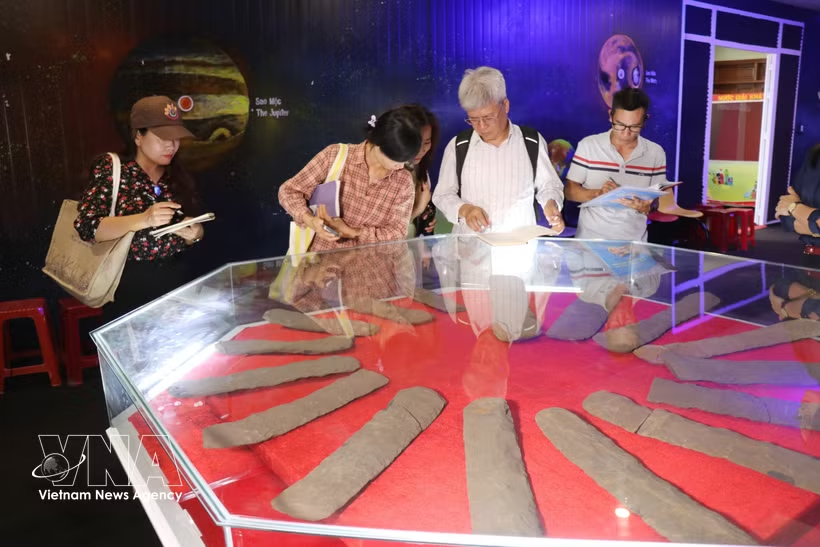
Experts from the Vietnam UNESCO Global Geoparks Network conduct a site survey at the Sound Exhibition House in Bac Gia Nghia ward, Lam Dong province. (Photo: VNA)

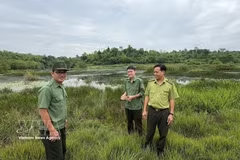
Lam Dong (VNA) – Lam Dong province's Department of Culture, Sports and Tourism, in collaboration with the Vietnam UNESCO Global Geoparks Network, carried out a field assessment of tourism routes and heritage sites across the Dak Nong Geopark from June 8–11 to evaluate the implementation of UNESCO recommendations.

The survey covered three tourism routes and nearly 50 heritage and visitor attractions, including Ta Dung Lake, Nam Kar volcanic range, Krong No volcanic cave system, historical sites along Truong Son route, community-based tourism destinations, traditional craft villages and indigenous cultural spaces.

During the inspection, experts assessed infrastructure and visitor facilities while consulting local authorities, businesses and communities on challenges related to heritage conservation, management and sustainable development.

Experts noted that, UNESCO is increasingly emphasising community engagement alongside heritage preservation. As such, community-based tourism, the safeguarding of traditional livelihoods and cultural identities, and the creation of sustainable income opportunities for local residents remain central to the geopark’s revalidation process.

The review identified several priorities, including strengthening management and protection measures at heritage sites, improving interpretive and directional signs, enhancing connectivity between destinations and expanding tourism products. The findings will help shape Lam Dong’s investment and upgrade plans for 2026–2027 ahead of the UNESCO assessment.
vnanet-potal-lam-dong-chuan-bi-tai-tham-dinh-cong-vien-dia-chat-toan-cau-unesco-dak-nong-8822088.jpg
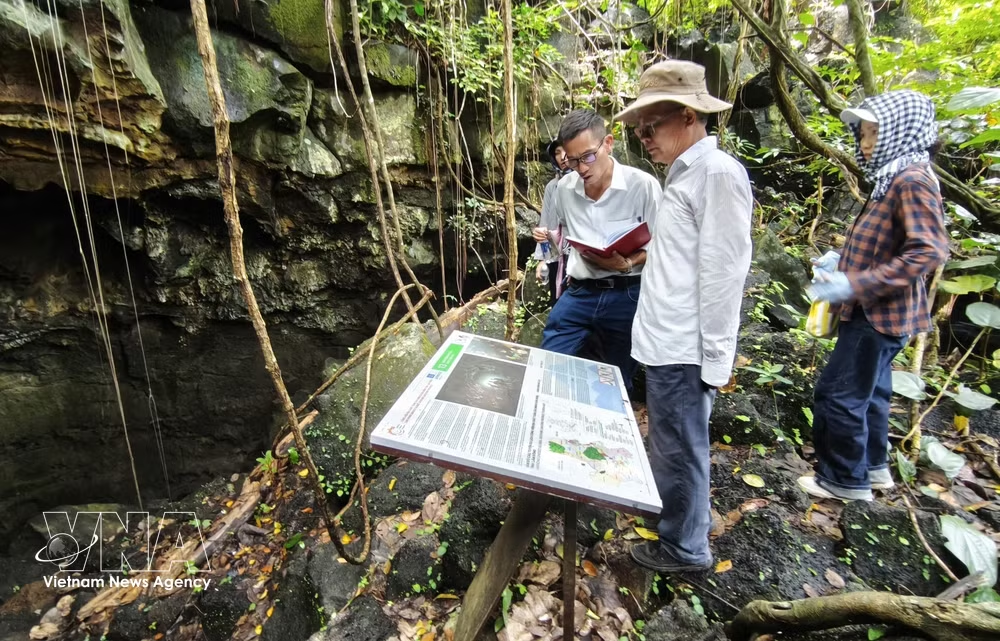
Assoc. Prof. Dr. Tran Tan Van (wearing a hat), Coordinator of the Vietnam UNESCO Global Geoparks Network, surveys Cave C4 in the volcanic cave system of the UNESCO Global Geopark Dak Nong in Nam Da commune, Lam Dong province. (Photo: VNA)

Assoc. Prof. Dr. Tran Tan Van, Coordinator of the Vietnam UNESCO Global Geoparks Network, said the geopark still faces a number of shortcomings that need to be addressed within a limited preparation timeframe.

He called for a coordinated approach, including strengthening the management structure, increasing specialised personnel, upgrading infrastructure and visitor facilities, and intensifying promotional activities. Greater efforts are also needed to raise the geopark’s visibility across the newly expanded province and among international visitors and experts, he said.

Van also stressed the importance of introducing appropriate management mechanisms to encourage the private sector's participation in heritage conservation and promotion, while continuing to draw on international expertise to support the revalidation process.

Le Thi Truc Linh, Deputy Director of the provincial Department of Culture, Sports and Tourism, said the department will advise provincial authorities on implementing key measures, prioritising resources to address UNESCO's recommendations, improve infrastructure and heritage sites, and strengthen the role of local administrations in heritage management and tourism promotion.

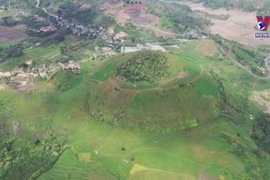
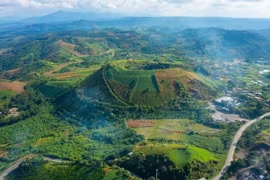
Following the recent administrative restructuring, the UNESCO Global Geopark Dak Nong now spans approximately 4,760 sq.km across 22 communes and wards in western Lam Dong. The area is home to nearly 50 volcanic caves formed in basalt rock, one of the largest and most distinctive volcanic cave systems in Southeast Asia, along with ancient volcanoes, waterfalls, natural lakes and the rich cultural heritage of the M'nong, E De, Ma and other ethnic communities.

Maintaining the UNESCO Global Geopark status is expected to further elevate the international profile of Lam Dong’s geological heritage while supporting sustainable tourism and green economic growth linked to the preservation of natural and cultural assets./.
VNA

See more

Recognising the maritime economy as one of its strategic pillars, Da Nang city aims to develop into a world-class coastal megacity (Photo: VNA)

Strong maritime nation takes shape through blue future

The vision of a strong maritime nation will be reflected in green ports, offshore wind farms, thriving coastal communities, restored mangrove forests, sustainable coastal cities, resilient island outposts and generations of Vietnamese equipped with ocean knowledge and a deep sense of responsibility for the nation’s maritime future.

A Vietnamese pheasant chick born at Pairi Daiza Zoo in Belgium (Photo: published by VNA)

Vietnamese pheasants successfully hatched at Belgian zoo

The chicks were born at Pairi Daiza’s Oasis greenhouse following a carefully monitored breeding and care programme. According to the International Union for Conservation of Nature (IUCN), the Vietnamese pheasant is classified as Critically Endangered and may already be extinct in the wild.

An endangered Asian elephant in the wild in the Central Highlands region in Vietnam. (Photo courtesy of Animals Asia)

Conservation project set to protect endangered elephant herds

WWF VN said the non-refundable grant worth 23.9 billion VND (908,000 USD) will help provide conservation and protection solutions for the wild elephant community, including by creating safe migratory corridors, improving habitat and reducing conflict between humans and wildlife.

The national campaign launched to mobilise public action for a greener, cleaner and more beautiful Vietnam. (Photo: VNA)

National environmental protection campaign calls for public action

Hoai stressed that protecting the environment is a shared responsibility of authorities, businesses, organisations and citizens, calling on the public to adopt practical measures such as reducing litter, limiting single-use plastics, conserving resources, planting trees and sorting waste at source.

Members of the “Kindness for Sa Can” project collect plastic waste at the Sa Can estuary in Quang Ngai province. (Photo: VNA)

Front calls on entire people to join hands in environmental protection campaign

In the appeal, the VFF Central Committee's Presidium noted that environmental protection has been identified by the Party and State as a strategic priority. The 14th National Party Congress highlighted the need to harmonise economic, cultural and social development with environmental protection and improvements in living standards.

Officers release the rare elongated tortoise (Indotestudo elongata) back into its natural habitat in the Ta Thiet historical forest area. (Photo: VNA)

Rare elongated tortoise released into the wild in Dong Nai

The elongated tortoise is one of the most beautiful and rare terrestrial tortoise species, listed in both the Vietnam Red Data Book and the International Union for Conservation of Nature (IUCN) Red List of Threatened Species. It typically inhabits tropical and subtropical forests and plays an important role in maintaining ecological balance. However, due to illegal trade and habitat loss, its wild population has been declining sharply.

Cai Khe ward of Can Tho city is under water after a storm (Photo: VNA)

Can Tho pushes JICA-funded drainage project to deliver results in 18 months

The Japan International Cooperation Agency (JICA)-funded technical cooperation project on drainage management for climate resilience in Can Tho aims to improve planning capacity for wastewater collection, enhance operations and management of existing treatment plants, and the city’s ability to run public awareness campaigns.

Plastic waste poses a growing challenge to communities and societies around the world, including Vietnam. (Illustrative photo: VNA)

Wide range of activities planned for 2026 environment and marine awareness campaign

A series of environmental and marine-related events to held in the central province of Nghe An from June 4-6 will generate a broad social impact, helping transform awareness into action and commitments into concrete results, and contributing to Vietnam’s goals of green growth, circular economy development, net-zero emissions and harmonious coexistence between people and nature.

At the working session (Photo: VNA)

AFD, Lang Son move to fast-track climate resilience project

The climate resilience and sustainable infrastructure project in Lang Son consists of two main components, focusing on sustainable infrastructure and environmental improvement; and technical assistance and capacity building, with AFD experts expected to train project management officials and local agencies in disaster response and climate adaptation.

People wear sun-protective clothing when going outside in Quang Ninh province. (Photo: VNA)

Forecast of more intense heat and complex typhoons in summer

The number and activity of tropical cyclones and depressions over the East Sea, internationally known as the South China Sea, and their direct impacts on mainland Vietnam are expected to be comparable to the multi-year average. The long-term average over the East Sea is 5.2 typhoons, with 1.9 making landfall.

An overview of the seminar reviewing the project’s implementation during the 2021–2026 period (Photo: VNA)

Hue project prevents over 933 tonnes of plastic waste leakage

Launched in 2021 with funding from the Norwegian people through WWF-Norway and WWF-Vietnam, the “Hue – Plastic Smart City in Central Vietnam” project aims to help Hue protect rivers, wetlands and coastal ecosystems from plastic pollution while building the city into a model plastic-reduced urban area in central Vietnam.

Deputy Minister of Agriculture and Environment Nguyen Quoc Tri speaks at the event. (Photo: VNA)

Vietnam diversifies financing mechanisms for nature conservation

Initiatives on biodiversity finance, carbon credits, public – private partnerships, nature-based tourism, and private sector investment are creating more opportunities to increase resources for ecosystem conservation and restoration, said an official.