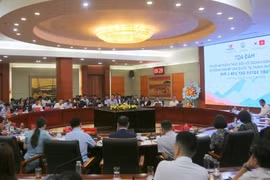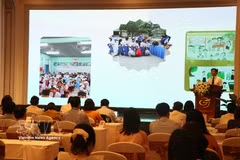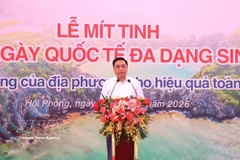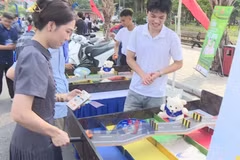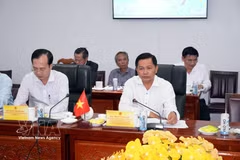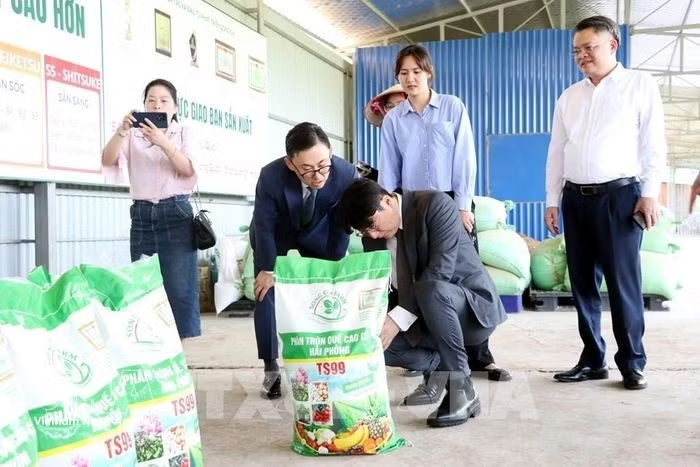
Hai Phong (VNA) – A cooperation programme under the KOICA IBS project was launched in Luu Kiem ward, Hai Phong city, on May 26 with a view to promoting circular agriculture, environmental treatment and sustainable development.
The programme is a partnership between the Song Gia Investment and Development Cooperative, the Eco Hopia Co., Ltd., and the Korea Institute of Science and Technology (KIST).
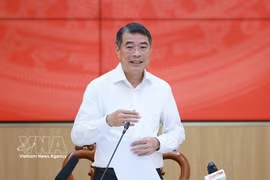
Speaking at the event, Chairman of the Hai Phong Farmers' Association Trinh Van Thien praised the scientific and technological achievements of the Republic of Korea (RoK), particularly those of Eco Hopia, as well as the proactive efforts of the Song Gia Investment and Development Cooperative in seeking international cooperation and introducing advanced technologies to the locality.
He pledged support for coordination and connectivity efforts to ensure that innovative and science-based projects such as the KOICA IBS initiative are implemented effectively and integrated into local agricultural practices.
Do Thi Thuy Ha, Director of the Song Gia Investment and Development Cooperative, said Hai Phong generates approximately 3,300 tonnes of waste each day, of which 70–80% is organic. The northern city is also grappling with the proliferation of water hyacinth in rivers, which obstructs water flows and worsens environmental pollution.
To address these challenges, the cooperative has been applying biological treatment solutions using water hyacinth, organic waste and agricultural by-products as inputs. Over the past five years, it has developed three models that produce organic fertilisers and microbial products for waste treatment.
However, Ha noted that the current technologies are not sufficient to support large-scale waste processing. The cooperative is therefore seeking international partnerships to modernise its technology and enhance environmental treatment capacity.
She said if the cooperation progresses successfully and the technologies proves suitable for local conditions, it could create significant opportunities for developing a circular economy.
Describing his company as one of the RoK's leading bioenergy enterprises, Wonbae Kim, Chief Executive Officer of Eco Hopia, said that beyond helping Hai Phong tackle environmental issues, the company's primary objective is to transfer advanced technologies to Vietnam, enabling local partners to master them and contribute to the sustainable development of the country's agricultural sector.
He added the project will proceed following thorough feasibility studies and assessments of its effectiveness.
According to the Hai Phong Farmers' Association, the city faces increasing challenges from growing volumes of organic waste, environmental pollution, declining soil quality, and rising demand for greener and more sustainable agricultural production. The treatment of organic biomass sources such as water hyacinth, agricultural by-products and organic waste requires effective and environmentally friendly solutions that can also generate economic value.
Thien stressed that cooperation models focusing on biotechnology applications, organic resource recycling, emissions reduction, circular economy development and value-added agricultural production are particularly relevant in the current context.
Although Hai Phong has successfully implemented a number of green agriculture initiatives and developed many products certified under the One Commune, One Product (OCOP) programme, most of these models remain small-scale and fragmented, he said.
The official expressed his hope that the international partnership will provide a breakthrough solution capable of standardising and expanding existing models on a larger and more professional scale.
He also called on Korean experts and the Song Gia Cooperative's leadership to work together to ensure farmers can readily adopt and operate the technologies. He noted demonstrating tangible economic benefits, increasing farmers’ incomes, reducing production costs, and ensuring scalability will be key to transforming the Song Gia model into a pilot initiative that can be replicated across Hai Phong./.