Top leader orders shift to proactive disaster risk management

Disaster prevention must be woven into national development planning, public investment, production, business, investment attraction, social welfare and livelihood protection, said top leader To Lam.

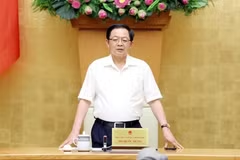
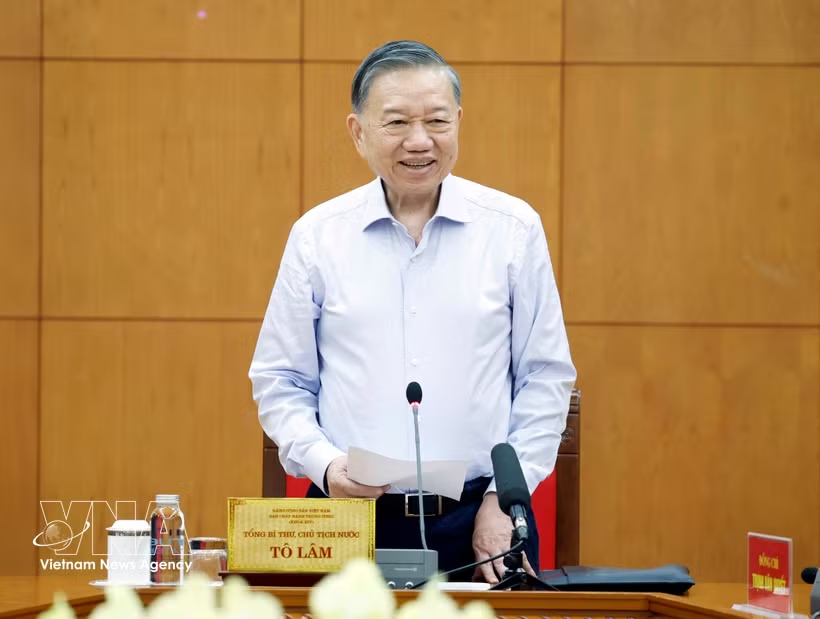
Party General Secretary and State President To Lam speaks at the meeting (Photo: VNA)

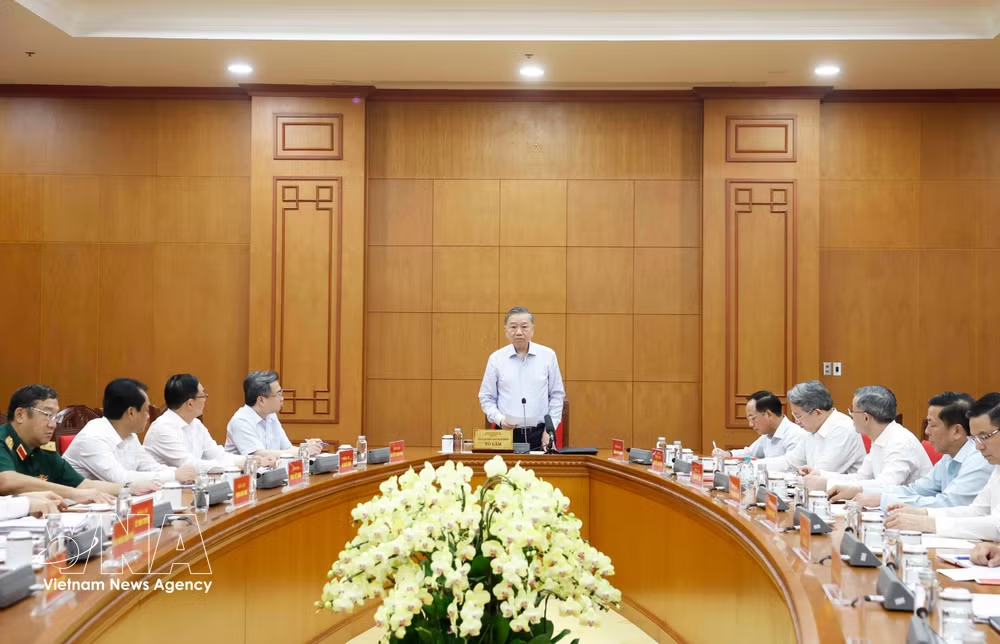
Hanoi (VNA) - Party General Secretary and State President To Lam ordered a systemic shift from reactive disaster response to proactive risk management at a June 29 meeting in Hanoi, directing the Government Party Committee and agencies to brace for storms, floods, extreme weather and climate change through late 2026.

Disaster prevention must be woven into national development planning, public investment, production, business, investment attraction, social welfare and livelihood protection, he stressed.

He said the approach must shift from mopping up after disasters to preempting risks early and from afar, from seasonal reaction to year-round readiness, and from experience-based management to data-driven governance anchored in sci-tech, law, planning discipline and leadership accountability.

Protecting human life is the highest priority and the foremost command, he said, adding that every contingency plan, operational decision and resource must first and foremost be directed toward safeguarding the public, particularly the elderly, children, pregnant women, the disabled, the sick, poor households, those living alone and in high-risk zones.

Through the year-end, he instructed agencies to carry out a full review and update of all 2026 disaster response scenarios, customising them to specific regions, river basins, infrastructure categories and vulnerable groups.

He also ordered proactive preparations for drought, water shortages and saltwater intrusion in the 2026–2027 dry season. The south central coast, Central Highlands and Mekong Delta regions were told to pre-plan crops, boost water storage, regulate reservoirs, secure water supplies, prevent forest fires; protect crops, livestock, aquaculture and fruit output; support livelihoods, and ensure clean water access in all conditions. Steps should also shield production, critical infrastructure and local economic growth targets.

The Government Party Committee was tasked with turning the meeting’s conclusions into a detailed action plan through late 2026, with clearly defined responsibilities for ministries and agencies, deadlines, resource allocations and monitoring mechanisms.

Municipal and provincial authorities, he said, must assume direct responsibility for disaster management in their mandates. Provincial Party secretaries and People’s Committee chairpersons were required to personally supervise high-risk zones, while commune-level officials must keep accurate, real-time data on local populations, terrain and hazards, not just filing general reports.
vnanet-o.jpg
Party General Secretary and State President To Lam speaks at the meeting (Photo: VNA)

The Vietnam Fatherland Front and mass organisations must uphold their role in mass mobilisation, oversight and community support, pooling local volunteers for prevention, emergency response and recovery, and ensuring aid is delivered transparently and reaches the right recipients, he added.

Looking to 2026–2030, the top leader stressed the imperative to overhaul the legal framework, calling for a review and amendment of laws and regulations on disaster prevention, civil defence, water resources, irrigation, dyke management, hydrometeorology, planning, public investment, state budget, insurance, search and rescue, and the mobilisation of personnel and assets.

He also called for the rapid drafting, approval and rollout of the national disaster prevention and control plan for 2026–2030, to be aligned with the national disaster prevention strategy to 2030 with a vision to 2050, the master plan on disaster prevention and irrigation for 2021–2030 with a vision to 2050, and related river basin, urban, rural, transport, energy, land-use and construction blueprints./.

VNA

See more

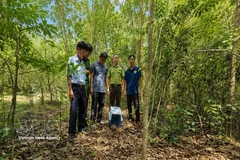
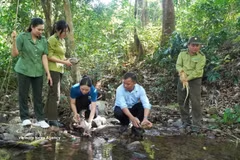
The release site is carefully selected to provide suitable ecological conditions and improve the pangolin's chances of survival in the wild. (Photo: VNA)

Tay Ninh releases rare pangolin back to nature

Following health checks, care and monitoring, the pangolin was confirmed be in good condition and fit for release. The release site was carefully selected to provide suitable ecological conditions and improve the animal's chances of survival in the wild.

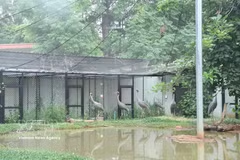
Sarus cranes cranes are being cared for at Nakhon Ratchasima Zoo in Nakhon Ratchasima province, Thailand. (Photo: VNA)

Six sarus cranes from Thailand arrive in Dong Thap

Of the six cranes, two are males and four females, with individual weights ranging from 5.3kg to 6.7kg. The birds were raised at Nakhon Ratchasima Zoo in Thailand and transported to Vietnam by air.

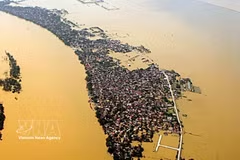
An area in Ha Tinh province under water following Storm Megi in October 2010 (Photo: VNA)

Conference delivers hydro-meteorological outlook for 2026

Deputy Minister of Agriculture and Environment Le Cong Thanh, in his speech, said climate change is making weather more severe and unpredictable, with a powerful El Nino set to hit Vietnam in the second half of 2026 and early 2027. Against such backdrop, enhancing forecasting and early warning capacity, while effectively translating scientific information into management decisions and timely response actions, has become urgent, he said.

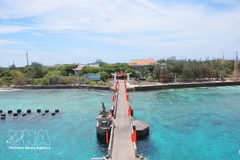
Truong Sa Lon (Big Spratly) of Vietnam (Photo: VNA)

Blue sea, strong economy: Vietnam’s vision for sustainable development

The robust growth of the marine economy has created significant opportunities for Vietnam while at the same time posing major challenges to marine environment protection. From coastal aquaculture areas and renowned tourist bays to marine protected areas rich in biodiversity, traces of plastic waste, land-based pollution and unsustainable exploitation remain visible every day.

Deputy Prime Minister Ho Quoc Dung chairs a meeting in Hanoi on June 17, 2026 to discuss the draft law amending and supplementing a number of articles of the Law on Environmental Protection. (Photo: baochinhphu.vn)

Deputy PM identifies three major environmental issues requiring special attention

The pressing concerns comprise persistent environmental hotspots in industrial parks and industrial clusters; increasingly complex air and water pollution in major cities directly affecting public health; and shortcomings in waste management and wastewater treatment across river basins and rural areas that have yet to meet practical requirements.

Illustrative photo (Photo: VNA)

Vietnam accelerates adoption of sustainable aviation fuel

In Vietnam, airlines, fuel suppliers and energy companies have begun collaborating to deploy SAF on commercial flights, demonstrating that key links in the fuel value chain—from production and supply to operation—are gradually taking shape.

Vietnam's 12 world biosphere reserves underscore commitment to environmental protection and sustainable development (Photo: VNA)

Vietnam's 12 world biosphere reserves showcase commitment to environmental protection, sustainable development

On June 5, 2026, the 38th session of the International Coordinating Council of UNESCO's Man and the Biosphere Programme (MAB-ICC 38) officially designated Vietnam's Phong Nha–Ke Bang National Park as a member of the World Network of Biosphere Reserves (WNBR). The recognition marks another milestone in the country's conservation efforts, bringing its total number of UNESCO-designated World Biosphere Reserves to 12.

The rare spot-billed pelicans reappear at Tram Chim National Park in Dong Thap province after a six-year absence. (Photo: VNA)

Wildlife protection drive delivers encouraging conservation gains

Implemented under Plan 628, a joint initiative between the Ministry of Public Security and the Ministry of Agriculture and Environment, the campaign marks a shift towards a more coordinated and long-term approach to protecting wildlife and natural resources.

Recognising the maritime economy as one of its strategic pillars, Da Nang city aims to develop into a world-class coastal megacity (Photo: VNA)

Strong maritime nation takes shape through blue future

The vision of a strong maritime nation will be reflected in green ports, offshore wind farms, thriving coastal communities, restored mangrove forests, sustainable coastal cities, resilient island outposts and generations of Vietnamese equipped with ocean knowledge and a deep sense of responsibility for the nation’s maritime future.