Measures suggested to conserve black-shanked doucs on Ba Den Mountain

Based on the findings, scientists proposed a range of measures to ensure the long-term protection of the black-shanked douc population on Ba Den Mountain.

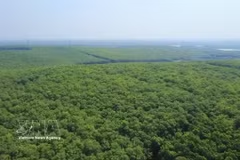
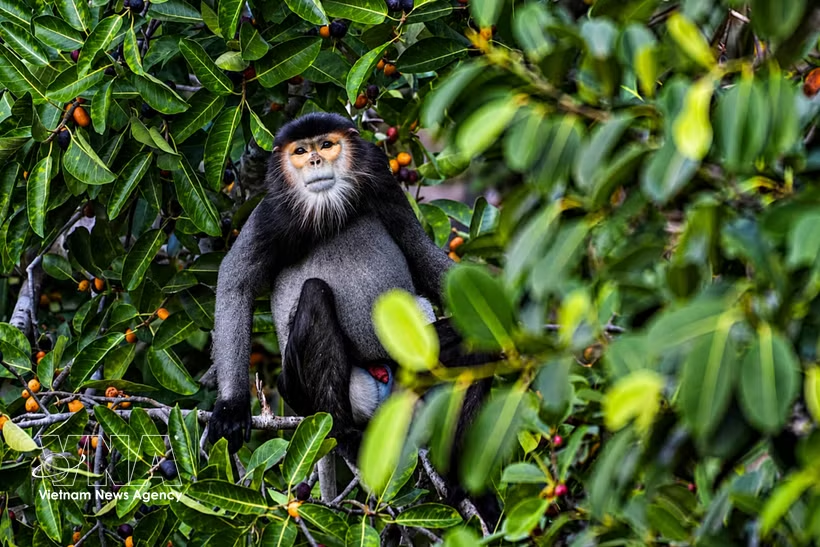
The natural forest provides an essential habitat and rich food sources for black-shanked douc langurs. (Photo: VNA)

​Tay Ninh (VNA) – Recent findings from a survey of black-shanked douc langur (Pygathrix nigripes) groups on Ba Den Mountain in the southern province of Tay Ninh have provided an important scientific basis for developing a long-term conservation strategy for the critically endangered primate.

At a recent consultation workshop on the current status of and conservation measures for black-shanked douc langurs in Sub-zone 66 of the Ba Den Mountain cultural and historical forest, scientists, conservationists and local authorities reviewed the condition of the population inhabiting the area.

According to the Centre for Nature Conservation and Development (CCD), the black-shanked douc is one of Vietnam’s 25 primate species and primarily feeds on leaves. It is endemic to Vietnam and Cambodia. Vietnam is home to three douc species: the red-shanked douc, regarded as a symbolic species of Da Nang; the grey-shanked douc; and the black-shanked douc.

The International Union for Conservation of Nature (IUCN)’s 2025 Red List classified the black-shanked douc as critically endangered while Vietnam’s Red Data Book 2024 lists it as endangered. It is also included in Group IB – endangered, precious and rare forest animals subject to Vietnam’s strict protection.
vnanet-ba-den-mountain.jpg
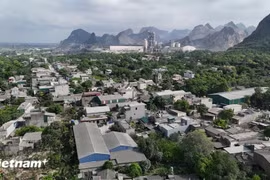
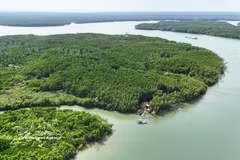
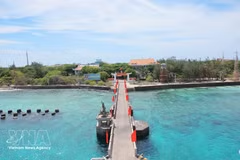
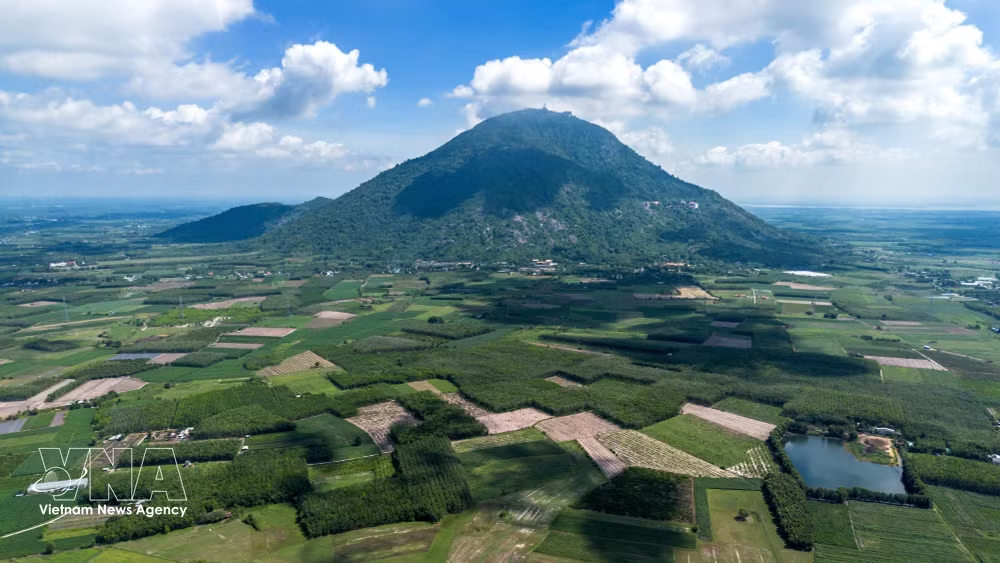
A view of Ba Den Mountain in the southern province of Tay Ninh (Photo: VNA)

Bui Thanh Tung, head of the CCD’s species conservation division, said the centre’s research team employed multiple survey methods simultaneously to assess the status of the langur population on Ba Den Mountain, including field surveys across 20 transects and 10 observation points, alongside camera traps and thermal drone technology.

“As doucs typically inhabit the forest canopy, the use of unmanned aerial vehicles proved highly effective, allowing researchers to observe from a distance without disturbing the animals or alerting them to human presence,” Tung said.

The survey documented the current status of the black-shanked douc population, mapped its distribution and identified key threats, forming the basis for proposing appropriate conservation measures.

Researchers noted that the langurs are mainly found in natural forest at elevations between 300 and 900 metres on Ba Den Mountain. They are active between 6am and 5pm daily, with peak activity occurring in the early morning and late afternoon. The species typically selects large trees for resting and overnight shelter. Although different groups maintain separate home ranges, some overlap was observed, suggesting ecological characteristics distinct from highly territorial primate species.

The survey recorded six groups comprising a total of 118 black-shanked douc langurs living within the mountain’s natural forest.

Researchers also found that all six groups included infant individuals, indicating that breeding activity is occurring across the entire population rather than being concentrated in larger groups. The finding is considered biologically significant, suggesting that the langurs have maintained stable social structures and ecological conditions suitable for reproducing and raising offspring are in place.

In addition, sub-adult individuals accounted for 30.5% of the total recorded population while infants represented 15.3%. This shows that the population is not only reproducing successfully but also has the potential to recruit new breeding individuals in the future, supporting long-term population stability, according to the CCD.

Based on the findings, scientists proposed a range of measures to ensure the long-term protection of the black-shanked douc population on Ba Den Mountain.
vnanet-vooc-2.jpg
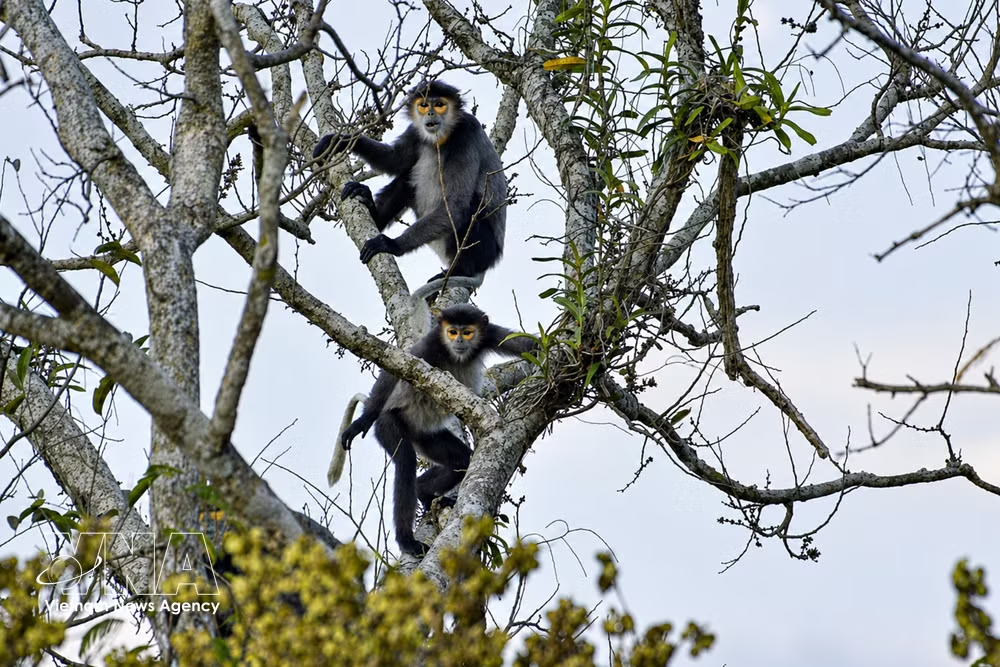
Black-shanked douc langurs inhabit the forest canopy on Ba Den Mountain and are one of the rare primate populations being monitored and conserved in Tay Ninh province. (Photo: VNA)

Tung said public communications and education to raise awareness are fundamental to reducing harmful human impacts on wildlife.

Additional recommendations included installing more educational and warning signage, strengthening forest patrols and monitoring, tightening controls over the release of rescued animals into the area, and expanding long-term research and monitoring.

Notably, the research team proposed gradually restoring habitat connectivity through a system of canopy bridges to enable movement between groups, facilitate genetic exchange, and support future expansion of the species’ range./.


VNA

See more

A rubber plantation are in Dong Nai province. Vietnam has more than 900,000 ha of rubber plantations, with over 60% operated by smallholders. (Photo: VNA)

Rubber traceability accelerated as EU deforestation regulation deadline nears

Speaking at a conference held recently in Ho Chi Minh City to gather feedback on draft EUDR compliance guidelines for the rubber sector, Nguyen Quoc Manh, Deputy Director of the Plant Production and Protection Department under the Ministry of Agriculture and Environment, said that Vietnam had spent the past three years preparing for the regulation through awareness campaigns, training programmes and coordination with ministries, local authorities and businesses.

A view of the Can Gio mangrove forest, a crucial "carbon sink" ecosystem that contributes to generating carbon credits for operating Vietnam's carbon market. (Photo: VNA)

Vietnam earns 56.5 million USD from forest carbon credit sales to World Bank

Speaking at a conference in Hanoi on July 2 to introduce Decree No. 180 on forest carbon sequestration and storage services, Luong said the latest transaction brought the country's total revenue from the transfer to 56.5 million USD, covering 11.3 million tonnes of CO2 emission reductions at a price of 5 USD per tonne.

Dray Sap Waterfall is located within the UNESCO Dak Nong Global Geopark in Nam Da commune, Lam Dong province. (Photo: VNA)

UNESCO review spurs conservation drive at Dak Nong Global Geopark

The provincial Department of Culture, Sports and Tourism, in collaboration with the Vietnam UNESCO Global Geoparks Network and relevant agencies, surveyed 41 geological, cultural and tourism sites across the geopark, identifying a number of issues requiring urgent attention to safeguard the site's outstanding values.

The release site is carefully selected to provide suitable ecological conditions and improve the pangolin's chances of survival in the wild. (Photo: VNA)

Tay Ninh releases rare pangolin back to nature

Following health checks, care and monitoring, the pangolin was confirmed be in good condition and fit for release. The release site was carefully selected to provide suitable ecological conditions and improve the animal's chances of survival in the wild.

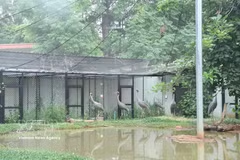
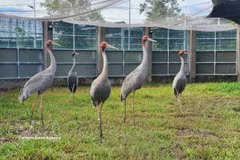
Sarus cranes cranes are being cared for at Nakhon Ratchasima Zoo in Nakhon Ratchasima province, Thailand. (Photo: VNA)

Six sarus cranes from Thailand arrive in Dong Thap

Of the six cranes, two are males and four females, with individual weights ranging from 5.3kg to 6.7kg. The birds were raised at Nakhon Ratchasima Zoo in Thailand and transported to Vietnam by air.

An area in Ha Tinh province under water following Storm Megi in October 2010 (Photo: VNA)

Conference delivers hydro-meteorological outlook for 2026

Deputy Minister of Agriculture and Environment Le Cong Thanh, in his speech, said climate change is making weather more severe and unpredictable, with a powerful El Nino set to hit Vietnam in the second half of 2026 and early 2027. Against such backdrop, enhancing forecasting and early warning capacity, while effectively translating scientific information into management decisions and timely response actions, has become urgent, he said.

Truong Sa Lon (Big Spratly) of Vietnam (Photo: VNA)

Blue sea, strong economy: Vietnam’s vision for sustainable development

The robust growth of the marine economy has created significant opportunities for Vietnam while at the same time posing major challenges to marine environment protection. From coastal aquaculture areas and renowned tourist bays to marine protected areas rich in biodiversity, traces of plastic waste, land-based pollution and unsustainable exploitation remain visible every day.

Sea dike protection works to deal with the risk of erosion and rising sea levels in Hai Thinh commune, Ninh Binh province. (Photo: VNA)

Law amendments needed to strengthen disaster prevention and response: official

According to the Department of Dyke Management and Natural Disaster Prevention and Control under the Ministry of Agriculture and Environment, natural disasters during the 2020–2025 period caused increasingly serious damage nationwide. On average, natural disasters claimed more than 300 lives each year and caused economic losses exceeding 45 trillion VND (1.7 billion USD), up about 167% compared to the 2015–2019 period.

Deputy Prime Minister Ho Quoc Dung chairs a meeting in Hanoi on June 17, 2026 to discuss the draft law amending and supplementing a number of articles of the Law on Environmental Protection. (Photo: baochinhphu.vn)

Deputy PM identifies three major environmental issues requiring special attention

The pressing concerns comprise persistent environmental hotspots in industrial parks and industrial clusters; increasingly complex air and water pollution in major cities directly affecting public health; and shortcomings in waste management and wastewater treatment across river basins and rural areas that have yet to meet practical requirements.