Green-certified Vietnamese farm produce gains premium in global markets

Vietnamese coffee already compliant with EUDR requirements is being sold at a premium of around 50 USD per tonne. Once the regulation is fully enforced, opportunities for Vietnam's coffee industry will become even greater, an insider said.

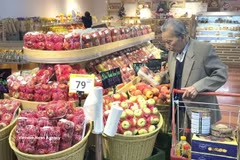
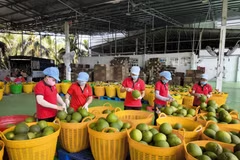
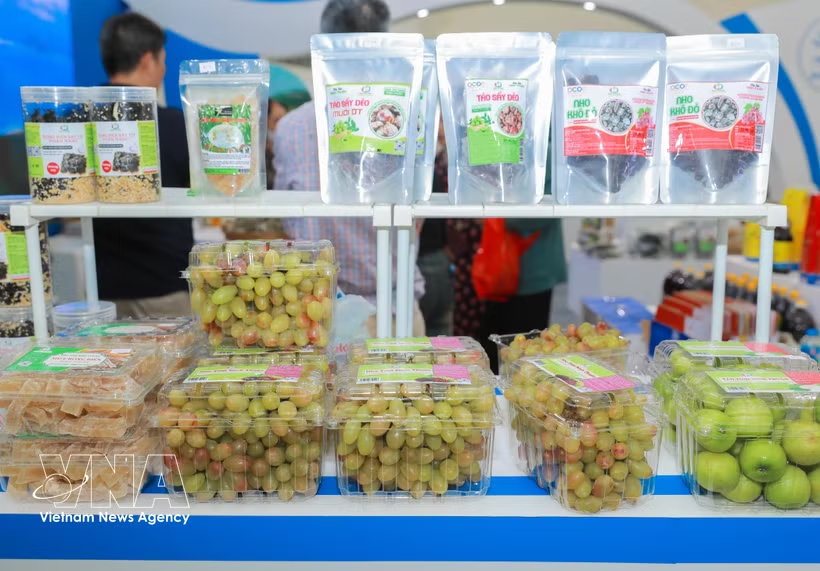
Grape, apple, and seaweed products from Trang Huynh Green Agricultural Facility in Phuoc Dinh commune, Khanh Hoa province at the 2025 Autumn Fair. (Photo: VNA)

Hanoi (VNA) – Vietnamese agricultural products that meet stringent sustainability standards are beginning to command premium prices in international markets.

Coffee is emerging as one of the strongest examples of this trend.

Despite sharp fluctuations in global coffee prices last week, Vietnamese robusta prices remained firm at around 95,500 VND (3.65 USD) per kilogramme, up roughly 2,500 VND from the previous week and also the highest in many months. More notably, Vietnamese coffee certified under the European Union Deforestation Regulation (EUDR) is currently fetching about 50 USD more per tonne than conventional coffee in the EU market.

Vice Chairman of the Vietnam Coffee – Cocoa Association (VICOFA) Do Ha Nam said Vietnam is well positioned to benefit when the EUDR comes into full effect on January 1, 2027.

Although the regulation was originally scheduled for implementation in early 2025, it was postponed to allow exporting countries and businesses more time to prepare. Vietnam, however, has been among the best-prepared suppliers, he said.

"Vietnamese coffee already compliant with EUDR requirements is being sold at a premium of around 50 USD per tonne. Once the regulation is fully enforced, opportunities for Vietnam's coffee industry will become even greater," Nam said.

Thai Anh Tuan, General Director of Simexco DakLak, shared a similarly optimistic outlook, noting that many European buyers have already begun sourcing EUDR-compliant coffee despite the delayed implementation.

The company, moving to adhere to the EUDR early, has worked with provincial authorities to establish a digital database covering coffee-growing areas and around 20,000 farming households, allowing customers to trace products back to their origin. At the same time, it is expanding deep processing to increase product value, he said.

The EU remains Vietnam's largest coffee export market, accounting for nearly 41% of total export value. In 2025, Vietnam exported about 666,000 tonnes of coffee worth 3.6 billion USD to the bloc. However, compared with the coffee industry's value chain of the EU+ (comprising the EU, the UK, Norway and Switzerland), estimated at nearly 667 billion USD, experts say there is still significant room for Vietnamese coffee to increase both market share and value through higher quality, processing and packaging.

Beyond coffee, sustainability standards are becoming increasingly important across the agricultural sector.

The EU has introduced strict regulations not only on deforestation but also on illegal, unreported and unregulated (IUU) fishing. Meanwhile, other major markets, including the US and China, are tightening environmental and food safety requirements for imported agricultural products.
vnanet-potal-khai-mac-hoi-cho-nong-nghiep-nong-san-xanh-dong-bang-song-cuu-long-8483654.jpg
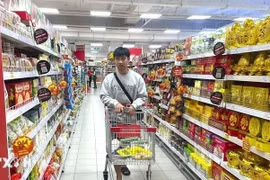
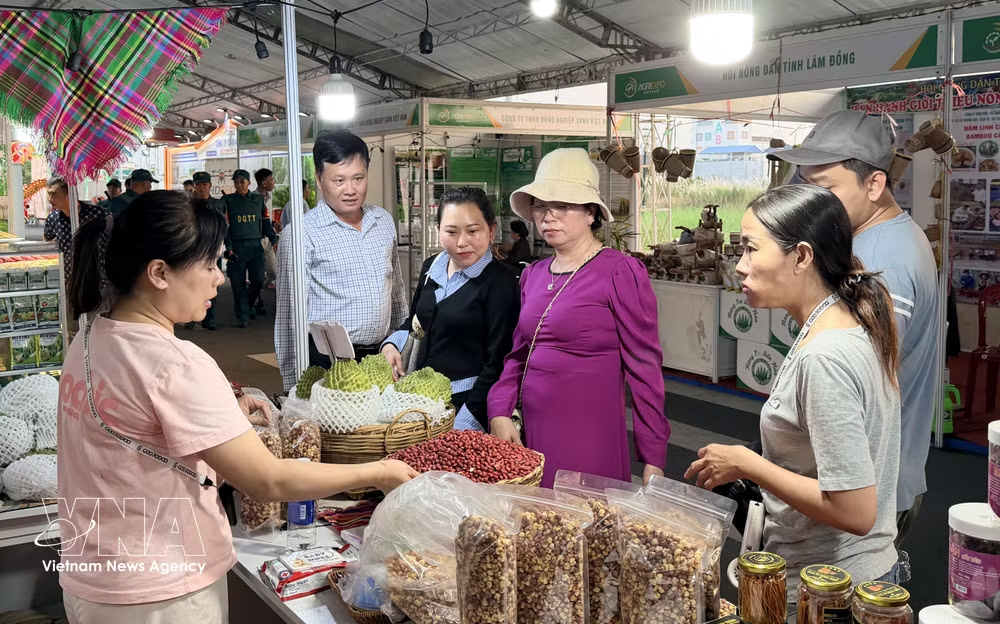
At a food fair in the southern province of An Giang. (Photo: VNA)

Vietnam has responded by promoting sustainable production models, including its one-million-hectare low-emission rice cultivation project in the Mekong Delta, which is expected to strengthen the competitiveness of Vietnamese rice in foreign markets.

Dang Phuc Nguyen, General Secretary of the Vietnam Fruit and Vegetables Association (VINAFRUIT), said although fruit and vegetable exports are not currently subject to the EUDR, exporters should prepare for expanding environmental requirements as green consumption becomes mainstream in Europe.

He noted that the EU is continuously tightening maximum residue limits for pesticides, meaning a single violation could place an exporter or even an entire country's products under closer scrutiny.

European consumers also increasingly favour products with biodegradable packaging, water-saving farming practices and lower greenhouse gas emissions. To access major supermarket chains, Vietnamese exporters must obtain internationally recognised certificates such as GlobalG.A.P., Organic or SMETA, he said.

Nguyen added that climate change and rising temperatures in Europe are creating growing demand for tropical fruits with high water content, including passion fruit, dragon fruit, seedless limes and fresh coconuts. Processed products such as frozen diced mango, frozen passion fruit cubes and frozen pineapple are also becoming increasingly popular, offering new opportunities for Vietnamese exporters able to meet evolving consumer preferences./.
VNA

See more

Trains on the elevated section of the Cau Giay – Nhon route in Hanoi provide convenient transportation for local residents. (Photo: VNA)

Multimodal connectivity to drive Vietnam’s transport infrastructure

Under the proposed approach, roads would serve mainly as connectors and for first- and last-mile transport; railways would handle large volumes over long distances; maritime transport would serve import and export cargo; inland waterways would carry large volumes at low cost; and air transport would focus on fast delivery and high-value goods.

Amata Industrial Park in Dong Nai city (Photo: VNA)

Green shift powers investment in southeast Vietnam

The Amata Industrial Park in Dong Nai City, established 32 years ago and covering more than 500ha, is home to over 160 domestic and foreign businesses. Selected in 2020 as one of three national pilot sites for conversion into an eco-industrial park, Amata has raised its compliance with the international eco-industrial park framework from 41% to 86% in 2024, and is working towards becoming Dong Nai's first certified eco-industrial park.

At a port in Ho Chi Minh City (Photo: VNA)

Multi-channel capital mobilisation needed to achieve double-digit growth

The Ministry of Finance estimates development investment for 2026-2030 at a minimum of 38.5 quadrillion VND (1.48 trillion USD), or about 40% of GDP. The state budget is expected to provide only about 20%, or more than 7.7 quadrillion VND, leaving over 80%, or more than 30 quadrillion VND, to be raised from the broader economy. That makes expanding capital mobilisation channels beyond bank credit essential.

An aerial view of the Nhieu Loc – Thi Nghe area in Ho Chi Minh City. The southern metropolis is home to the Vietnam International Financial Centre. (Photo: VNA)

Vietnam International Financial Centre launches membership registration system

Integrated into the official Vietnam International Financial Centre portal at vifc.gov.vn, the online system for registering and recognising members provides a unified online service channel through which investors, organisations and businesses can complete procedures related to membership, from new registration and recognition to information updates and termination of membership.

At a tax office in Hung Yen province (Photo: VNA)

Finance ministry moves to cut business costs, spur growth

Tax policy is among the solutions with the most direct impact on companies. Rather than prioritising near-term revenue collection, fiscal policy is being run to help them preserve cash flow, expand production and build more sustainable revenue sources.

In the Kim Long Motor Hue factory (Photo: VNA)

Hue courts capital to turn industrial zones into growth engine

The economic and industrial zones in Hue city host more than 200 active investment projects worth over 152 trillion VND (5.84 billion USD), with 139 already operational. Since the start of 2026, they have generated about 32 trillion VND, contributed 4.2 trillion VND to the state budget and brought in 730 million USD in exports, while employing more than 46,000 workers.

An overview of a meeting between Politburo member and Secretary of the Hanoi Party Committee Tran Duc Thang and representatives of Saint Petersburg businesses. (Photo: VNA)

Saint Petersburg’s metro expertise valuable for Vietnam

As Hanoi implements its master plan with a 100-year vision, in which metro lines are identified as the backbone of the capital city’s transport network, Secretary of the municipal Party Committee Tran Duc Thang met with representatives from several Saint Petersburg companies specialising in urban rail development.

An art performance at 2026 Dak Lak Durian Festival. (Photo: VNA)

Dak Lak Durian Festival seeks to elevate Vietnam’s agricultural brand globally

Dak Lak has about 41,000ha of durian, with this year’s output estimated at nearly 500,000 tonnes. The province has 280 growing-area codes covering around 7,500ha, along with 41 packing facilities approved for export. In 2025, Dak Lak’s durian sector contributed about 1.1 billion USD to the country’s export turnover.

Delegates cut the ribbon to inaugurate the Ho Chi Minh City-Shenzhen direct air route. Photo: baodautu.vn

Vietravel Airlines launches direct Ho Chi Minh City-Shenzhen route

Vietravel Airlines' new route connects Tan Son Nhat International Airport (SGN) in Ho Chi Minh City with Shenzhen Bao'an International Airport (SZX), meeting growing demand for travel between the two markets for investment, trade, tourism and visiting relatives.