Hanoi (VNA) – Politburo Resolution No. 10-NQ/TW on the development of the foreign-invested sector marks a shift in Vietnam’s approach to attracting FDI, laying the groundwork for Ho Chi Minh City to move from attracting individual projects to building an ecosystem capable of drawing high-quality investment, fostering innovation, facilitating technology transfer and enhancing national competitiveness.
Accelerating project licensing
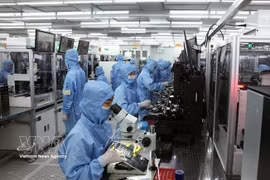
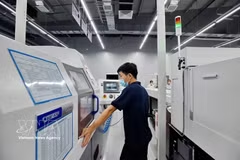
Recently, the Ho Chi Minh City Export Processing and Industrial Zones Authority (HEPZA) granted an investment licence to Automation Technologies Vietnam, a subsidiary of Singapore’s Ito Group, for a project worth about 8 million USD. The 12,000-square-metre factory is scheduled to break ground in August 2026 and begin operations in January 2027. It will specialise in the design and manufacturing of automation equipment, robots, inspection systems and production data management solutions.
Nguyen Huy Hoang, Chief Executive Officer of Ito Vietnam, said the company pursues a green manufacturing model linked to investment efficiency. Over the past 14 years, its existing 2,600-square-metre facility has generated annual revenue of around 4-5 million USD with a workforce of about 120 engineers. The plant is also Ito Group’s only manufacturing base worldwide.
According to HEPZA, Ito Vietnam belongs to the high-tech, low labour-intensive segment and is the first FDI project to be approved under the authority’s special green-lane mechanism aimed at shortening investment procedures. Hoang said the city’s investment environment has improved significantly, with the company’s application processed quickly from early March to June 26, 2026.
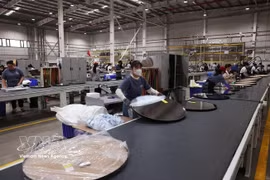
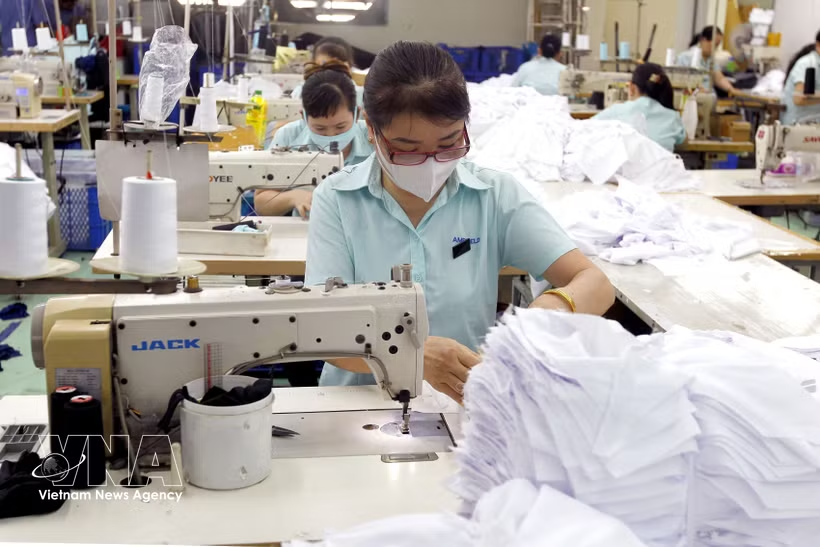
Similarly, Worldon Vietnam, a subsidiary of China’s Shenzhou Group, has invested 12.6 million USD in a smart, closed-loop manufacturing model. The company has also partnered with Nike to establish a Flyknit footwear upper design centre to optimise material use, reduce waste and strengthen its position in the supply chain.
Attracting high-quality capital
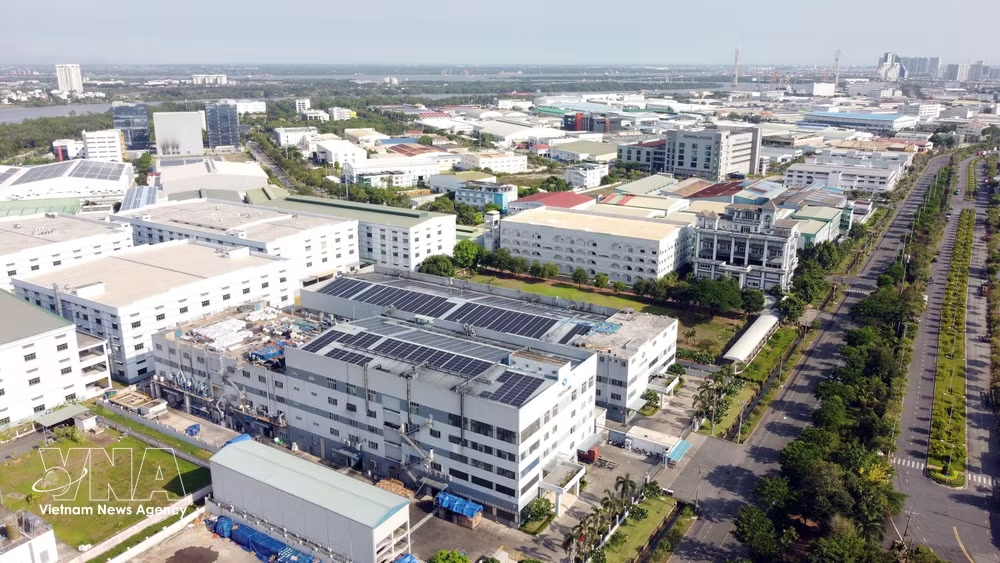
Ho Chi Minh City is currently home to 20,259 FDI projects with total registered capital of nearly 142 billion USD from 152 countries and territories. In the first half of 2026, the city attracted more than 6.8 billion USD, fulfilling 62% of its annual target.
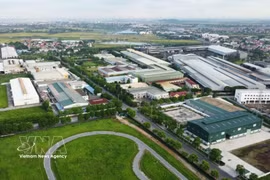
Tran Viet Ha, Deputy Head of HEPZA, said the FDI sector accounts for roughly 20% of total social investment and more than 50% of the city’s export turnover, making it a key driver of economic restructuring and international integration. The city is therefore prioritising high-tech and digital industries while developing green and eco-industrial parks.
Investors are increasingly focused on digital infrastructure, green energy and smart supply chains. A representative of THACO said Vietnamese enterprises need to strengthen their capacity to absorb technology, participate more deeply in the supply chains of foreign-invested companies and develop industrial clusters to reduce logistics costs and enhance cooperation with international partners.
Ha also acknowledged that limited industrial land and incomplete infrastructure in some industrial parks remain concerns for investors, particularly those planning large-scale, high-tech projects. He said the city should prioritise strategic sectors such as electronics and semiconductors, artificial intelligence, big data, biotechnology, new materials and renewable energy, while accelerating the transformation of older industrial parks and strengthening linkages between FDI enterprises and domestic firms.
Chairman of the Ho Chi Minh City People’s Committee Nguyen Van Duoc stressed that the city has a responsibility to take the lead in implementing Resolution No. 10-NQ/TW, especially through the Vietnam International Financial Centre. The centre is expected to help attract next-generation FDI and bring in intangible assets such as financial technology, advanced management expertise, transparency standards, data systems and global networks of experts.
Duoc said that next-generation FDI is no longer driven solely by low costs or tax incentives. Strategic investors now place greater emphasis on institutional stability, infrastructure quality, access to capital, environmental, social and governance (ESG) standards, workforce quality, innovation capacity, technology ecosystems, modern financial services and connectivity to regional and global markets./.