Tireless efforts made to restore the names of fallen soldiers

Quang Ngai currently has 127 martyrs' cemeteries containing 37,689 graves, including 26 collective ones. Of these, 16,758 have complete information, 5,134 contain partial information, while 15,771 remain unidentified. Around 6,000 martyrs from the province have yet to have their remains located.

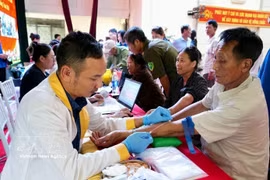
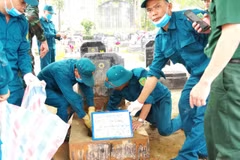
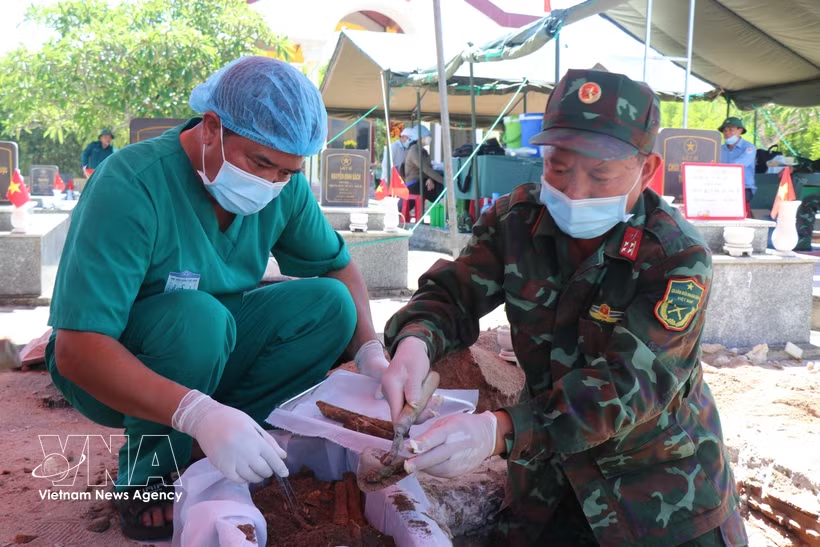
Biological samples are collected from the remains of unidentified fallen soldiers at the Pho An Martyrs' Cemetery in Tra Cau ward, Quang Ngai province. (Photo: VNA)

Quang Ngai (VNA) – In the central province of Quang Ngai, one of the localities with the largest number of unidentified war martyrs' graves, hundreds of officers, soldiers and specialists are pressing ahead with the nationwide 500-day campaign to collect biological samples and digitise grave records for DNA analysis, with the hope of restoring the names of those who sacrificed their lives for the nation.

At the martyrs' cemetery in Tra Cau ward, dozens of military and militia personnel, and doctors have worked from dawn till dusk for more than 10 consecutive days to collect samples for DNA testing. At the Pho An Martyrs' Cemetery, where 353 martyrs are buried, including 68 whose identities remain unknown, different forces have coordinated closely to ensure the work proceeds on schedule during the campaign's peak period.

Senior Lieutenant Colonel Nguyen Huu Hoang, head of sampling team No. 3, said his unit has been assigned to collect samples from 2,598 graves across 11 eastern communes and wards of the province. According to him, the task has proved demanding. Many graves were relocated during previous renovation projects, with some shifted by more than one metre. While some still contain recoverable remains, others have deteriorated over time, limiting the availability of biological material. The harsh coastal weather has added further difficulties, with intense heat during the day followed by frequent afternoon thunderstorms.

To maintain progress, officers and soldiers often work through midday and resume excavation immediately after rainfall, continuing until evening. Every stage of the sampling process requires meticulous care and precision to preserve the integrity of the evidence.

Under temporary shelters erected to shield them from the scorching sun, members of the working teams rotate duties to cope with the physically demanding conditions. Major Colonel A Ka, a member of recovery team K53 under the provincial Military Command, said each participant performs assigned tasks with the highest sense of responsibility.

Taking part in this work is both a sacred mission and a great honour, he said, showing his hope that their efforts will help identify the martyrs as soon as possible and bring comfort to their families.
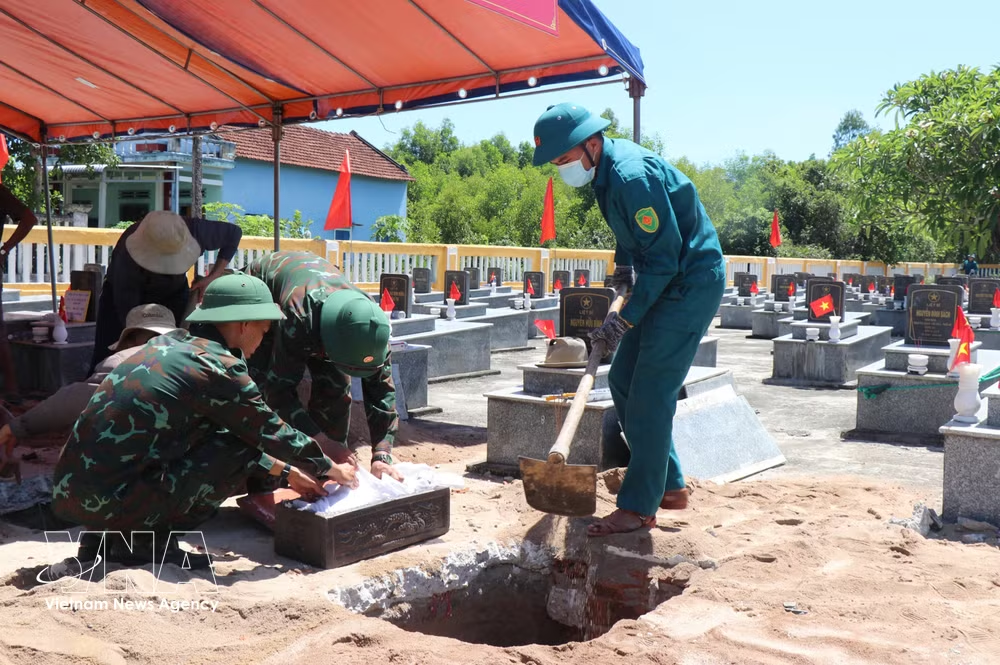
vnanet-martyrs2.jpg
Officers and soldiers excavate a martyr's grave to collect biological samples for DNA analysis under harsh summer heat. (Photo: VNA)

Working alongside the military throughout the campaign, Dr. Nguyen Manh Hung from the Quang Ngai provincial Forensic Centre noted that many remains at cemeteries across the province have deteriorated after decades, making sample collection impossible. However, at the Pho An cemetery, a considerable number of intact teeth and bone fragments have been recovered, providing valuable material for DNA testing.

Hung stressed that strict procedures are followed at every stage, from sample collection during excavation to cleaning, packaging, preservation and transportation, ensuring there is no cross-contamination. The ultimate goal, he said, is to help restore the identities of those who laid down their lives for the country's independence and freedom.

Alongside sample collection, comprehensive digitisation of grave information is also underway. Lieutenant Colonel Ngo Duy Tra, a member of sampling team No. 3, said each grave is photographed, assigned a unique identification code and fully documented, including its location and excavation process. The resulting electronic records, together with biological samples and supporting images, are carefully cross-checked to ensure accuracy for DNA analysis while establishing a long-term digital management system for martyrs' cemeteries nationwide.

At the Quang Ngai provincial Martyrs' Cemetery in Nghia Giang commune, sampling and digitisation are also progressing rapidly.

According to Vice Chairman of the commune People's Committee Truong Van Trung, the commune manages three martyrs' cemeteries containing 540 unidentified graves, including 194 at the provincial cemetery alone. Local authorities have coordinated security arrangements, supported the sampling teams and will restore every grave to its original condition after the work is completed.

Thanks to strong coordination with local authorities and the determination of officers and soldiers, sampling team No. 4 is processing around 30 graves each day. At the current pace, work at the provincial cemetery is expected to finish about three days ahead of schedule, allowing additional time to restore the cemetery grounds before activities marking the 79th anniversary of War Invalids and Martyrs' Day (July 27).

Quang Ngai currently has 127 martyrs' cemeteries containing 37,689 graves, including 26 collective ones. Of these, 16,758 have complete information, 5,134 contain partial information, while 15,771 remain unidentified. Around 6,000 martyrs from the province have yet to have their remains located.

Under the 500-day campaign, the locality aims to collect biological samples from 13,650 graves by October. Beyond building a national DNA database for martyrs, the campaign offers renewed hope that thousands of unidentified heroes will one day regain their names and be reunited with their families and hometowns after decades of waiting.

During a recent inspection of the campaign at the provincial cemetery, Standing Vice Chairman of the provincial People's Committee Y Ngoc described every DNA sample as "another hope" of returning a fallen son of Vietnam to his identity, homeland and family.

He called on local authorities to mobilise youth unions, women's associations and other mass organisations to support frontline personnel, while stressing that all sampling procedures must be conducted with scientific rigour and the utmost respect. Once completed, every grave, he said, must be carefully restored to its original condition, reflecting the nation's enduring gratitude to the martyrs./.
VNA

See more

Overseas Vietnamese delegates attend the opening ceremony of the Vietnam Summer Camp 2026. (Photo: VNA)

Vietnam Summer Camp 2026 strengthens cultural identity, deepens young OVs’ bond with homeland

Addressing the ceremony, Deputy Minister of Foreign Affairs Le Thi Thu Hang said the participants return to Vietnam at a particularly significant moment, as the country enters a new stage of development following the 14th National Party Congress. She noted that the ongoing reorganisation of administrative units has created new development space for localities and the nation, unlocking fresh potential, encouraging innovation and providing new momentum for faster and more sustainable growth.

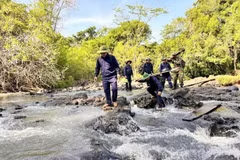
Members of Team K51 under the Dak Lak provincial Military Command travel through remote forests and mountains in Vietnam and Cambodia in search of the remains of Vietnamese volunteer soldiers and military experts who died during wartime. (Photo published by VNA)

Dak Lak team presses on with search for fallen soldiers

During the 2025–2026 dry season, Team K51 recovered and repatriated the remains of 27 Vietnamese volunteer soldiers and experts who died in Cambodia. The achievement came after nearly seven months of searching through forests, crossing streams and following even the smallest leads.

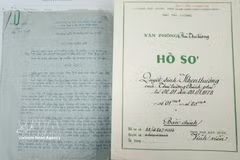
Documents containing the Prime Minister's commendation decisions awarding the “To quoc ghi cong” (The Fatherland acknowledges the merit) certificate to the families of martyrs, including Decision No. 04TtgA awarding the certificate to the family of martyr Huynh Van Quen (Photo: VNA)

Unlocking value of archives in search for fallen soldiers’ identities

Once digitisation is completed and a unified database is established, searches will become much faster and more accurate, providing an important foundation for the search for, recovery and identification of martyrs’ remains and for better implementing policies for people with meritorious service.

Vietnamese and Indian officials at the handover ceremony of the mortal remains of 15 Indian victims in the speedboat capsize off Phu Quoc Island in the southern province of An Giang. (Photo: Ho Chi Minh City Department of External Relations)

Mortal remains of Indian victims in Phu Quoc speedboat accident repatriated

The mortal remains of 15 Indian tourists who died in the speedboat capsize off Phu Quoc Island in the southern province of An Giang were handed over to the Indian side and transported on a flight departing at 18:00 on July 13 for their homeland, in accordance with the wishes of the victims' families.

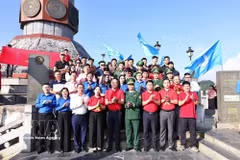
Delegates at the Lung Cu Flag Tower, a symbol of Vietnam's northernmost point. (Photo: VNA)

"I Love My Fatherland" journey reaches Lung Cu Flag Tower

This year's journey comprises of seven stages linked to historical, cultural and revolutionary sites across the country. It began in Nghe An on May 16 to celebrate President Ho Chi Minh’s birth anniversary, before continuing through Hue city, Tuyen Quang–Lung Cu Flag Tower, Dien Bien, Khanh Hoa, Ca Mau and Ho Chi Minh City, and concluding in Hanoi in October.

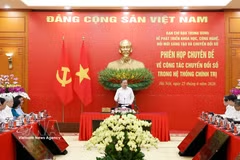
Party General Secretary and State President To Lam, Head of the Central Steering Committee for Science and Technology Development, Innovation and Digital Transformation, chairs the thematic session on digital transformation in the political system on June 25, 2026. (Photo: VNA)

100-day drive launched to remove digital bottlenecks

The plan seeks to accelerate the shift to data-driven governance by reducing paperwork, streamlining administrative procedures and expanding the use of shared digital platforms and integrated data across government agencies while strengthening cybersecurity.

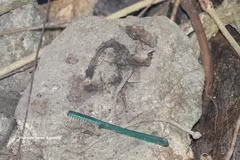
Wartime relics, including ammunition and a toothbrush, discovered at Da Sap Cave in Lam Tay hamlet, Ha Nha commune, Da Nang city. (Photo: VNA)

Bringing the fallen home: Da Sap Cave mission begins

Situated between protection and production forests in Ha Nha commune, the cave remains largely untouched since the war. Huge boulders blasted down by bombing still block part of the entrance, making excavation difficult and hazardous.

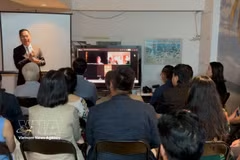
Participants in the ceremony celebrating the CVS's 10th founding anniversary in Ottawa on July 12 (Photo: VNA)

Canada-Vietnam Society marks decade of promoting people-to-people exchanges

Nguyen Dai Trang, a member of the CVS’s executive board, said the organisation's greatest achievement over the past 10 years lies not only in the number of programmes it has organised but also in its success in bringing together Vietnamese associations across Canada, and fostering a shared voice within the community.

The former headquarters of the Bac Lieu provincial Fatherland Front Committee and mass organisations is proposed for transfer to the provincial Land Development Centre for auction or investment attraction. (Photo: VNA)

Efficient use of surplus public assets gains urgency

According to the Ministry of Finance (MoF), more than 11,000 public land and property facilities nationwide have been recovered or transferred to local authorities but have yet to be put back into use. The portfolio includes office buildings, public service facilities and many land plots in prime urban and residential locations.