Top leader unveils people-centred vision for new development model

Vietnam's growth model, long fueled by low-cost labour, resource extraction, contract manufacturing, expanded investment, and capital accumulation, has run out of road. The country now needs a sweeping reform agenda to shift from extensive growth to a model driven by productivity, knowledge, science and technology, innovation, and digital transformation.

A medical worker gives guidance to a mother on how to care for a newborn in Ta Ca commune, Nghe An province. (Photo: VNA)

Hanoi (VNA) – Party General Secretary and State President To Lam has set major orientations for a resolution on overhauling Vietnam’s growth model, directing that people must be the goal, engine, and primary stakeholders of development.

Speaking at a recent working session with the Party Central Committee's Commission for Policies and Strategies, he said every policy must raise material and spiritual living standards, unlock creativity, uphold human dignity, widen advancement pathways, and guarantee fair access to the gains of expansion. In the new era, Vietnamese citizens need digital skills, creative thinking, lifelong learning capacity, the ability to rapidly adapt to changes, cross-border collaboration skills, digital ethics, and a strong sense of digital citizenship.

Citizens as core stakeholders

Prof. Dr. Mac Quoc Anh, Vice Chairman and General Secretary of the Hanoi Association of Small and Medium Enterprises and Director of the Institute for Economics and Enterprise Development, said the country must look beyond headline growth rates and prioritise job quality, real incomes, and access to education, health care, housing, culture, a healthy living environment, social welfare, online security, and public satisfaction.

Every major policy, Anh noted, should have to clear three litmus tests: How will people benefit? How will it sharpen their capabilities? Will any social group be left behind? Those questions should become mandatory criteria in assessing impacts of policies on investment, finance, sci-tech, education, health, labour, and social welfare.

He pushed for a new human development strategy that equips citizens with digital skills, creative thinking, lifelong learning, foreign language proficiency, teamwork, legal awareness, professional ethics, and responsible digital citizenship. Education and training must pivot from delivering knowledge to cultivating critical thinking, creativity, problem solving, and the ability to adapt to emerging occupations.

Simultaneously, the social welfare system must be built to absorb fast labour market shocks. Artificial intelligence (AI), automation, and digitisation are creating new roles but also disrupt or erase traditional ones. The State, he said, should roll out retraining and upskilling courses, support career transitions, and make sure no one is shut out of digital transformation because of limited access to technology.

Putting people at the centre also demands wider public involvement in policymaking, enforcement, and oversight. Citizens should be active contributors to national progress, not passive recipients. Policies that are closer to the ground, responsive to needs, and rooted in reality will be easier to enforce and enjoy broader consensus, he added.

Ensuring equal opportunities and social welfare

Dr. Bui Thanh Minh, Deputy Director of the Office of the Private Economic Development Research Board (Board IV) under the Prime Minister's Advisory Council for Administrative Procedure Reform, said Vietnam's growth model, long fueled by low-cost labour, resource extraction, contract manufacturing, expanded investment, and capital accumulation, has run out of road.

The country now needs a sweeping reform agenda to shift from extensive growth to a model driven by productivity, knowledge, science and technology, innovation, and digital transformation, he argued.

Land, capital, labour, technology, data, and business opportunities should be allocated increasingly through market mechanisms, rather than administrative intervention or "ask-and-grant" practices. At the same time, the State must play an active redistributive role and build a modern social welfare system to ensure all citizens can engage in and benefit from growth.

Recent initiatives, including housing, public health checkups, and tuition-free education for students, have meaningfully lifted public confidence. Going forward, Vietnam should build a multi-tiered welfare system covering formal and informal workers, the self-employed, and gig-economy participants. Spending on education, health care, reskilling, social insurance, and career transition support should be treated as an investment in national competitiveness.

Dang Thi Hoai, a lecturer at the Institute of State and Law under the Ho Chi Minh National Academy of Politics, stressed that development policies must be fully reviewed for their impact on demographic groups, especially the vulnerable.

Policymakers should ensure equitable access to resources, unlock the potential, brainpower, and creativity of the Vietnamese people, refuse to trade the environment, cultural values, or social welfare for short-term economic wins, and broaden the involvement of citizens, businesses, and experts throughout the policy formulation, enforcement, and oversight, Hoai added./.​

VNA

See more

Youth union members in Bu Gia Map commune help local residents complete administrative procedures. (Photo: VNA)

Digital governance transforms life in border commune of Dong Nai city

A year after adopting the two-tier local administration model, Bu Gia Map, a remote border commune in the southern city of Dong Nai with a significant ethnic minority community, has experienced notable improvements in public administration, making digital public services more accessible to residents and boosting governance efficiency.

Individuals and organisations should strengthen data protection measures in the digital economy. ( Photo: nhandan.vn)

Experts recommend risk-based data governance to strengthen legal protection

In the first quarter of 2026, more than 6.9 million accounts were exposed, double the figure recorded in the same period last years. Stolen personal data has frequently been exploited in sophisticated online scams, particularly impersonation schemes targeting victims through fake relatives or acquaintances.

The exhibition combines digital technology, simulation models and hands-on activities to help the public gain knowledge of information security in an engaging and easy-to-understand manner. (Photo: VNA)

Interactive "Cyber Security Wall" exhibition spreads digital safety awareness in Hanoi

Through a series of display areas, visitors can explore notable scientific and technological achievements of the People's Public Security Force in safeguarding national security in cyberspace. The exhibition also provides information on common forms of online fraud and cyber scams, along with practical guidance on how to identify and prevent them.

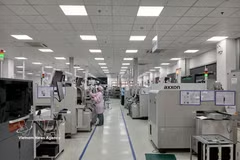
A SMT (Surface Mount Technology) production line for electronic devices at Trung Nam EMS Factory, Da Nang High-Tech Park. (Photo: VNA)

New decree offers major incentives for high-tech R&D

The decree, which took effect on July 1, gives priority to investment in high-tech R&D, including research into innovative and core technologies; efforts to decode, master and improve high technologies; and the application, testing and refinement of advanced technologies.

The smart medical kiosk system at Hop Luc General Hospital in Thanh Hoa province makes it easier for patients to access medical examination and treatment services. (Photo: VNA)

Vietnam’s digital overhaul starts to deliver: French newswire

Inforadar noted that Vietnam has progressively streamlined its regulatory framework to clear institutional bottlenecks while putting in place mechanisms designed to spur innovation and technology adoption. The process has also pivoted from a resource-heavy approach to one focused on practical results, with stricter monitoring of projects’ progress.

Visitors experience an e-book app (Photo: VNA)

Verified subscriber data builds stronger digital shield

As Vietnam accelerates its national digital transformation, every correctly verified mobile subscription builds a more comprehensive and reliable telecom database, laying the groundwork for secure, sustainable digital services and public confidence in the country’s digital ecosystem.

A banana plantation cultivated to standardised production practices by Hung Son High-Tech Agriculture JSC in An Phu ward, Gia Lai province. (Photo: VNA)

Crop breeding innovation key to boosting agricultural productivity

According to the Plant Production and Protection Department under the Ministry of Agriculture and Environment, improved crop varieties have increased yields by 8–15%, depending on the crop, while enhancing farmers' incomes and supporting the restructuring of the agricultural sector.

Quantum technology is emerging as a strategic frontier in global science, technology and security competition. - Illustrative image (Photo: VNA)

Quantum tech seen as strategic pillar for Vietnam’s technological self-reliance

In Vietnam, the Politburo’s Resolution No. 57-NQ/TW identifies science, technology, innovation and digital transformation as breakthrough drivers of national development. In this context, the Prime Minister’s Decision No. 21/2026/QD-TTg has added cybersecurity and quantum technologies to the country’s list of 10 strategic technology groups.

A 3D mapping light show projected onto Turtle Tower, combined with a water screen system. (Photo: VNA)

Smart tourism takes hold nationwide

Under the country’s 2026–2030 digital economy and digital society development programme, the sector has been identified as one of the priority ones for accelerating digital transformation to improve governance efficiency, service quality, and visitor experiences.