Top leader urges three major overhauls to reshape socialist culture in new era

Party General Secretary and State President To Lam pushed for a shift from a focus on traditional spaces to cultivating culture in both physical and digital spaces, and from simply prioritising preservation to striking a close balance between preservation with innovation.

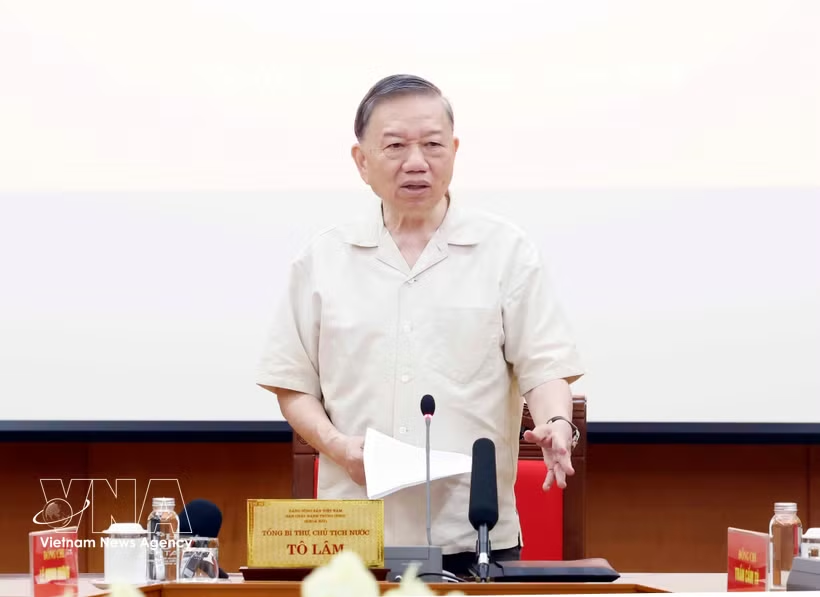
Party General Secretary and State President To Lam speaks at the second session of the Central Steering Committee for Vietnamese culture development in Hanoi on July 13. (Photo: VNA)

Hanoi (VNA) – Party General Secretary and State President To Lam called for a stronger emphasis on three major overhauls to reshape Vietnam’s socialist culture in the new era while addressing the second session of the Central Steering Committee for Vietnamese culture development in Hanoi on July 13.

The meeting saw the presence of Prime Minister Le Minh Hung; Permanent member of the Party Central Committee's Secretariat Tran Cam Tu, who is also head of the steering committee; other Politburo members; members of the Party Central Committee and its Secretariat; along with officials of ministries, sectors and central agencies.

Citing the Politburo’s Resolution 80 on developing Vietnamese culture, General Secretary and President Lam said culture must no longer be treated as just another development sector but must become society’s spiritual foundation. He pushed for a shift from a focus on traditional spaces to cultivating culture in both physical and digital spaces, and from simply prioritising preservation to striking a close balance between preservation with innovation.

To lay the groundwork for cultural development in the coming years, he directed the committee to press ahead with institutional reforms from the second half onward, aiming to unleash society’s creative potential and pool resources for cultural development more efficiently.

The leader also ordered a review and update of all cultural development strategies, master plans and agendas to meet the demands of a new era, singling out the Vietnam Cultural Development Strategy to 2035, with a vision to 2045, as a priority, to ensure cultural development goes hand in hand with socio-economic progress.

He requested greater engagement of the public, including communities, businesses, and social organisations, as well as stronger mobilisation of state and non-state resources, to develop an advanced Vietnamese culture deeply imbued with national identity and having strong competitiveness and spillover effects in the new era.

Strengthening cultural sovereignty in the digital space is now essential to sharpen the appeal, reach and protection of Vietnam’s cultural values, he said.

He tasked the Government Party Committee with building and launching a national digital cultural space scheme and refining policies that back digital platforms, communication channels and content ecosystems rooted in Vietnamese identity. It was also told to set up partnerships among the State, businesses, social organisations and creative communities to produce and distribute quality and attractive cultural products that can compete in the digital environment.

Targeted commissioning and investment mechanisms should be put in place for artistic and cultural works of high artistic merit, broad public appeal, educational value and the potential to compete for international recognition, he said.
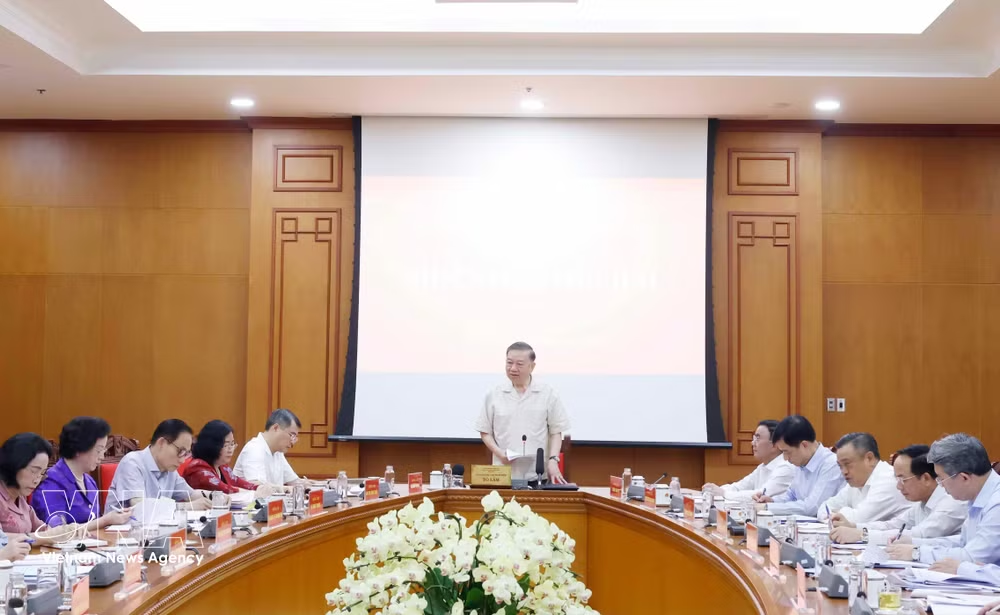
The second session of the Central Steering Committee for Vietnamese culture development in Hanoi on July 13 (Photo: VNA)

The second session of the Central Steering Committee for Vietnamese culture development in Hanoi on July 13 (Photo: VNA)

The Party Central Committee’s Commission for Information, Education and Mass Mobilisation was ordered to work with relevant agencies to raise public awareness of Vietnamese cultural values, and modernise communications, especially on digital platforms, so that the country’s national, cultural and family values and standards of conduct resonate more directly with the public, particularly the youth.

The Central Steering Committee must conduct regular reviews in which success is measured not only by the volume of cultural content digitised but by whether the public actually recognises and embraces it, with the goal of building a healthy digital cultural environment by 2030, he said.

The leader called for turning cultural heritage and cultural capital into knowledge, intellectual property, creative products and resources for education, science – technology, cultural industries and innovation. Resolution 80 sets a target of digitising all nationally recognised and specially designated national cultural heritage elements.

Heritage data must be standardised, traceable and searchable, with interoperability that allows sharing and reuse. Rather than sitting in closed databases, such data should power governance, education, research, tourism, cultural industries and artificial intelligence development, beginning with the creation of core data sets, he said.

According to him, each key locality should focus on only a limited set of priority sectors and no more than three flagship projects, each with clearly defined products, enterprises, financing, target markets, intellectual property outputs and expected contributions to gross regional economic growth, employment, exports or tourism.

General Secretary and President Lam concluded by urging relevant agencies to sustain a strong sense of responsibility and rapidly translate Resolution 80 into concrete action, aiming to make culture a genuine spiritual foundation, a source of internal strength and a key driver of Vietnam’s development in the new era./.
VNA

See more

Vietnamese Minister of Foreign Affairs Le Hoai Trung (front, second from left), other foreign ministers of ASEAN and their Myanmar counterpart attend an informal meeting in Bangkok on July 12. (Photo: VNA)

Vietnam ready to work with ASEAN to support Myanmar: FM

Vietnam stands ready to work closely with the ASEAN Chair for 2026 and other member states to support Myanmar to recover the economy, address social issues and combat transnational crimes while promoting bilateral and subregional cooperation for the sake of peace, stability and sustainable development in Myanmar and the region, and for the building the ASEAN Community, stated Minister of Foreign Affairs Le Hoai Trung.

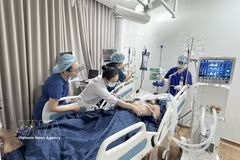
Doctors from Cho Ray Hospital in Ho Chi Minh City are collaborating with doctors from Sun Group International Hospital in Phu Quoc to provide intensive treatment for a victim of the speedboat accident in Phu Quoc (Photo published by VNA)

Ministry of Foreign Affairs supports efforts to deal with aftermath of Phu Quoc speedboat capsize

In the coming days, the MoFA will continue to work closely with the An Giang provincial People’s Committee, the Phu Quoc Special Zone, relevant agencies, the Vietnamese Embassy in India, the Embassy of India in Hanoi and the Consulate General of India in Ho Chi Minh City to closely monitor the situation, carry out consular and citizen protection work, and repatriate the bodies of the deceased tourists to India in accordance with the wishes of their families as soon as possible.

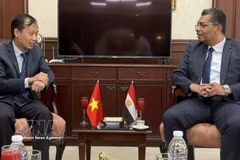
Vietnamese Ambassador to Egypt Nguyen Nam Duong (L) has a working session with Egypt’s Red Sea Governor Walid Al Barqi on July 11. (Photo: VNA)

Vietnam seeks stronger economic links with Egypt's Red Sea Governorate

Beyond traditional exports, there remains considerable room to expand bilateral trade. Vietnam has potential to increase exports of tea, rice, frozen shrimp, machinery and electrical equipment, while Egypt could boost shipments of citrus fruits, grapes, fertilisers and, in particular, phosphate ore.

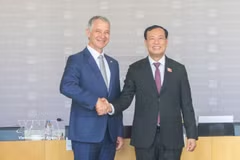
Chairman of the National Assembly's Committee for National Defence, Security and Foreign Affairs Le Tan Toi (R) meets with Jean-Michel Jacques, Chairman of the French National Assembly's National Defence and Armed Forces Committee. (Photo: VNA)

Vietnam, France seek to deepen Comprehensive Strategic Partnership

Both sides agreed to continue promoting regular exchanges and practical cooperation within their respective areas of responsibility, contributing to closer ties between the two legislatures and further strengthening the Vietnam-France Comprehensive Strategic Partnership.

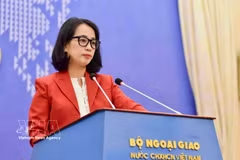
Spokesperson of the Vietnamese Ministry of Foreign Affairs Pham Thu Hang (Photo: VNA)

Vietnam reaffirms goodwill in adhering to 1982 UNCLOS

Vietnam’s clear and consistent stance is that maritime disputes must be resolved through peaceful means, with respect for diplomatic and legal processes, without the use or threat of force, and in accordance with international law, particularly the 1982 UNCLOS

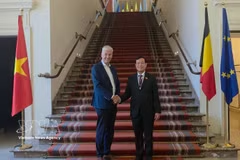
Chairman of the National Assembly's Committee for National Defence, Security and Foreign Affairs Senior Lieutenant General Le Tan Toi (right) meets with First Vice President of the Belgian Senate Andries Gryffroy. (Photo: VNA)

Vietnam, Belgium boost parliamentary cooperation, deepen bilateral relations

Toi called on the Belgian Senate to continue supporting stronger Vietnam-EU relations, including the effective implementation of the EU-Vietnam Free Trade Agreement (EVFTA), the ratification of the EU-Vietnam Investment Protection Agreement (EVIPA), and promoting the European Commission's early removal of its "yellow card" warning against Vietnamese seafood exports, in recognition of Vietnam's efforts to improve its legal framework and promote sustainable fisheries management.

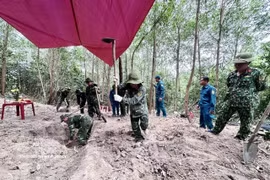
Director of the General Department of Politics under the Vietnam People’s Army General Nguyen Trong Nghia inspects the ongoing search and recovery operation for martyrs’ remains at Le Thi Rieng Park in Ho Chi Minh City. (Photo: VNA)

Senior military officer inspects martyrs’ remains search at Le Thị Rieng Park

Nghia described the ongoing 500-day campaign as a sacred mission that embodies the Vietnamese tradition of remembering those who served and sacrificed for the nation. The current generation, he said, must spare no effort in carrying out the Party’s policy and fulfilling the aspirations of the people, particularly the families of the fallen.

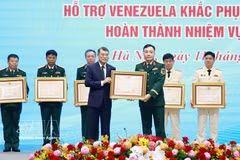
Prime Minister Le Minh Hung (L) presents the First-Class and Second-Class Fatherland Protection Orders to the collectives for their achievements in search and rescue, humanitarian assistance and disaster relief operations in Venezuela. (Photo: VNA)

PM calls for building elite, professional international search and rescue force

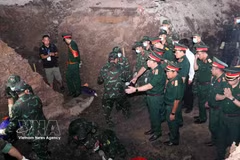
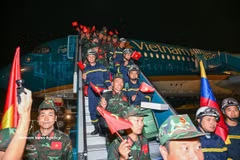
During its mission from June 29 to July 7, the team worked around the clock under extremely hazardous conditions amid heavily damaged and contaminated disaster zones. Despite the challenges, rescue personnel recovered 57 victims' bodies and handed them over to local authorities and families. They also identified and reported several suspected locations where additional victims might be trapped.

General Phan Van Giang (R) and General Khamlieng Outhakaysone plant a tree at Thanh Thuy border gate. (Illustrative photo: VNA)

Border community twinning strengthens Vietnam–Laos friendship

Over the past decade, the twinning relationship between Thuy Phong village in Nghe An’s Kim Bang commune, and Xop Tuong village in Nam On commune, Xaychamphone district, Bolikhamxay province of Laos, has become a model for fostering a shared border of peace, friendship and cooperation.