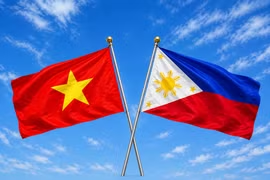
Hanoi (VNA) – Vietnam and the Philippines have steadily built deeper, broader, and more substantive ties since establishing diplomatic relations on July 12, 1976.
A major milestone came in June 2026 when the two countries elevated the relationship to an Enhanced Strategic Partnership, creating a stronger stage for more comprehensive cooperation in a new era.
Half a century of comprehensive and sustainable partnership
Bilateral momentum has accelerated in recent years, underpinned by growing political trust, expanding economic engagement, and closer coordination on global and regional issues.
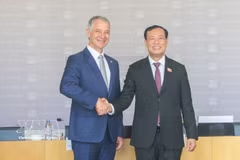
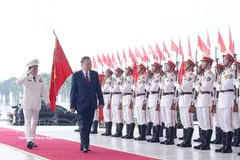
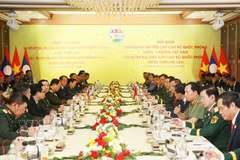
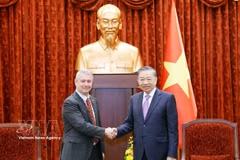
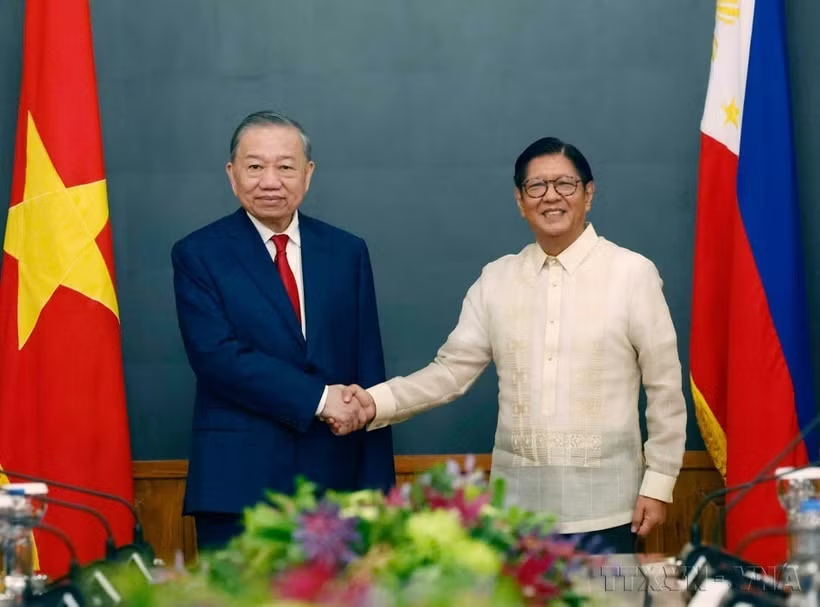
High-level visits and exchanges have remained frequent. A landmark event was the state visit to the Philippines by General Secretary of the Communist Party of Vietnam Central Committee and State President To Lam on May 31–June 1, 2026. Timed with the 50th anniversary of diplomatic ties, the visit not only reinforced political confidence but also elevated bilateral ties to an Enhanced Strategic Partnership. Vietnam remains the only ASEAN member to have established an Enhanced Strategic Partnership with the Philippines.
Under the upgraded framework, the two sides will formulate a Joint Action Plan to drive the partnership forward. They pledged to bolster political trust by increasing high-level exchanges, maintaining existing cooperation mechanisms, and expanding engagement across agencies and localities.
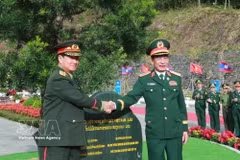
Both countries reaffirmed their commitment to advancing practical cooperation in national defence-security, maritime and ocean affairs, while safeguarding freedom of navigation and overflight and promoting regional peace and stability through coordinated mechanisms. On the economic front, they set their sights on surpassing the 10 billion USD bilateral trade target by broadening two-way trade opportunities, improving market access, and lowering trade and investment barriers to deliver tangible benefits and support national development.
Key cooperation mechanisms, including the Joint Commission for Bilateral Cooperation, Political Consultations, the Defence Policy Dialogue, and the Joint Permanent Working Group on Maritime and Ocean Concerns, continue to solidify strategic dialogue, policy coordination, and the effective handling of issues of mutual interest.
Both nations also work closely together at global and regional forums, particularly within ASEAN, the United Nations, and other multilateral frameworks. They reaffirm ASEAN centrality, uphold multilateralism and international law, and back the vision of a united, resilient, and sustainably developing Southeast Asia.
The Philippines has expressed support for Vietnam’s chairmanship of the 11th Review Conference of the Parties to the Treaty on the Non-Proliferation of Nuclear Weapons, as well as Vietnam’s bids for the UN Economic and Social Council for the 2030–2032 term and the UN Security Council for 2032–2033 as ASEAN’s candidate. Vietnam, in turn, backs the Philippines’ ASEAN-endorsed bid for the UN Security Council seat in 2027–2028.
Economic and trade cooperation: A key pillar
The Philippines is now one of Vietnam's most important markets within ASEAN, particularly in agriculture and food security. Vietnam remains a major rice supplier, shoring up Philippine food security while locking in a stable export channel for Vietnamese farm produce.
Vietnam ranks as the Philippines’ 11th largest trade partner. Bilateral trade grew at an average annual clip above 10% from 2015-2025, climbing to 7.8 billion USD from 2.92 billion USD. Turnover reached 3.74 billion USD during January - May, with both nations now targeting 10 billion USD in the near future.
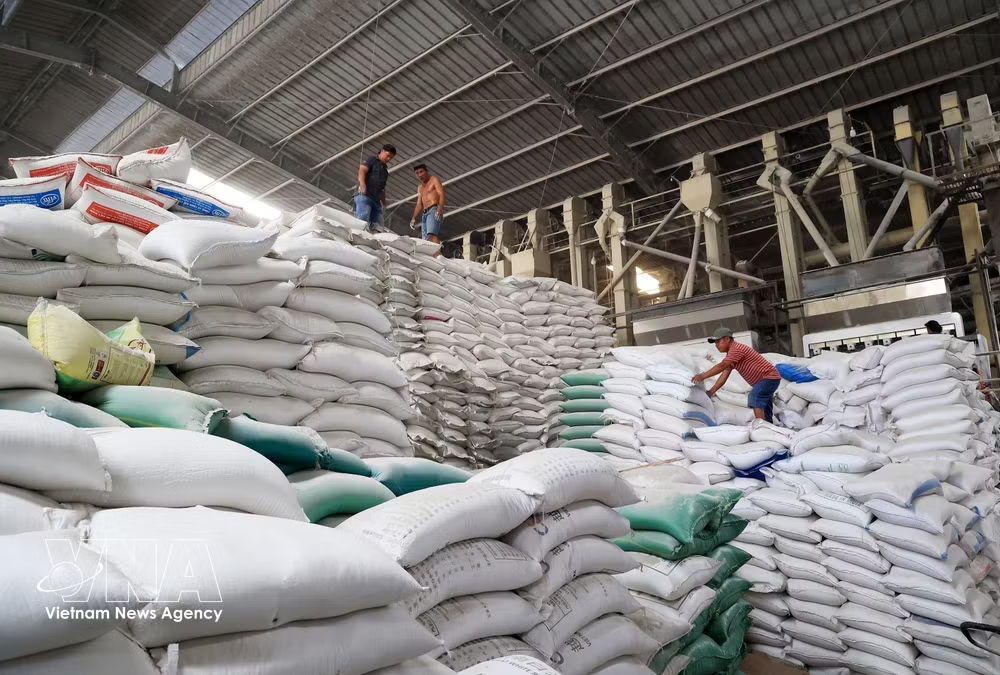
The trade basket has diversified to encompass nearly 40 major Vietnamese export categories, spanning agro-fishery products, processed food, construction materials, apparel, and machinery and equipment.
As of the late April, the Philippines held 112 valid investment projects worth over 626.8 million USD in Vietnam, ranking 32nd among 154 investing economies. Meanwhile, Vietnam had 25 projects valued at 148.2 million USD in the Philippines, making the country its 22nd largest overseas investment destination among 88 markets.
Vietnamese investments in the Philippines focus on green transition, electric taxi services, and high technology, creating new momentum for infrastructure and sustainable growth in the Philippines.
People-to-people exchanges, along with cooperation in education, culture, and tourism, have deepened markedly. A rising number of Filipino students are pursuing undergraduate and postgraduate studies in Vietnam, while more Vietnamese students are taking up internships and completing parts of their academic courses in the Philippines.

Tourism saw particularly strong growth. In 2025, Vietnam welcomed more than 482,000 visitors from the Philippines, an 81.3% jump from 2024. During the first four months of 2026, arrivals neared 236,000, up 73.4% year-on-year, pushing the Philippines into Vietnam’s top 10 source markets for the first time.
Air connectivity expanded sharply, with 6,700 flights operated between the two countries in 2025, a 59% leap over 2024. A rapid buildup of direct services by five airlines, including Vietnam Airlines, Philippine Airlines, Vietjet Air, Cebu Pacific, and AirAsia, drove the growth.
Deepening the Vietnam–Philippines Enhanced Strategic Partnership
The year 2026 holds special significance as it marks the 50th anniversary of diplomatic ties and the Philippines’ tenure as ASEAN Chair. Vietnam has made clear that it attaches high importance to the Enhanced Strategic Partnership and is committed to elevating the relationship to a deeper, broader, and more comprehensive level.
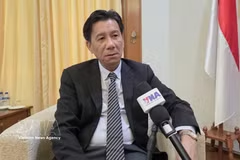
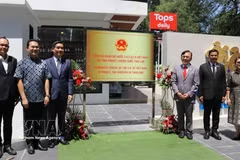
Vietnamese Ambassador to the Philippines Lai Thai Binh called on both sides to sustain and intensify exchanges at all levels while ensuring existing dialogue mechanisms operate effectively and regularly. The aim is to raise mutual understanding, reinforce strategic trust, and deliver long-term, substantive cooperation against an increasingly complex global and regional landscapes.
As two of Southeast Asia’s fastest-growing economies with highly complementary structures, Vietnam and the Philippines have ample room to scale up trade and investment. He underscored the need to keep improving trade facilitation policies, widen market access, and boost investment and business-to-business connectivity.
He also stressed the importance of fully tapping the newly signed Memorandum of Understanding on sci-tech and digital transformation to accelerate collaboration in the digital and green economies, which are expected to become key growth drivers for both countries.
Beyond traditional agricultural cooperation, he urged greater emphasis on smart agriculture and climate-resilient aquaculture to address the common challenges faced by coastal nations.
On people-to-people exchanges, Binh pushed for effective rollout of the 2026–2029 tourism cooperation agenda and existing cultural agreements, while promoting direct partnerships among local authorities, friendship organisations, and educational establishments./.