Vietnamese culture expected to undergo sharp transformation

Drawing on Party General Secretary and State President To Lam's detailed and practical guidance, artists and researchers voiced confidence that Vietnamese culture will undergo a sharp transformation and truly become both a spiritual foundation and a key driver of sustainable development in the new era.

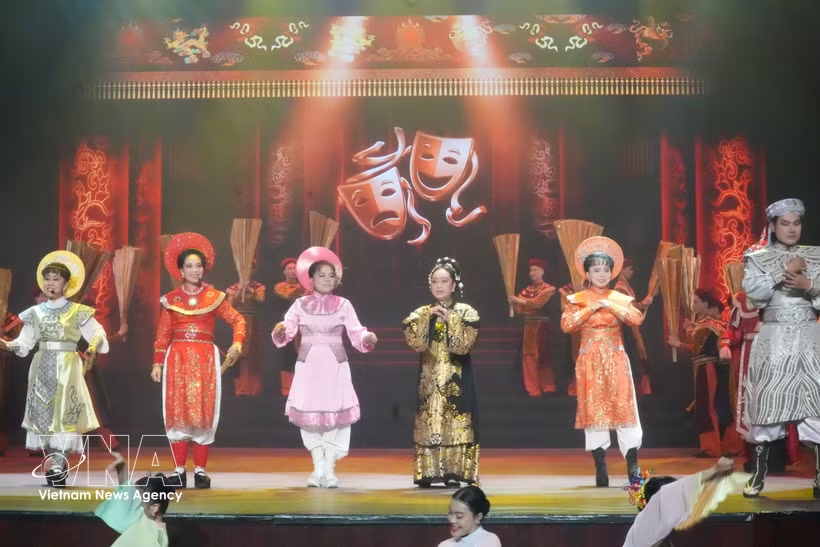
A performance of classic "cai luong" excerpts at a 2026 competition to look for talents. (Photo: VNA)

Hanoi (VNA) – Party General Secretary and State President To Lam’s address at the second meeting of the Central Steering Committee for the Vietnamese Culture Development on July 13 directly confronted the bottlenecks in the implementation of the Politburo’s Resolution 80-NQ/TW and charted strategic directions for culture in a new era.

Artists, scholars and researchers praised the speech as a strategic, action-driven blueprint designed to turn culture into the nation’s spiritual foundation, a source of internal strength and a key engine of national development.

Confronting ‘four gaps’ to unlock breakthroughs

Six months after the Politburo issued the Resolution 80-NQ/TW, Lam acknowledged initial progress but pointed to “four major gaps” requiring urgent attention and outlined “three major transformations” to align cultural development with the demands of the new period.

Photographer Tran Thi Thu Dong, Vice President of the Vietnam Union of Literature and Arts Associations and President of the Vietnam Association of Photographic Artists, said the leader’s four gaps strike at the core bottlenecks.

Those include the limited appeal and reach of Vietnamese cultural values in the digital space, which has failed to keep pace with surging online content. Vietnam holds a vast cultural trove of more than 40,000 historical sites, nearly 70,000 items of intangible cultural heritage and 38 UNESCO-inscribed elements, yet most remain undigitised, lack standardised data and have yet to be converted into digital knowledge or intellectual property (IP) assets.

Other gaps lie with the country’s limited capacity to create competitive cultural products that could become national icons, a fragmented institutional framework, and an underdeveloped cultural industry ecosystem. The sector contributes roughly 4% of GDP, well below the Government’s 2030 target of 7%.

Against this backdrop, the “three major transformations” set a comprehensive strategic framework: recasting culture from a standalone sector into a spiritual foundation, strategic pillar and new economic growth engine; expanding cultural development into both physical and digital spaces, where sovereignty over data, platforms and content is treated as an integral part of national sovereignty; and shifting from a preservation-only mindset to a model that fuses preservation with innovation.

Dong welcomed the focus on genuine digital transformation rather than superficial digitisation. A heritage asset, she said, is not digitised simply because it has been photographed or uploaded online. Digital records must carry standardised identification, technical specifications, interoperability and the capacity for data sharing and reuse, while serving education, research, tourism and cultural industries. Equally critical is a fair benefit-sharing mechanism among the State, local communities, artisans, creators and businesses, which has been long demanded by the domestic creative community.
vnanet-b.jpg
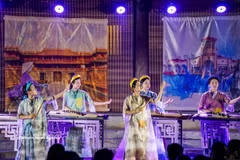
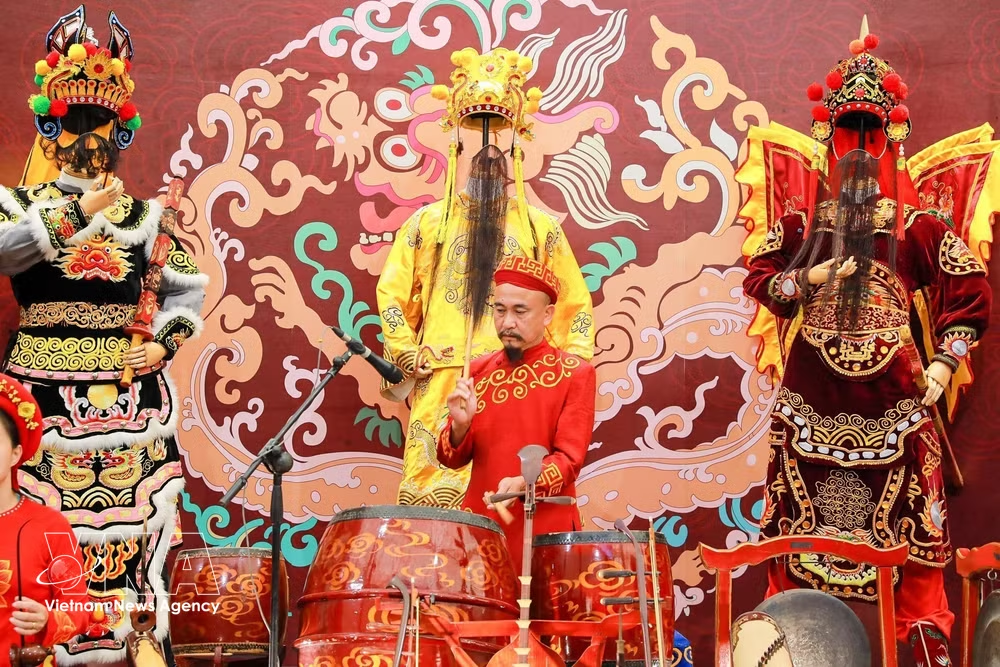
A performance at the 2025 Hanoi Autumn Festival. (Photo: VNA)

According to her, the directions come with clearly defined tasks, timelines and measurable targets. Those include completing a legal framework through foundational laws on copyright, artistic activities and cultural industries, developing a National Cultural Index, raising public spending on culture to at least 2% of the state budget, and turning cultural industries into a new growth driver via flagship projects and cultural hubs in key localities.

For artists, cultural managers and researchers, the push represents both a major opportunity, with increased state support and targeted investment in quality works, and a profound responsibility to create works that become national symbols and tell Vietnam’s story to the world.

From strategic vision to a measured roadmap

Dr. Dang Vu Canh Linh, Deputy Director of the Institute for Personnel Training and Scientific Research under the Vietnam Fatherland Front Central Committee, said the four gaps the leader identified make the practical challenges of realising the resolution plain. Turning culture into genuine internal strength, soft power and a pillar of national competitiveness requires further refining institutional framework, policies and an ecosystem capable of converting cultural values into data, knowledge, creative works, products and markets that the public voluntarily embraces.

In his view, the address plays a crucial role in translating the resolution from a strategic policy framework into a focused action agenda, complete with clear responsibilities, deliverables, deadlines and evaluation criteria.

Drawing on that detailed and practical guidance, artists and researchers voiced confidence that with the entire political system, businesses and the creative community engaged, Vietnamese culture will undergo a sharp transformation and truly become both a spiritual foundation and a key driver of sustainable development in the new era./.
VNA

See more

Members of the Mong ethnic group in Cao Bang province say that embracing Protestantism and participating in local congregations has brought positive changes to their lives, fostering closer bonds and a strong sense of solidarity among followers. (Photo: VNA)

Digital transformation in religion: When religious teachings spread with a single tap

As Vietnam's digital transformation continues, technology is opening new avenues for religious communities to share their teachings more quickly, more broadly and with more diverse audiences than ever before. Yet these opportunities also bring responsibilities: safeguarding the authenticity of religious teachings, cultivating a healthy and trustworthy digital environment, and equipping religious communities with the digital literacy needed to navigate the online world responsibly.

A working session between Deputy Minister of Culture, Sports and Tourism Ta Quang Dong (centre, right) and UNESCO representative to Vietnam Jonathan Wallace Baker (Photo: baovanhoa.vn)

UNESCO, culture ministry discuss Photography City proposal

Jonathan Wallace Baker, UNESCO representative to Vietnam, confirmed that UNESCO stands ready to work alongside the culture ministry throughout the planning and implementation of the Photography City project, helping identify effective solutions to ensure its success.

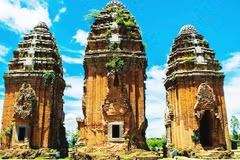
The Duong Long tower complex is a special national relic built by the Cham people in the late 12th and early 13th centuries. (Photo: nhandan.vn)

Restoration breathes new life into Southeast Asia's tallest Cham tower

After more than 800 years, the towers have suffered damage from weather, time and plant growth. In late 2025, the provincial Department of Culture, Sports and Tourism launched a restoration project worth more than 90 billion VND (3.4 million USD). Scheduled to last 10 months, the project now sees 40% of its workload completed.

A space for performing traditional Vietnamese music at the Temple of Literature. (Photo: VNA)

Art breathes new life into Vietnam's heritage spaces

In Hanoi, many historical and cultural landmarks have successfully enhanced their value through creative artistic activities. The Thang Long Imperial Citadel regularly hosts historical re-enactments, exhibitions and cultural experiences, while popular night tours at Hoa Lo Prison relic site demonstrate the effectiveness of storytelling through the combination of sound, light and performance.

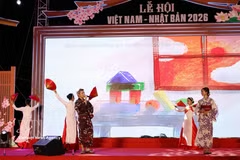
An art performance at the Vietnam-Japan Festival 2026 in Da Nang city. (Photo: VNA)

Vietnam-Japan Festival 2026 opens in Da Nang

Speaking at the opening ceremony, Vice Chairwoman of the municipal People's Committee and head of the festival's organising committee Nguyen Thi Anh Thi said that after many editions, the festival has become one of the city's signature external affairs events, helping reinforce the increasingly close partnership between Da Nang and Japanese localities and partners.

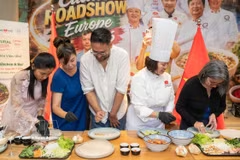
Visitors participate in a live demonstration of pho roll preparation at the event. (Photo: VNA)

Pho takes Vietnam’s flavours, identity on Europe journey

More than a food showcase, the programme combines live cooking demonstrations, cultural talks, chef-to-chef exchanges, and business networking to strengthen the global profile of Vietnamese cuisine and promote deeper international connections through gastronomy.

The opening ceremony of The Grand Esports 2026 on July 9 (Photo courtesy of the Sports Authority of Vietnam)

The Grand Esports 2026 opens in Hanoi

The Grand Esports 2026 officially opened in Hanoi on July 9, demonstrating that esports has entered a new stage of development and is increasingly recognised as an important part of Vietnam's national sports strategy, cultural industries and digital economy.

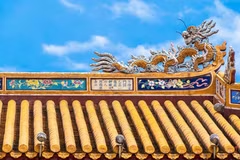
The poem inscribed on the roof ridge of Ngo Mon Gate is part of the Poetry on Hue Royal Architecture collection, which was recognised by UNESCO as documentary heritage under the Memory of the World Programme for Asia and the Pacific. (Photo: qdnd.vn)

Workforce vital to documentary heritage

The combination of a transparent legal framework, a comprehensive digitisation strategy and an internationally qualified workforce will provide a solid foundation for preserving, utilising and disseminating the value of Vietnam’s documentary heritage, enabling the nation’s collective memory to be passed on sustainably to future generations.

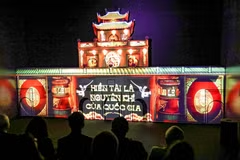
Viewers watch Thang Long Capital show featuring 3D mapping and digital experiential spaces. (Photo: VNA)

Digital technologies unlock new value from Vietnam’s cultural heritage

Vietnam possesses a wealth of tangible and intangible cultural heritage, with tens of thousands of historical and cultural sites nationwide. Experts believe that, supported by digital technologies, these resources can become a major driver of culture, tourism, education and creative industries.

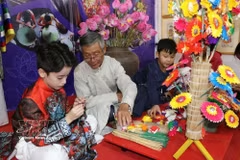
Children experience traditional craft (Photo: VNA)

Promoting souvenir industry to spread national image

Experts said that with market-oriented development, improved functionality, stronger storytelling and greater involvement from designers, businesses and market-connecting organisations, souvenirs could become a bridge linking Vietnam with the world while contributing to the growth of cultural industries and the creative economy.

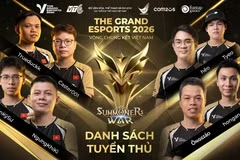
Vietnamese players will compete at the Esports Grand Championship 2026 this July. (Photo: Sports Authority of Vietnam)

Vietnam to host Esports Grand Championship for first time

The international tournament, endorsed by the Southeast Asian Esports Federation and recognised under Olympic-standard achievement criteria, will take place from July 9 to 12 at the My Dinh Athletics Palace in Hanoi as part of The Grand Esports 2026 series.