Paris programme promotes values of Van Mieu – Quoc Tu Giam

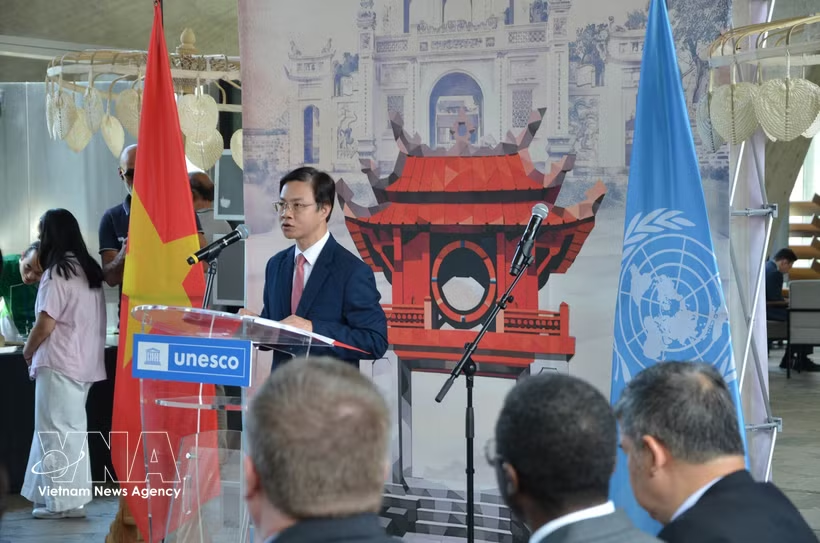
UNESCO Assistant Director-General for Culture Nayef Al-Fayez stressed that the values represented by Van Mieu – Quoc Tu Giam – the fondness for learning, cultural continuity, and the pursuit of knowledge – closely align with UNESCO’s mission to advance education, safeguard heritage, and foster dialogue among nations.

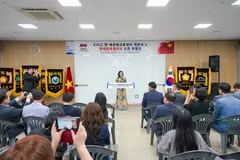
Vietnamese Deputy Minister of Foreign Affairs Ngo Le Van, who is Chairman of the Vietnam National Commission for UNESCO, speaks at the "Dao Hoc" cultural programme in Paris. (Photo: VNA)

Paris (VNA) – A cultural programme entitled “Dao Hoc” (The Way of Learning) was held at the headquarters of the United Nations Educational, Scientific and Cultural Organisation (UNESCO) in Paris on June 17, highlighting the enduring values of Van Mieu (Temple of Literature) – Quoc Tu Giam and Vietnam’s rich cultural heritage.

The event formed part of a series of activities marking the 50th anniversary of relations between Vietnam and UNESCO (1976–2026). It was jointly organised by the Vietnam National Commission for UNESCO, the Hanoi People’s Committee, and the Permanent Delegation of Vietnam to UNESCO on the occasion of the 950th founding anniversary of Quoc Tu Giam, Vietnam’s first national university.

The programme brought together more than 200 participants, including UNESCO Director-General Khaled El-Enany, ministers, heads of delegations attending the General Assembly of States Parties to the 2003 Convention for the Safeguarding of the Intangible Cultural Heritage, ambassadors, representatives from over 100 UNESCO member states, and numerous international guests.

In his opening remarks, Vietnamese Deputy Minister of Foreign Affairs Ngo Le Van, who is Chairman of the Vietnam National Commission for UNESCO, described Van Mieu – Quoc Tu Giam as a defining symbol of Vietnam’s civilisation and educational tradition. With a history spanning nearly a millennium, the site embodies the nation’s respect for learning, reverence for teachers, appreciation of talent, and enduring belief that education and knowledge form the foundation for sustainable national development.

He noted that the 82 doctoral steles preserved at the site have been inscribed on UNESCO’s Memory of the World Register, further reinforcing the monument’s significance as a symbol of Hanoi and Vietnam’s long-standing commitment to scholarship and intellectual achievement.

Van also highlighted the close cooperation between Vietnam and UNESCO in heritage preservation, citing the Imperial Citadel of Thang Long, a UNESCO-recognised world heritage site, as another success example. Together, the two heritage sites at the heart of Hanoi convey a powerful message to the world that culture and education are essential pillars of peace, sustainable development, and humanity’s future.

Marking five decades of Vietnam – UNESCO relations, the deputy minister affirmed that the partnership has grown increasingly comprehensive, substantive, and effective. He described UNESCO as a trusted companion that has supported Vietnam throughout the country's post-war reconstruction, renewal, international integration, and development process, while Vietnam has become an active and responsible member contributing to UNESCO’s shared objectives.

UNESCO Assistant Director-General for Culture Nayef Al-Fayez praised the special significance of Van Mieu – Quoc Tu Giam as one of Vietnam’s most prominent cultural and historical symbols. Beyond its architectural and historical value, he said, the site stands as a living testament to Vietnam’s long tradition of valuing education and scholarship, demonstrating that heritage is not merely about preserving the past but also about inspiring future generations.

He stressed that the values represented by Van Mieu – Quoc Tu Giam – the fondness for learning, cultural continuity, and the pursuit of knowledge – closely align with UNESCO’s mission to advance education, safeguard heritage, and foster dialogue among nations. In a rapidly changing world, culture remains a vital resource for resilience and sustainable development, and Van Mieu – Quoc Tu Giam demonstrates the role of heritage as a bridge connecting the past with the present.
vnanet-aodai.jpg
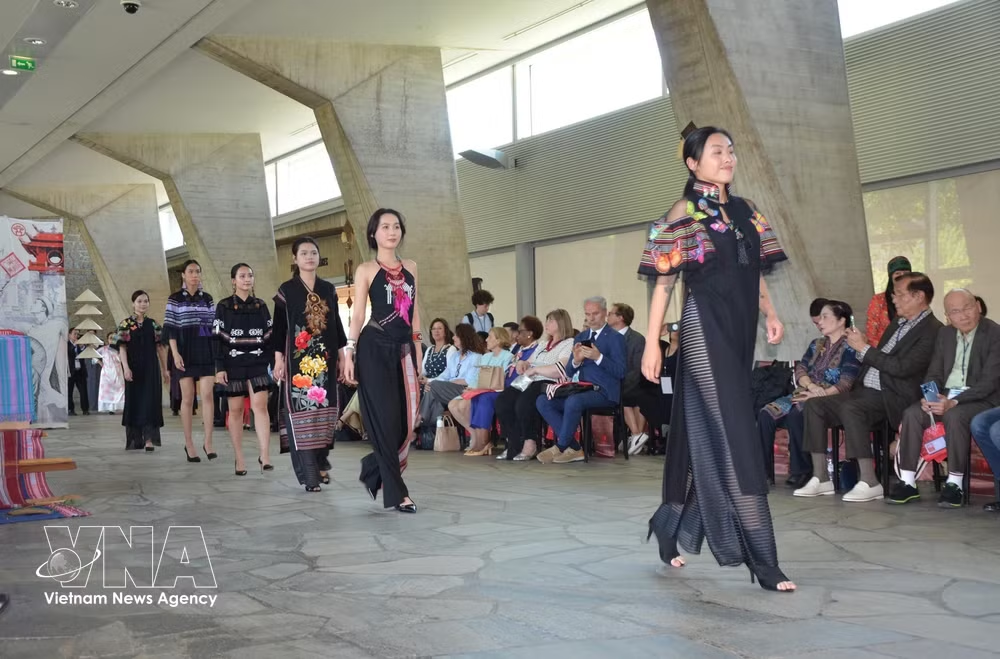
A collection of “Ao dai” (Vietnam’s traditional long dress) by designer Minh Hanh. (Photo: VNA)

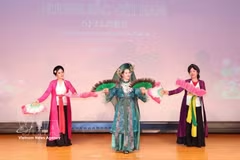
A highlight of the event was the artistic programme “Dao Hoc”, which showcased the depth and diversity of Vietnamese culture through exhibitions, music, traditional costumes, and performing arts. Collections of “ao dai” (Vietnam’s traditional long dress) by designer Minh Hanh, inspired by Vietnam’s educational heritage, promoted the values of humanity, propriety, righteousness, wisdom, and integrity.

The programme also featured interactive heritage experiences, enabling international guests to engage directly with traditional Vietnamese materials, techniques, and cultural symbols. Participants had the opportunity to explore the nation’s scholarly traditions, historical documents, and fine arts, while also sampling signature dishes from Hanoi and other localities of Vietnam, celebrating cultural values shaped over thousands of years of history./.
VNA

See more

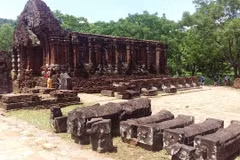
The Duong Long tower complex is a special national relic built by the Cham people in the late 12th and early 13th centuries. (Photo: nhandan.vn)

Restoration breathes new life into Southeast Asia's tallest Cham tower

After more than 800 years, the towers have suffered damage from weather, time and plant growth. In late 2025, the provincial Department of Culture, Sports and Tourism launched a restoration project worth more than 90 billion VND (3.4 million USD). Scheduled to last 10 months, the project now sees 40% of its workload completed.

A space for performing traditional Vietnamese music at the Temple of Literature. (Photo: VNA)

Art breathes new life into Vietnam's heritage spaces

In Hanoi, many historical and cultural landmarks have successfully enhanced their value through creative artistic activities. The Thang Long Imperial Citadel regularly hosts historical re-enactments, exhibitions and cultural experiences, while popular night tours at Hoa Lo Prison relic site demonstrate the effectiveness of storytelling through the combination of sound, light and performance.

An art performance at the Vietnam-Japan Festival 2026 in Da Nang city. (Photo: VNA)

Vietnam-Japan Festival 2026 opens in Da Nang

Speaking at the opening ceremony, Vice Chairwoman of the municipal People's Committee and head of the festival's organising committee Nguyen Thi Anh Thi said that after many editions, the festival has become one of the city's signature external affairs events, helping reinforce the increasingly close partnership between Da Nang and Japanese localities and partners.

Visitors participate in a live demonstration of pho roll preparation at the event. (Photo: VNA)

Pho takes Vietnam’s flavours, identity on Europe journey

More than a food showcase, the programme combines live cooking demonstrations, cultural talks, chef-to-chef exchanges, and business networking to strengthen the global profile of Vietnamese cuisine and promote deeper international connections through gastronomy.

The opening ceremony of The Grand Esports 2026 on July 9 (Photo courtesy of the Sports Authority of Vietnam)

The Grand Esports 2026 opens in Hanoi

The Grand Esports 2026 officially opened in Hanoi on July 9, demonstrating that esports has entered a new stage of development and is increasingly recognised as an important part of Vietnam's national sports strategy, cultural industries and digital economy.

The poem inscribed on the roof ridge of Ngo Mon Gate is part of the Poetry on Hue Royal Architecture collection, which was recognised by UNESCO as documentary heritage under the Memory of the World Programme for Asia and the Pacific. (Photo: qdnd.vn)

Workforce vital to documentary heritage

The combination of a transparent legal framework, a comprehensive digitisation strategy and an internationally qualified workforce will provide a solid foundation for preserving, utilising and disseminating the value of Vietnam’s documentary heritage, enabling the nation’s collective memory to be passed on sustainably to future generations.

Members of the Vovinam club in Paris. (Photo: VNA)

Paris Vovinam club promotes Vietnamese culture in France

The club currently has nearly 50 members aged from seven to over 70, with regular training sessions held on Tuesday and Wednesday evenings, alongside extended weekend classes for both children and adults. The classes are led by a father-and-daughter team, assisted by between two and six instructors depending on the session.

Viewers watch Thang Long Capital show featuring 3D mapping and digital experiential spaces. (Photo: VNA)

Digital technologies unlock new value from Vietnam’s cultural heritage

Vietnam possesses a wealth of tangible and intangible cultural heritage, with tens of thousands of historical and cultural sites nationwide. Experts believe that, supported by digital technologies, these resources can become a major driver of culture, tourism, education and creative industries.

Children experience traditional craft (Photo: VNA)

Promoting souvenir industry to spread national image

Experts said that with market-oriented development, improved functionality, stronger storytelling and greater involvement from designers, businesses and market-connecting organisations, souvenirs could become a bridge linking Vietnam with the world while contributing to the growth of cultural industries and the creative economy.

Vietnamese Ambassador to Slovakia Pham Truong Giang presents a certificate of merit from the Central Committee of the Vietnam Fatherland Front to the executive board of the Vietnamese People Association in Slovakia in recognition of its efforts to unite and support the overseas Vietnamese community. (Photo: published by VNA)

Vietnam Day 2026 promotes Vietnamese culture in Slovakia

Jointly organised by the Vietnamese Embassy and community in Slovakia, the annual event showcased Vietnam's rich cultural heritage while promoting people-to-people exchanges and strengthening friendship between the two countries.

Vietnamese players will compete at the Esports Grand Championship 2026 this July. (Photo: Sports Authority of Vietnam)

Vietnam to host Esports Grand Championship for first time

The international tournament, endorsed by the Southeast Asian Esports Federation and recognised under Olympic-standard achievement criteria, will take place from July 9 to 12 at the My Dinh Athletics Palace in Hanoi as part of The Grand Esports 2026 series.