Ancient inscriptions collection set for heritage recognition

The inscription collection, which is believed to be from the fifth century to 13th century, were carved on sandstone and terracotta stele, cantilevers and architectural structure beams and girders, or were engraved texts on pedestals.

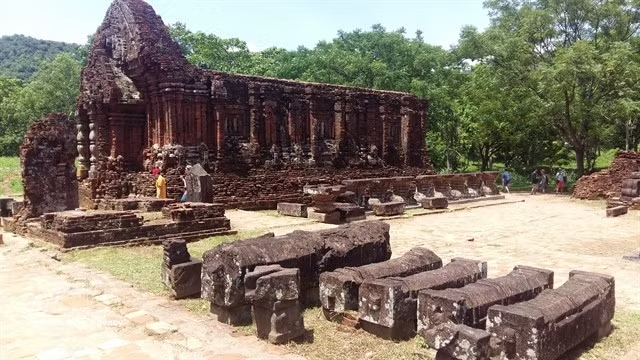
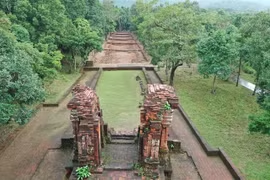
A tower is preserved at My Son Sanctuary, 70km south of Da Nang city's downtown. The world heritage site is one of the most popular destinations in central Vietnam, and it has restored a huge amount of valuable ancient culture and items. (Photo: VNS/VNA)

Hanoi (VNS/VNA) – Experts and archaeologists from the World Cultural Heritage site of My Son Sanctuary have started an assessment and research project of a collection of inscriptions, carved texts on sandstone and terracotta material to build a dossier for heritage recognition.

Nguyen Van Tho, from the management of the My Son Sanctuary World Cultural Heritage site, said the project, kicked off in May, will be review a 50-inscription collection.

He said the inscription collection, which is believed to be from the fifth century to 13th century, had been carved on sandstone and terracotta stele, cantilevers and architectural structure beams and girders, or were engraved texts on pedestals.

The heritage management board also said some inscriptions had been stored for display at the Vietnam National Museum of History and Cham Sculpture Museum of Da Nang.

It said translation works on ancient inscriptions had been done during the 20th century, but major engraved inscriptions have not yet been translated, or remain unexcavated at the heritage site.

In past years, Sanskrit inscriptions on stone slabs at the My Son Sanctuary were translated into Vietnamese and English, as part of a joint project between Vietnamese and Indian scientists.

Experts from India and the French Institute of Far Eastern Studies had assisted in translating these ancient steles from Sanskrit, the ancient liturgical language of Hinduism.

The My Son Sanctuary has Sanskrit epitaphs engraved on 31 slabs made of brick and stone, the main materials used in building My Son Sanctuary, the sanctuary’s management board reported.

The ancient Cham scripts and Sanskrit inscriptions at the UNESCO-recognised site are highly valuable heritage.

The My Son Sanctuary is still a unique and mysterious archaeological site, and it remains a research centre for Cham culture – a defunct civilisation in Asia. At least 70 temples and towers were built at the site from the 4th century, and brick and natural cement were used.
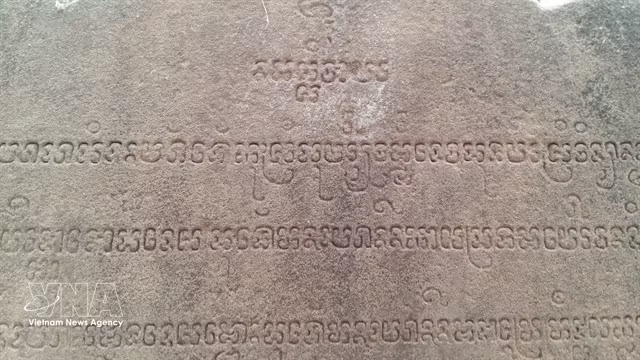
vnanet-my-son-sanctuary-world-cultural-heritage-site-3.jpg
Ancient carved texts on sandstone stele are displayed at the My Son Sanctuary – a UNESCO-recognised world heritage site. Many engraved inscriptions at the site have yet to be translated or assessed for a heritage dossier. (Photo: VNS/VNA)

Research into the construction techniques of the Cham people resulted from the restoration of monuments in 2003–2013 by the Vietnam – Italy – UNESCO tripartite partnership.

Polish archaeologist and architect Kazimierz Kwiatkowski, known as “Kazik”, made contributions to the recognition of the Sanctuary as a world heritage site by UNESCO in 1999.

Kazik and a group of Polish archaeologists had strengthened ruined towers with cement, as well as clearing groups of towers in 1981–1995 before they would be damaged due to weather and poor conservation.

Italian archaeologists then continued the restoration of Group G on the site from 1997 before Indian experts began recovering towers of Groups K, A and H from 2017–2021.

Much earlier, French archaeologists and researchers found the My Son Sanctuary in 1885, and the first excavation and research on the Cham towers began in 1898–1999 by Louis Finot and Launet de Lajongquere.

Heri Parmentier researched the site in 1901–1902, and many artefacts were brought to the Cham Sculpture Museum in Da Nang city.

Last year, excavations exposed an ancient entrance road linking the K Tower to the central towers complex, and it is believed to have served as a sacred route for Hindu deities and a royal passage for Champa kings and priests between the 10th and 12th centuries.

Indian archaeologists had earlier identified two gates to the east and west of the K Tower, as well as a section of the guide wall leading to towers E and F during a restoration project in 2017–2018.

The My Son Sanctuary, recognised by UNESCO as a world heritage site in 1999, remains one of the most popular destinations in central Vietnam, alongside Hoi An Ancient Town and the Cham Islands – Hoi An World Biosphere Reserve.

Located about 70km from downtown Da Nang, My Son is the only central complex of Champa towers dating from the fourth to the 13th centuries, representing a unique centre of the former Champa Kingdom in central Vietnam.

Many artefacts excavated from the sanctuary have been preserved and displayed at the Cham Sculpture Museum in Da Nang since 1915, with significant contributions from French archaeologist Henri Parmentier.

Da Nang plans an emergency restoration project to save the ruins of Dong Duong Buddhism monastery – a Cham tower complex and pedestal alter from the ancient Kingdom of Champa – from collapsing soon./.
VNA

See more

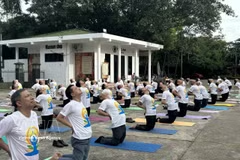
People join a mass yoga performance at the Vietnam Museum of Ethnology in Hanoi on June 14 as part of activities marking the International Day of Yoga (June 21). (Photo: VNA)

Mass yoga performance celebrates India – Vietnam cultural ties

Yoga's increasing popularity in Vietnam reflects the enduring appeal of positive cultural values and demonstrates the Vietnamese people's appreciation of India’s and humanity's cultural essence, said a leader of the Vietnam Academy of Social Sciences.

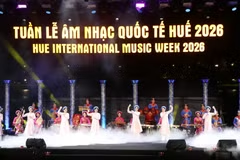
A performance at the opening ceremony of the Hue International Music Week 2026 on June 13. (Photo: VNA)

Hue International Music Week 2026 opens

Audiences will enjoy a diverse musical palette ranging from V-pop, K-pop, J-pop and alternative pop to flamenco and other emerging international performance trends.

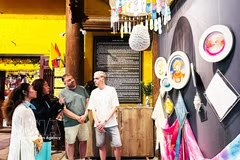
Foreigners explore Vietnamese silk at the Yen Thai communal house in Hanoi. (Photo: VNA)

Vietnamese silk gets modern pitch inside Hanoi communal house

Storytelling about preserving traditional crafts, paired with experiential activities within heritage spaces, is seen as an effective way for Vietnamese craft village products to continue to shine and claim their place in contemporary life, said an insider.

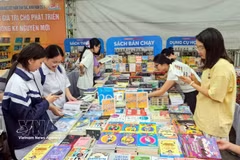
Book displays and introductions help foster a love of reading and spread reading culture throughout the community. (Photo: VNA)

Vietnam seeks strong global presence for its children's books

Vietnamese children’s literature has steadily expanded its presence in international literary circles in recent years. From a few notable titles earning recognition in respected competitions, the sector has shown encouraging progress in bringing Vietnamese stories to readers around the world.

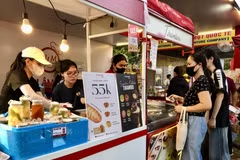
A stall offering discounted combo meals of bread and drinks at the fourth Banh mi Festival in Ho Chi Minh City on April 23 (Photo: VNA)

Ho Chi Minh City ranks among world’s top culinary destinations

According to Time Out, the appeal of Ho Chi Minh City’s cuisine lies in its creativity, much of which was shaped during challenging periods in history. Iconic dishes such as banh mi (sandwiches) and com tam (broken rice) are highlighted as examples of this resourcefulness.

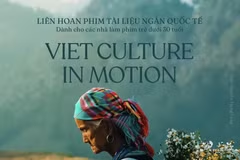
The international short documentary film festival “Viet Culture in Motion” officially opens at the Saint-André des Arts cinema in Paris on June 11 (Photo: organising board)

Vietnamese youth tell cultural stories on European screen

The international short documentary film festival “Viet Culture in Motion” highlights the efforts of young Vietnamese and overseas Vietnamese filmmakers to introduce Vietnam’s culture and people to international audiences through documentary storytelling. It has brought together professional filmmakers, screenwriters and cultural and film activists from Vietnam and abroad.

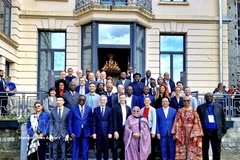
Delegates to the 107th meeting of the AIMF Executive Bureau 2026 (Photo: VNA)

Hue spreads heritage city values within Francophone community

Its participation marked an important step for the central city of Hue to expand its international partnerships, deepen integration with municipalities worldwide, and cement its role and standing as a dynamic and responsible heritage city within the Francophone network.

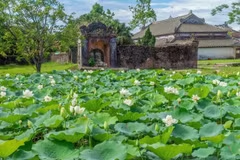
With its rich history, aesthetic grace, and spiritual meaning, the lotus stands as a central symbol in defining Hue’s cultural identity. (Photo: tapchidongnama.vn)

Lotus Festival lights up Hue’s summer

Scheduled for June 19-21 at Bong Lai Islet on Tinh Tam Lotus Lake in Phu Xuan ward, one of Hue’s most renowned scenic landmarks and a symbol of royal garden art, the festival draws inspiration from the lotus’s enduring beauty in court culture. The event aims to honour local heritage while offering visitors a distinctive summer tourism experience.

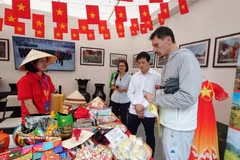
The “Vietnam Pavilion” at Aldea Global 2026 (Photo: VNA)

World Cup 2026: Vietnam leaves distinct mark at global cultural showcase

The “Vietnam Pavilion” at Aldea Global 2026 offers Mexican visitors and international guests an opportunity to explore the country’s rich cultural heritage, history and people through exhibitions, tourism promotion activities, traditional arts presentations and displays of representative cultural products.

Michelin Guide Vietnam recognises 11 one-Michelin star restaurants (Photo: Michelin Guide Vietnam)

Local ingredients, cultural roots propel Vietnam’s Michelin journey

One of the clearest examples is Hieu Luc, a modest fish soup eatery on Hai Ba Trung Street in Hanoi, which has been included in the Michelin Selected category for the second consecutive year. Known for its clear, delicately sweet broth made from freshwater perch and mustard greens, the restaurant serves a traditional specialty from Hung Yen province.

Delegates attending the ASEAN City Leaders Conference 2026 visit the Imperial Citadel of Thang Long on June 9. (Photo: VNA)

ASEAN city leaders explore Hanoi’s heritage sites

At the Imperial Citadel of Thang Long, delegates visited the Doan Mon Gate and learnt about the formation and development of the ancient capital through different historical periods at display spaces. They also explored the Kinh Thien Palace’s Dragon Steps (large stone steps with dragon carvings), regarded as the political and ceremonial centre of the imperial citadel during successive Vietnamese dynasties.

Ly Hoang Nam is Asia's No. 1 pickleball player. (Photo: webthethao.vn)

Ly Hoang Nam tops Asian pickleball rankings

Vietnam boasts five players in the DUPR Asian top 10, with Nam leading the rankings on 6,267 points ahead of competitors from the Philippines, India, Hong Kong (China) and Chinese Taipei.