Hanoi seeks to unlock night-time economy through culture, heritage

As the tourism sector seeks to increase visitor spending and extend stays, the development of the night-time economy is increasingly seen as a way to create new tourism products, enhance destination appeal and support sustainable urban growth.

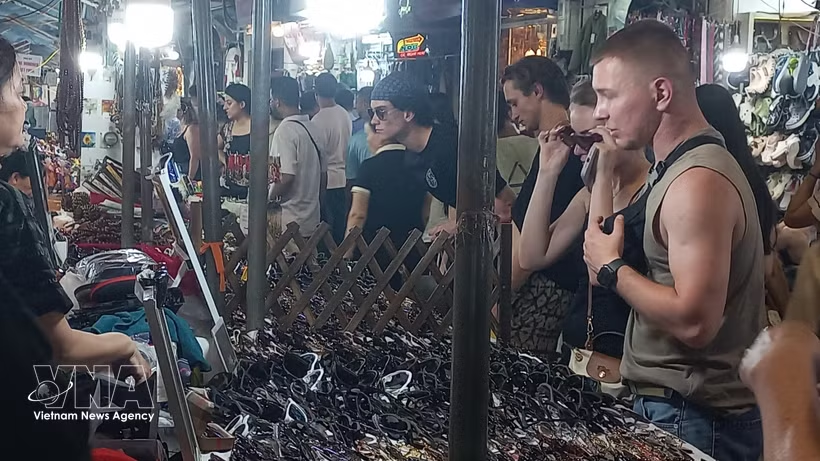
International tourists love shopping for souvenirs at Hanoi's Old Quarter night market (Photo: VNA)

Hanoi (VNA) – As Vietnam’s political, cultural and tourism hub, Hanoi welcomes tens of millions of domestic and international visitors each year and has gained global recognition for its rich heritage, distinctive cuisine and strong cultural identity. However, tourism experts say the city’s night-time economy and visitor experiences have yet to fully match its potential.

Beyond Hoan Kiem Lake (Sword Lake), the Old Quarter and several weekend pedestrian streets, evening entertainment and cultural offerings remain limited. Many visitors end their exploration of Hanoi early, despite the fact that night-time activities are a major driver of tourism spending in many global destinations.

Existing products have already demonstrated Hanoi’s potential. Night tours at the Imperial Citadel of Thang Long and Hoa Lo Prison Relic Site, cultural performances and pedestrian spaces have shown that the city can create compelling after-dark experiences.

As the tourism sector seeks to increase visitor spending and extend stays, the development of the night-time economy is increasingly seen as a way to create new tourism products, enhance destination appeal and support sustainable urban growth.

Culture and heritage at the core

Assoc. Prof. Dr. Bui Hoai Son, a full-time member of the National Assembly’s Committee for Culture and Social Affairs, Hanoi possesses unique resources to tell its story at night, including its extensive heritage, cultural layers and historic architecture.
vnanet-hanoi2.jpg
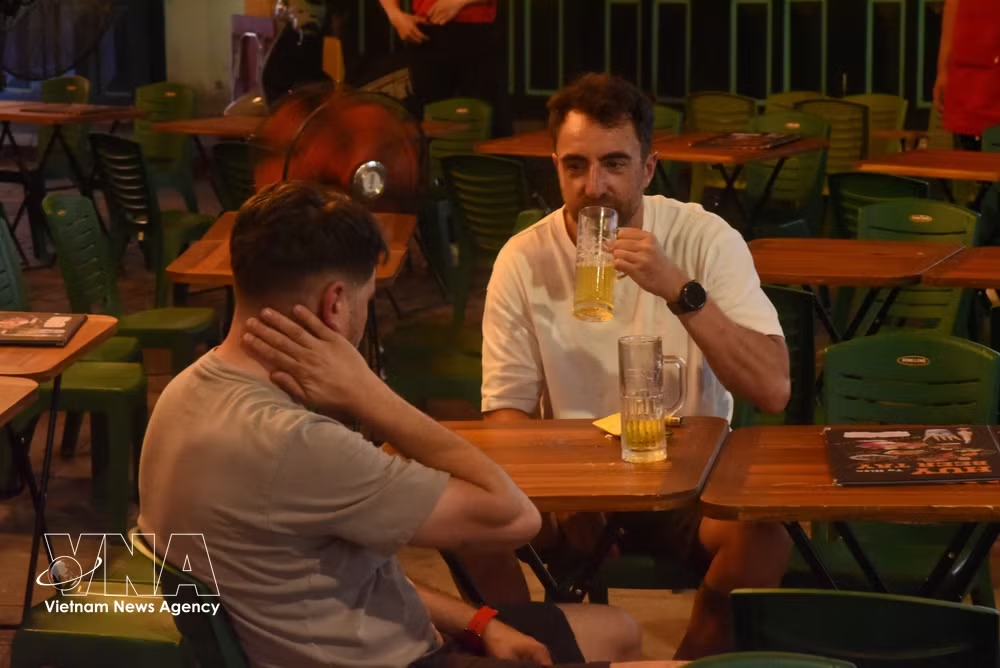
Tourists enjoy beer on Ta Hien Street in Hanoi (Photo: VNA)

When developed systematically, cuisine, arts and cultural activities can enrich visitor experiences and turn the night-time economy into a form of “soft power” that helps lengthen stays, increase spending and strengthen the capital’s competitiveness, he said.

Vu Van Tuyen, CEO of Travelogy Vietnam, said Hanoi’s greatest advantage lies not in vibrancy but in cultural depth.

“Hanoi’s night-time economy should be built on its thousand-year heritage rather than competing solely through sound and lighting effects,” he said, stressing that visitors need memorable experiences that encourage them to stay longer.

“If daytime allows visitors to see Hanoi, then nighttime should allow them to feel its soul,” he added.

Visitors have also expressed a desire for more diverse evening activities. Simon, a tourist from Germany, said more programmes encouraging interaction among travellers would help create a stronger sense of community. Meanwhile, Hanoi resident Hoang Minh Chien suggested expanding night-time entertainment options while ensuring activities remain closely linked to Vietnamese cultural identity and public security.

Removing bottlenecks for growth

Experts share the view that Hanoi needs more than additional late-night services. What is required is a comprehensive strategy with culture and heritage at its centre.

According to Tuyen, the city’s ongoing administrative restructuring presents an opportunity to redesign night-time tourism spaces. For years, activities have been concentrated around Hoan Kiem Lake, the Old Quarter and Ta Hien Street, creating localised overcrowding while leaving other areas underutilised.

He proposed developing functional clusters across the city. Hoan Kiem Lake and the Old Quarter could serve as heritage and cultural hubs; West Lake as a centre for festivals, arts and entertainment; and the Red River area as a new night-time economic corridor featuring outdoor events and tourism services. Outlying areas such as Son Tay, Ba Vi and Duong Lam could focus on agricultural and suburban tourism experiences.

Tuyen said Hanoi’s long-term goal should be to create a 24-hour urban experience ecosystem rather than simply extending opening hours. In today’s tourism market, destinations compete not only for visitor numbers but also for length of stay and spending per tourist.

Under a resolution recently adopted by the Hanoi People’s Council, the night-time economy is expected to contribute 7–8% of the city’s gross regional domestic product (GRDP) by 2035. Experts view the policy as not only an economic initiative but also a long-term cultural strategy, helping Hanoi tell a more compelling story and encouraging visitors to stay longer and explore more of the capital’s unique identity./.
VNA

See more

Lorient Mayor Fabrice Loher poses for a photo with participants in the fourth Vietnam Festival in Lorient. (Photo: VNA)

Festival brings Vietnamese culture to northwestern France

Lorient Mayor Fabrice Loher said the festival offers an opportunity for the public to discover the richness of Vietnamese culture while fostering dialogue, mutual understanding and stronger community ties through art and cultural activities.

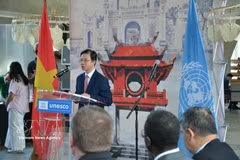
Vietnamese Deputy Minister of Foreign Affairs Ngo Le Van, who is Chairman of the Vietnam National Commission for UNESCO, speaks at the "Dao Hoc" cultural programme in Paris. (Photo: VNA)

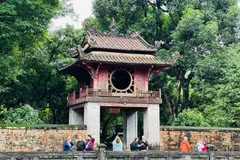
Paris programme promotes values of Van Mieu – Quoc Tu Giam

UNESCO Assistant Director-General for Culture Nayef Al-Fayez stressed that the values represented by Van Mieu – Quoc Tu Giam – the fondness for learning, cultural continuity, and the pursuit of knowledge – closely align with UNESCO’s mission to advance education, safeguard heritage, and foster dialogue among nations.

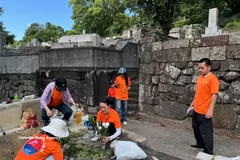
Volunteers clean up the grave of Princess Ngoc Hoa (Photo: VNA)

“Princess Anio” musical debuted in Japanese city

That transoceanic romance endures as a symbol of devotion and an early cultural bridge between Vietnam and Japan. It has spawned a string of artistic works, notably the “Princess Anio” musical, first staged to mark half a century of diplomatic ties.

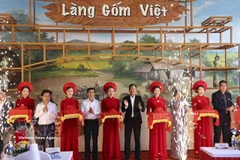
Delegates perform the ribbon-cutting ceremony to mark the soft opening of the Vietnamese pottery village in Da Nang’s Ba Na ward on June 16, 2026. (Photo: VNA)

Vietnamese pottery village launched in Da Nang

Beyond product display and retail, the village is positioned as an open cultural space where visitors can explore the history of pottery-making, observe production processes, interact with artisans, and take part directly in pottery-making activities.

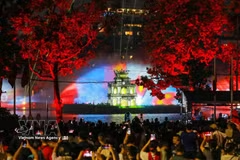
Large crowds gather around Hoan Kiem Lake to watch a 3D mapping light show projected onto Turtle Tower, accompanied by a water-screen display. (Photo: VNA)

AI ushers in a new era for digital art

As cultural industries and the creative economy gain momentum, AI is proving valuable in improving efficiency, streamlining operations and enabling creators to focus more on artistic content.

The working session between Vietnamese Consul General Dinh Hoang Linh and Khon Kaen University's representatives (Photo: VNA)

Vietnam Studies Centre taking shape at Thai university

The centre is expected to become a vital venue for the Vietnamese community in Thailand to hold on to their cultural identity and language, while doubling as a bridge to further deepen the two countries’ Comprehensive Strategic Partnership.

Vietnamese Consul General Doan Phuong Lan speaks at the event (Photo: Baoquocte)

Vietnam, RoK expand cultural exchanges

The Vietnamese Consulate General in Busan pledged to work closely with KVCC to organise more cultural activities, while local officials expressed support for programmes helping Korean-Vietnamese families and children better understand Vietnamese culture.

Visitors to the “Hoang Sa, Truong Sa – Sacred Sea and Islands” exhibition in Da Nang city (Photo: VNA)

Archival exhibition on Hoang Sa, Truong Sa opens in Da Nang

The display presents objective and verifiable historical and legal proof of Vietnam’s maritime and insular sovereignty while underscoring the unyielding resolve, patriotism, and contributions of generations of Vietnamese soldiers and citizens.

"Colours of Vietnam” is vividly brought to life through contemporary dance performances set to traditional Vietnamese music. (Photo: VNA)

Bonjour Vietnam festival promotes Vietnamese culture in Paris

Through music, art, cuisine and cultural experiences, the “Bonjour Vietnam” festival continues to promote Vietnam’s image in France while strengthening exchanges between overseas Vietnamese generations and international friends, helping bring Vietnamese culture closer to the world.

A Vietnamese traditional art performance at the event. (Photo: VNA)

Artistic exchange programme strengthens Vietnam- Japan cultural ties

Vietnamese Consul General in Osaka Nguyen Truong Son said the programme served as a meaningful platform to introduce and promote Vietnam’s rich cultural heritage to international audiences while strengthening solidarity within the Vietnamese community in Japan and fostering connections with their roots.

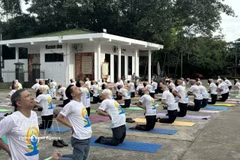
People join a mass yoga performance at the Vietnam Museum of Ethnology in Hanoi on June 14 as part of activities marking the International Day of Yoga (June 21). (Photo: VNA)

Mass yoga performance celebrates India – Vietnam cultural ties

Yoga's increasing popularity in Vietnam reflects the enduring appeal of positive cultural values and demonstrates the Vietnamese people's appreciation of India’s and humanity's cultural essence, said a leader of the Vietnam Academy of Social Sciences.