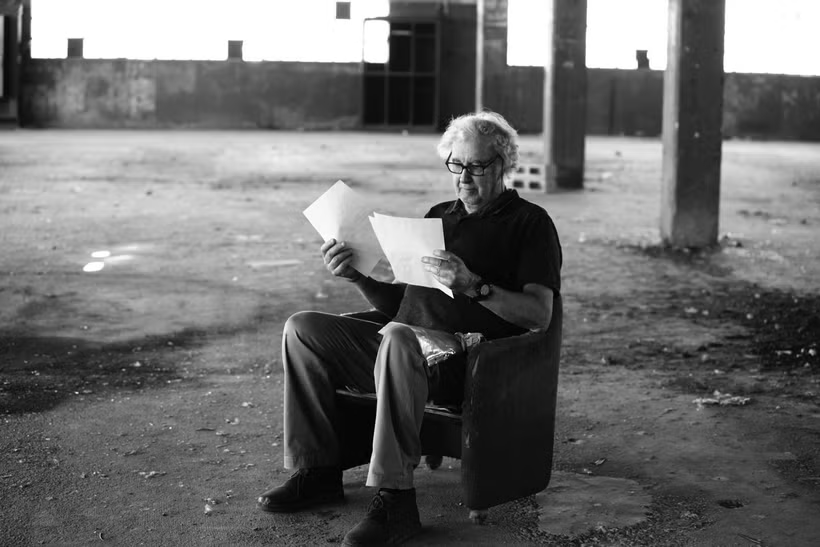
Buenos Aires (VNA) – After more than three decades making documentaries in over 80 countries, renowned Argentine filmmaker Ricardo Preve says what impressed him most about Vietnam was not only its history and landscapes, but also its remarkable ability to rebuild, overcome adversity and achieve rapid development after decades of war.
Speaking to Vietnam News Agency correspondents in Buenos Aires while completing his documentary A Price We Have to Pay, Preve described Vietnam as a powerful example of national resilience and determination.
The documentary, filmed in Argentina and Vietnam, centres on Argentine war correspondent Ignacio Ezcurra and the decades-long effort to uncover the circumstances surrounding his death during the war in Vietnam.
Born in 1939 into one of Argentina’s most prominent journalistic families, Ezcurra was a descendant of former President Bartolome Mitre, founder of the influential daily newspaper La Nacion. Considered one of the paper’s most promising young reporters, he arrived in southern Vietnam on April 24, 1968, to cover the war. Two weeks later, on May 8, he disappeared in the Cho Lon area of Saigon. For decades, the circumstances of his death remained a mystery.
The story attracted Preve, whose documentaries often explore historical, social and human rights issues. While the search for answers about Ezcurra’s fate forms the film’s narrative core, the director said his experiences in present-day Vietnam ultimately left the strongest impression.
Effective Vietnam–Argentina collaboration
Preve said the project began in 2024 and involved filming in both countries. After preparing production work in Hanoi, he and his team travelled to Ho Chi Minh City for principal filming.
The crew consisted of six Vietnamese and four Argentine members. Despite language and cultural differences, the team quickly adapted and worked effectively together.
After years of investigation, the filmmakers identified the exact location where Ezcurra died thanks to previously unpublished photographs taken by an 87-year-old Japanese photographer. A fortunate coincidence helped solve the mystery: while the crew was filming in Vietnam, the country was commemorating the 50th anniversary of the Liberation of the South and National Reunification, enabling them to locate the photographer. His photographs and testimony proved crucial in reconstructing the events.
Preve praised the support provided by Vietnam’s Ministry of Culture, Sports and Tourism, describing the project as one of the most effective international collaborations of his career. The professionalism and openness of Vietnamese colleagues helped the team overcome numerous challenges during filming and archival research.
The documentary has completed editing and entered post-production, including colour grading, sound design and archival integration. Preve hopes it will be selected for the Hanoi International Film Festival this November and said he would travel to Vietnam to present the work if invited.
He believes the project serves not only as a film but also as a cultural bridge between Argentina and Vietnam.
Offering a broader view of Vietnam
Preve said one of his key objectives was to provide Argentine audiences with a more complete and balanced understanding of Vietnam.
For decades, many people abroad have associated Vietnam primarily with war rather than its people, culture and development achievements. As a result, the production team made a conscious effort to incorporate Vietnamese voices into the story.
One of the film’s central figures is a veteran of the Vietnam People’s Army who fought in the area connected to the investigation. Preve described the interview as one of the documentary’s most valuable moments. Beyond recounting wartime memories, the veteran delivered a message about peace and the responsibility of younger generations to avoid repeating past tragedies.
According to the director, the film is not only a search for the truth behind an Argentine journalist’s fate but also an opportunity to present a more authentic Vietnam to international audiences.
Asked about his impressions of Vietnam, Preve said what he admired most was the country’s post-war reconstruction.
He noted that Vietnam endured prolonged conflicts against major powers during the 20th century and suffered enormous human and material losses. Yet it has overcome those challenges to become one of Asia’s most dynamic economies.
“Vietnam is a vivid example of a nation’s ability to recover and thrive after the harshest trials,” he said.
Coming from a family with a long history in the rice business, Preve also took a particular interest in Vietnam’s agricultural sector. His grandfather was the first person in Argentina to market branded packaged rice under the well-known Arroz Gallo label.
He said Vietnam’s rise from a country facing immense difficulties to one of the world’s leading rice exporters is an achievement worthy of admiration, reflecting the organisation, diligence and determination of its people.
Preve also pointed to the massive wartime destruction Vietnam endured, noting that despite the enormous scale of bombing, the country was able to rebuild and continue advancing.
“Everything Vietnam has achieved today demonstrates the extraordinary work ethic and resilience of its people,” he said.
Lasting impressions of Vietnam
During his stay, Preve visited several localities and explored different aspects of Vietnamese life. He was particularly impressed by the Mekong Delta, with its extensive waterways, vast rice fields and distinctive way of life.
Although he spent months in Vietnam working on the film, much of his time was devoted to production and research activities. He hopes to return one day as a tourist to discover more of the country.
For Preve, A Price We Have to Pay is not only a historical investigation but also an opportunity to introduce international audiences to a modern, dynamic and vibrant Vietnam.
He said that if the documentary helps Argentine viewers better understand the Vietnamese people, the country’s post-war reconstruction efforts and its development achievements, it will have fulfilled one of its most important goals.
Ricardo Preve is regarded as one of Argentina’s leading documentary filmmakers, known for projects set in historically and archaeologically significant locations worldwide. His works have been screened at major international festivals and won numerous awards.
His documentary Volviendo a Casa (Coming Home) won Best Documentary at the Punta del Este Latin American Film Festival in Uruguay in 2018 and earned him the festival’s Career Achievement Award. More recently, Sometime, Somewhere, focusing on Latin American immigrant communities in the United States, was named Best Foreign Film at the Golden Gate International Film Festival. In 2023, he received the Gerald L. Baliles Founder’s Award at the Virginia Film Festival in recognition of his contributions to international documentary filmmaking./.
VNA