Brussels (VNA) – Vietnamese exporters are entering the final countdown to comply with the European Union's Deforestation Regulation (EUDR), as the bloc completes the last legal and technical steps before the new rules take effect.
Speaking to the Vietnam News Agency's correspondent in Brussels, Tran Ngoc Quan, Vietnam's Trade Counsellor to Belgium and the European Union (EU), said the EUDR Delegated Act adopted on July 13 had largely concluded years of debate over derived products by finalising the list of commodities covered by the regulation. Newly added products include instant coffee, certain palm oil derivatives and frozen bovine tongues.
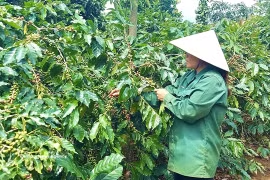
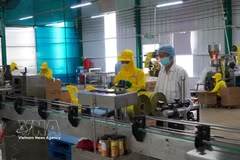
For Vietnam, Quan said the addition of instant coffee is the most significant change. Unlike green coffee beans, instant coffee is typically produced from blends of different coffee varieties and other ingredients. Some products also contain soybeans or cocoa powder, both of which are covered by the EUDR, meaning manufacturers will face much more demanding supply chain data and traceability requirements.
The latest update also narrows the regulation's scope for the rubber industry. Vulcanised rubber products, conveyor and transmission belts, aircraft seats and motor vehicle seats have been removed from the list of regulated goods. Quan described the move as welcome news for Vietnam's rubber processing sector, particularly producers using recycled rubber materials. However, he noted that efforts to exclude kitchenware and household utensils were unsuccessful, while products made from natural rubber remain subject to the regulation.
Quan also highlighted the introduction of a representative declaration mechanism as one of the regulation's most significant practical improvements. Under the system, purchasing companies and cooperatives may submit declarations on behalf of farmers, while industry associations can do the same for small businesses.
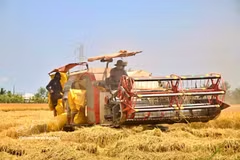
He said the mechanism reflects the realities of agricultural supply chains in developing countries, where exporters source products from large numbers of smallholders who often have limited access to information and foreign-language skills. Nevertheless, he stressed that the mechanism only simplifies the declaration process and does not remove traceability obligations.
"Every shipment must effectively have a 'birth certificate' created at the production stage," Quan said, adding that the information must remain with the product throughout its entire supply chain.
He also cautioned that implementation on the ground could prove far more challenging than the regulation suggests. While the EU describes the declaration system as simple and user-friendly, fragmented production and procurement systems in developing countries mean even a streamlined process may still be difficult for individual farmers and households.
According to Quan, the online declaration platform is expected to open in late July but will initially be available only in English, creating a significant hurdle for many producers. He also warned of possible technical issues, noting that EU websites and document portals have already experienced heavy traffic and system overloads as businesses rush to prepare before the deadline.
With the legal framework now largely complete and little chance of another postponement, Quan stressed that compliance with the EUDR is no longer optional. Rather than focusing on market access or product quality, the regulation places data management, traceability and supply chain governance at the centre of compliance.
Large companies have about five months to prepare before the December 30 deadline, while small and micro-sized enterprises will be given an additional six months. Quan described the remaining period as a "golden window" for businesses to establish robust product data management systems.
Only shipments that fully satisfy the EUDR's data requirements will qualify for export to the EU, he said, adding that exporters will no longer be able to source products with unclear compliance records for the European market.
He urged exporters to work closely with their procurement networks to help farmers build production data systems. Local authorities should also support producers in compiling shipment-specific information and encourage them to join cooperatives or sign contracts with purchasing companies to facilitate compliance.
Meanwhile, the Vietnam Trade Office in Belgium and the EU will continue providing businesses and industry associations with updates on the EU's implementation guidance, particularly the more detailed instructions expected from late July. The office is also coordinating with industry associations in both Vietnam and Europe to maintain dialogue with EU authorities.
Quan said the collaborative approach has already produced concrete results, pointing to the successful joint effort by the Vietnam Trade Office and the Confederation of Tanners of the European Community (COTANCE), which secured the removal of leather products from the EUDR's scope in the latest revision./.