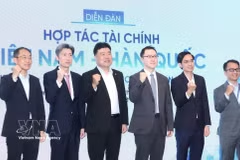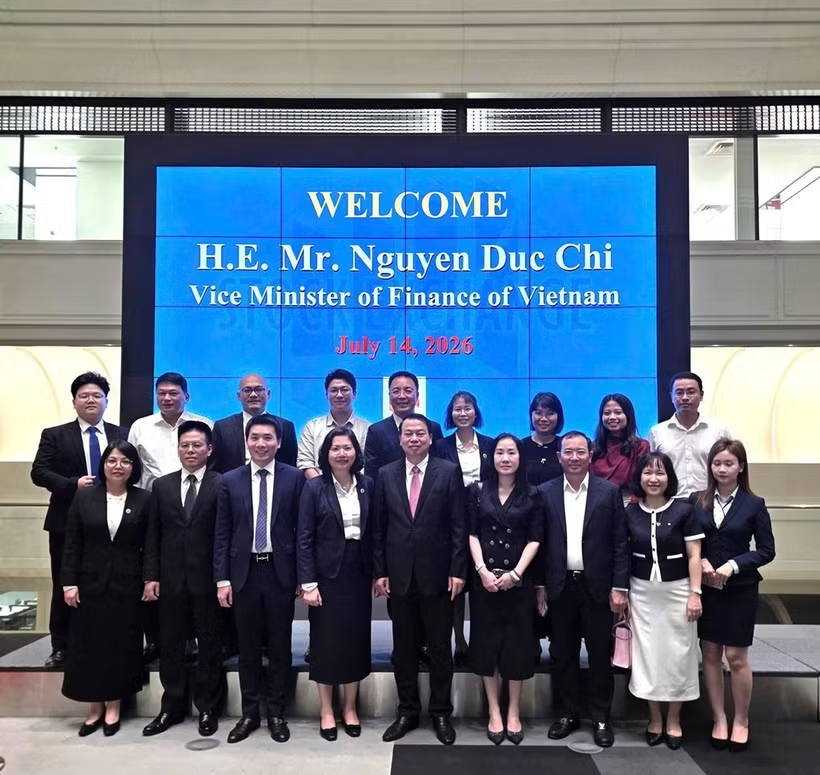
Hanoi (VNA) - Deputy Minister of Finance Nguyen Duc Chi had a working session with representatives of Japan's Financial Services Agency (JFSA) and Securities and Exchange Surveillance Commission (SESC) in Tokyo on July 14 to exchange experience in securities market development, financial regulation and innovation, as Vietnam moves to revise its Securities Law and further develop its capital market.
The meeting was part of a trip by officials from Vietnam's Ministry of Finance and State Securities Commission (SSC) to Japan and the Republic of Korea to study securities market development, new financial products and regulatory frameworks in support of amendments to Vietnam's Securities Law.
During the session, Chi highly valued Japan's support provided by Japanese financial management agencies for Vietnam in forming and developing Vietnam's stock market over the past three decades. He said Japan's experience and assistance have has made an important contribution to the Southeast Asian country's institutional development and market growth.
He noted that after almost 30 years of development, Vietnam's stock market has become a key medium- and long-term capital mobilisation channel for the economy. Market capitalisation now exceeds 80% of GDP, while securities firms, fund management companies and market institutions have operated safely and steadily, attracting growing participation from domestic and foreign investors. Vietnam is also under FTSE's review for an upgrade from frontier to emerging market status.
As Vietnam pursues rapid and sustainable economic growth, Chi said further developing the capital and securities markets is essential to mobilising resources efficiently.
Advances in digital technology, artificial intelligence (AI) and new financial business models require a more adaptive legal framework and regulatory system to ensure market transparency, safety and alignment with international practices, he noted.
He called on the JFSA and SESC to share their experience in regulatory sandboxes for new financial products and services, market supervision, human resource development, and policies supporting innovation, technology application and modern financial services. Such experience, he said, will provide valuable references for improving Vietnam's legal framework and building a transparent, efficient, sustainable and internationally integrated securities market.
Deputy Commissioner for policy planning at JFSA Hiroshi Okada affirmed the agency's commitment to cooperation with Vietnam's Ministry of Finance and SSC, expressing readiness to continue sharing expertise to support the development of Vietnam's financial and securities markets.
Okada said the discussions focused on issues of particular interest to Vietnam, including sandbox mechanisms, exchange-traded funds (ETFs), technology- and algorithm-based financial services, market supervision, and training high-quality professionals for the securities sector.
Introducing Japan's sandbox model, he said his country encourages financial innovation while prioritising investor protection and financial system stability and safety. Projects participating in the sandbox must comply with existing laws, while regulators work alongside businesses from the early stages of development and guiding implementation.
He also stressed that developing a highly qualified workforce with strong professional ethics has been fundamental to Japan's securities market over decades, requiring close cooperation among regulators, financial institutions and the private sector.
Okada spoke highly of Vietnam's recent market reforms, particularly measures to facilitate foreign investment and its ambition to secure emerging market status, expressing confidence that the country's securities market will continue to strongly develop in the coming time. He also reaffirmed the JFSA's readiness to further enhance cooperation and exchange experience with Vietnam's regulatory authorities.
During a technical session, Vietnamese officials, including SSC Chairwoman Vu Thi Chan Phuong, exchanged views with Japanese experts on the legal basis for financial sandboxes, mechanisms for incorporating successful pilot models into legislation, risk management during pilot projects, experience in managing AI-based financial services and digital assets.
On the same day, the Vietnamese delegation also met with representatives of the Japan Exchange Group (JPX) to discuss supervision of AI- and algorithm-based trading and electronic trading infrastructure; and with experts from the Japan Securities Dealers Association (JSDA) on securities licensing, professional standards, service diversification and technology adoption in securities services./.
VNA