"Live data" paves way for Vietnamese farm exports

Achieving Vietnam's target of more than 74 billion USD in agricultural, forestry and fishery exports in 2026 will require stronger traceability systems, initially focusing on key export commodities, high-value products and major markets such as the EU, the US and China.

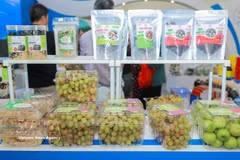
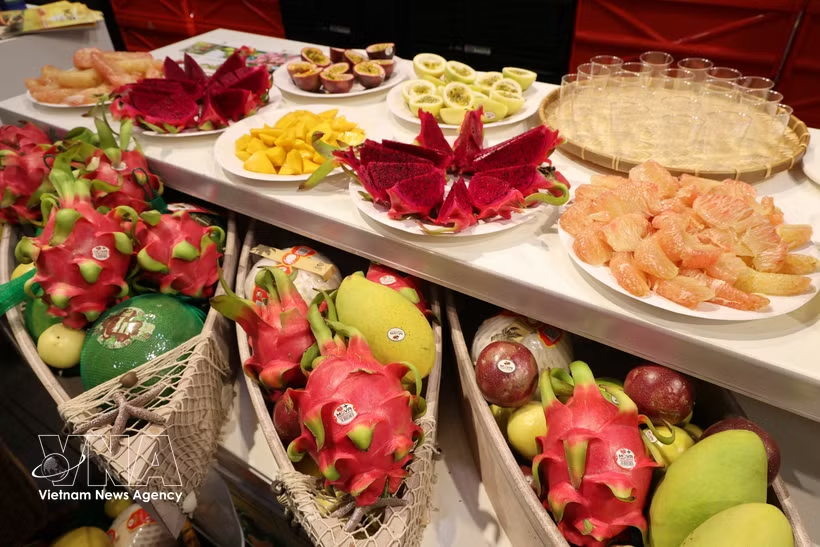
Fresh fruit products of Vietnam are introduced to German customers. (Photo: VNA)

Hanoi (VNA) - The Ministry of Agriculture and Environment (MAE)'s national agricultural traceability system has officially come into operation, creating a unified nationwide database to enhance transparency, strengthen competitiveness and expand export opportunities for Vietnamese agricultural products.

The platform currently contains data on more than 18,500 products across 181 product categories from 170 enterprises in 24 of Vietnam's 34 provinces and cities. However, experts say the system's real value lies not in the number of QR codes generated, but in the quality and timeliness of the data behind each product.

Hanoi has been among the pioneers in this field, launching its electronic traceability system for agricultural, forestry and fishery products in 2018. Since the national platform became operational, the city has synchronised data from 2,823 production and trading establishments and more than 10,100 agricultural, forestry and fishery products.

According to Ta Van Tuong, Deputy Director of the Hanoi Department of Agriculture and Environment, data integration has improved transparency, enabled real-time monitoring of production activities and strengthened food safety oversight across nearly 1,500 supply chains delivering products to the capital from other localities.

Experts say the foundation of an effective traceability system is a comprehensive and regularly updated database of cultivation areas. This remains a major challenge for Vietnam, where agricultural production is largely carried out by millions of smallholder farmers on fragmented landholdings.

To Xuan Phuc, an expert from Forest Trends, said cultivation-area databases offer benefits beyond product traceability. They provide an important basis for policymaking, monitoring land use, protecting forests, ensuring production safety and attracting investment into raw material production areas. He noted that many coffee companies are willing to pay for access to comprehensive and up-to-date cultivation-area data.

Experts have also called for mechanisms that allow enterprises to share data with regulators, helping avoid duplication in data collection while identifying overlaps between production zones or with forestry land.

The need to build comprehensive databases is becoming increasingly urgent as more export markets make traceability mandatory. Under the European Union Deforestation Regulation (EUDR), from December 30, 2026, coffee, rubber and timber exported to the EU must be traceable to individual production plots.

Phuc urged MAE to promptly issue a list of products subject to mandatory traceability requirements and require businesses to share cultivation-area data with local authorities to establish a unified national database.

According to Chairman and CEO of Vinh Hiep Co., Ltd Thai Nhu Hiep, the biggest challenge is no longer investment in technology, factories or logistics, but maintaining farmers' long-term participation in linked production chains by building trust and ensuring shared benefits.

From a regulatory perspective, Tuong proposed expanding the national platform to incorporate public administrative services, allowing businesses to update production information, report changes and submit reports online. Real-time updates would create a database that is "accurate, complete, clean and live", providing a solid foundation for meaningful digital transformation.

Experts also recommended introducing a mandatory roadmap for traceability across selected product groups, both to strengthen regulatory oversight and to protect transparent producers by enhancing their credibility and competitiveness.

According to Deputy Prime Minister Ho Quoc Dung, achieving Vietnam's target of more than 74 billion USD in agricultural, forestry and fishery exports in 2026 will require stronger traceability systems, initially focusing on key export commodities, high-value products and major markets such as the EU, the US and China./.

VNA

See more

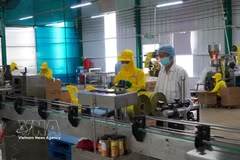
An enterprise in the southern province of Dong Thap invests in modern technologies and machinery for production. (Photo: VNA)

Broadening financing channels key to unlocking SME growth

As the private sector takes on a more central role under the Politburo's Resolution No. 68-NQ/TW, experts and business representatives say Vietnam needs a more comprehensive approach to supporting SMEs. This includes improving institutions, making financial support tools more effective and reshaping the financial system to better suit the characteristics of SMEs.

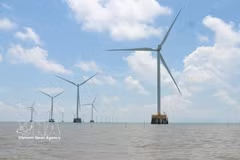
Phase 1 and Phase 2 of the Tan Thuan Wind Power Plant in Tan Thuan commune, Ca Mau province, have a combined installed capacity of 75 MW, comprising 18 wind turbines. (Photo: VNA)

Energy storage unlocks renewable power potential, cuts emissions

Energy transition is not simply about replacing fossil fuels with wind and solar power. It also requires building a sustainable energy ecosystem in which clean power generation, energy storage, smart grids and material recycling chains develop in parallel. Such an integrated approach will improve energy efficiency, further reduce greenhouse gas emissions and help Vietnam achieve green growth and net-zero emissions targets by 2050.

Vietnamese food is increasingly diverse in varieties and packaging, meeting domestic demand. (Photo: VNA)

Government urges vigilance as inflation pressures mount in H2

The Government's inflation target remains within reach despite mounting headwinds. Several forecasts suggest inflation can stay below 4.5% this year if international oil prices continue to retreat. Extending domestic fuel tax incentives through year-end, along with stable electricity prices, healthcare fees and exchange rates, would offer additional relief.

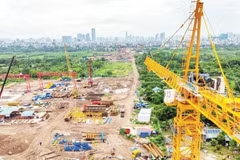
Construction is underway at the Tu Lien Bridge project in Hanoi. (Photo: nhandan.vn)

Public investment drives Hanoi’s growth momentum

In the first half of 2026, Hanoi disbursed 64 trillion VND (2.4 billion USD) in public investment, equivalent to more than 53% of the annual plan assigned by the Prime Minister – the highest mid-year disbursement rate recorded in many years.

Representatives of relevant parties at the sponsorship signing ceremony on July 13, 2026 (Photo: Vietjet)

Vietjet, Vikki Digital Bank named official partners of ASEAN United FC events

As the Official Airline Partner of the ASEAN United FC events, Vietjet connects fans and destinations across Southeast Asia through the region's leading football competitions, kicking off with the ASEAN Hyundai Cup™ 2026, the jewel in the crown of ASEAN football and the region's biggest sporting event.

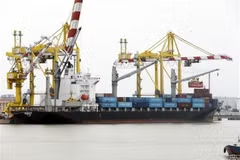
A truck carrying Vietnamese goods passes the Kim Thanh International Land Border Gate No. 2 in Lao Cai province. (Photo: VNA)

Lao Cai steps up anti-smuggling crackdown, handles more than 1,220 cases

Among the cases were 367 involving the illegal trade and transport of prohibited or smuggled goods, 692 related to commercial and tax fraud, and 162 concerning counterfeit products, imitation goods and intellectual property infringements. Criminal proceedings were launched in 231 cases, with 406 suspects facing criminal proceedings, while 957 cases were settled through administrative penalties.

A production line for electrical wires at Bandai Vietnam Co., Ltd., in Bo Trai Industrial Park in Hoa Binh ward of Phu Tho province. (Photo: VNA)

High-quality FDI expected to drive new growth model

The resolution calls for a shift in development mindset, positioning FDI as a key driver of growth model transformation, with a focus on quality, value addition and continuous improvement of intrinsic capacity and self-reliance of the economy. Many experts and businesses believe the policy provides a timely strategic boost, helping Vietnam to capitalise on the ongoing global supply chain realignment.

Workers produce sportswear at AMPFIELD (Vietnam) Co., Ltd. in the Tan Binh Industrial Park, Ho Chi Minh City. (Photo: VNA)

Ho Chi Minh City shifts focus to new-generation FDI

Ho Chi Minh City is currently home to 20,259 FDI projects with total registered capital of nearly 142 billion USD from 152 countries and territories. In the first half of 2026, the city attracted more than 6.8 billion USD, fulfilling 62% of its annual target.